
- PRICING
- LIVE QUOTES
- LEARN
- HELP


EN
Meta Stock: Wall Street Keeps Raising Price Targets as the Muse Bet Gets Bigger
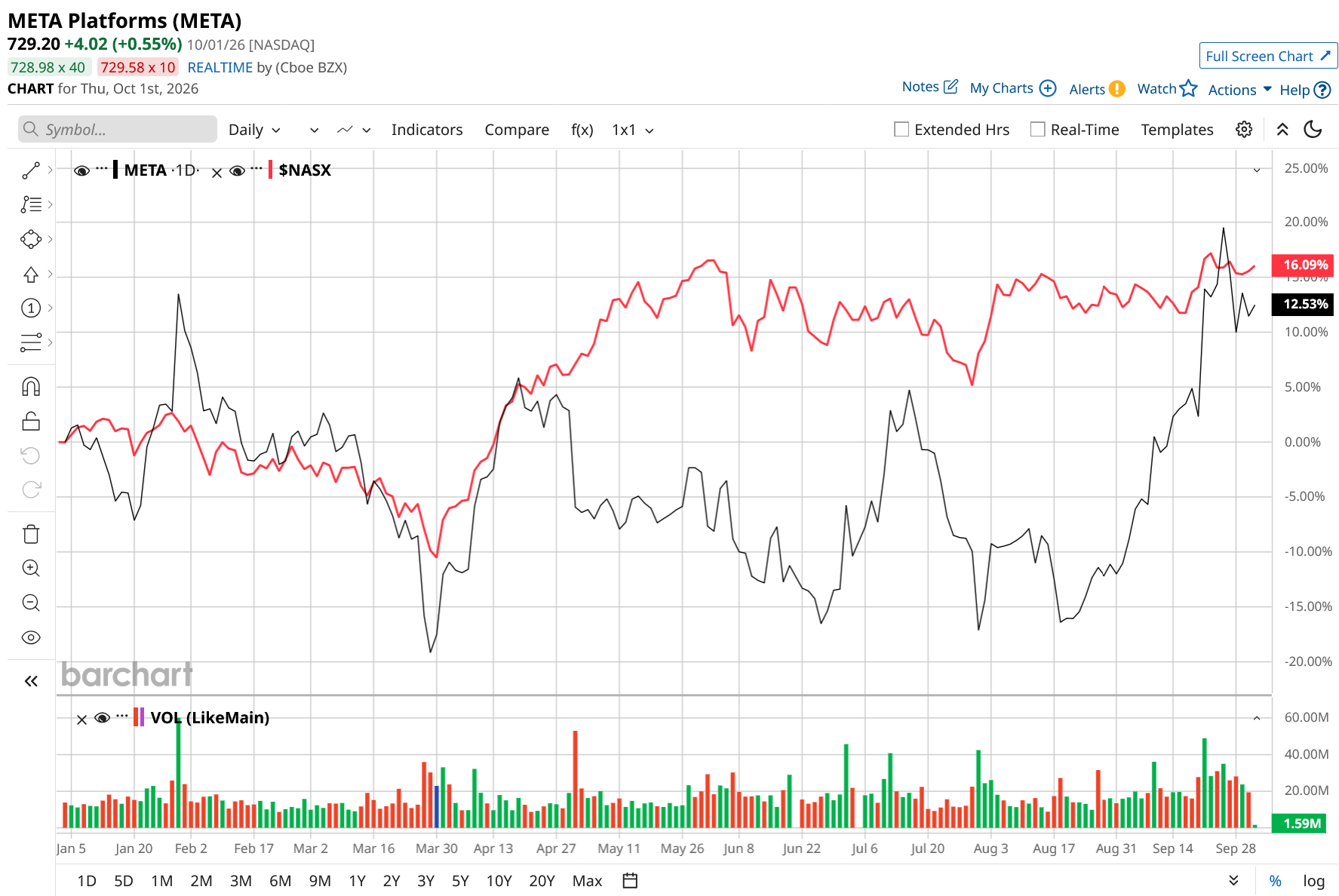
For the last two years, the AI story had two lead characters: ChatGPT and Claude. Although the market had many other AI assistants, most played supporting roles. Now, Meta Platforms (META) has entered the story with Muse AI on Sept. 8, sending its stock up 26% this month alone, even as shares remain up just 11% year-to-date (YTD).
Meta’s AI story has suddenly become much easier for Wall Street to see. Now investors are looking beyond the hype and asking if Muse can become a new revenue-generating business for Meta.
What Muse Actually Does
Muse goes beyond just answering questions to handling tasks such as sending emails, booking travel, and completing transactions for users. It can work across email, calendars, payments, shopping, travel, and other everyday services. Muse costs nothing to start, and paid plans run $20 and $100 a month for users requiring heavier usage. Meta has said there are no ads inside it, though executives are exploring commerce. Zuckerberg also said Meta will eventually charge a minimal fee on transactions completed using Muse AI.
At Meta Connect, Meta also unveiled Muse Charm, a compact device that lets users interact with its AI agent without having to open a traditional smartphone app. Meta already has around 3.6 billion active users on at least one of its apps daily. The company does not need to build a consumer audience from scratch in the way a standalone AI startup does. Goldman Sachs has even highlighted Meta’s scale and distribution as an advantage to prioritize adoption before aggressively pursuing monetization. And the early adoption numbers for Muse are overwhelming. Muse reached 2.8 million downloads in the U.S. and Canada during its first 12 days, according to Apptopia. Reuters noted that Muse had 1.8 million downloads versus 1.3 million for ChatGPT on a comparable 12-day basis.
This doesn’t prove that Muse will become a massive business. However, it indicates that consumers may be willing to use an AI product that actually does things for them rather than simply generating answers.
Wall Street Is Putting Numbers Behind the Muse Opportunity
Wall Street’s bullishness is showing up in price upgrades. Deutsche Bank raised META stock’s price target to $820 from $750, citing that Meta has identified a gap in the existing AI-agent market, making Muse a “virtually unique” platform. Similarly, JPMorgan moved its price target from $820 to $920 following Meta Connect, citing the progress of Muse and Meta’s broader AI efforts.
Separately, Canaccord has lifted its target to $950 from $930 after Meta Connect. The firm pointed to Muse’s early adoption and the expansion of the product across Meta’s glasses, Mac application, and dedicated hardware. Canaccord also sees several possible ways for Muse to eventually generate revenue, including subscriptions, transaction fees, and potentially advertising.
Additionally, Tigress Financial, Raymond James, TD Cowen, Piper Sandler, and many others increased the target price for META stock.
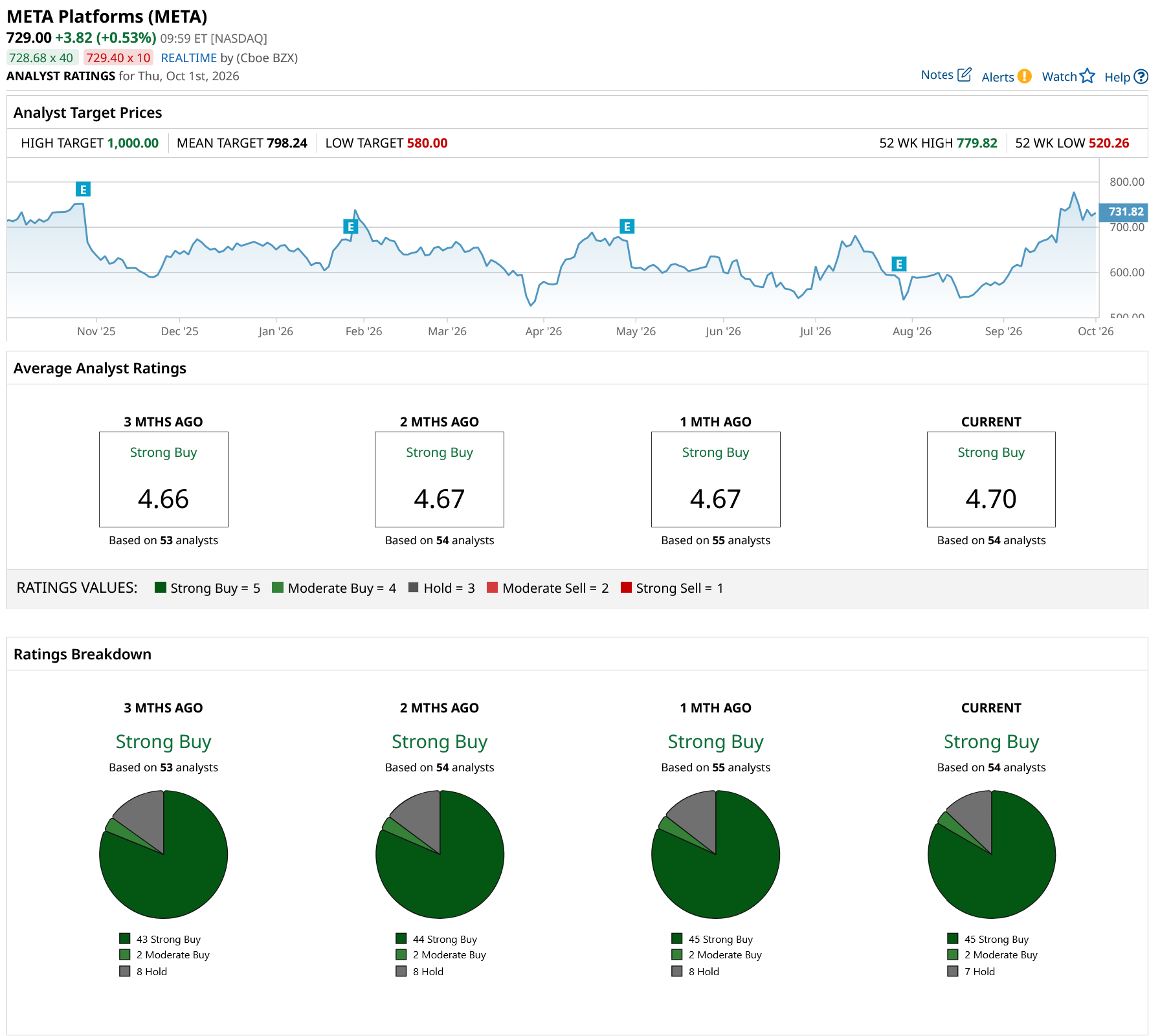
On Wall Street, META stock holds a consensus “Strong Buy” rating. Of the 54 analysts covering the stock, 45 rate it a “Strong Buy,” while two say it is a “Moderate Buy,” and seven rate it a “Hold.” The average target price of $798.24 implies an upside potential of 9.4% from current levels. But the high price estimate of $1,000 suggests the stock can climb 37% from here.
Why Has Wall Street Suddenly Turned So Bullish on META Stock?
Before Muse, plenty of investors and analysts had written off Meta as an AI player even though the company was spending heavily on AI and the metaverse. And now analysts have started sketching scenarios. Jefferies expects 1 billion users by the end of 2027, and with at least 3% paying, that would mean $10.8 billion a year in revenue. Raymond James's base case is more than $50 billion in revenue against about $12 billion in yearly costs. Evercore's Mark Mahaney expects 100 million users within six to twelve months.
Wall Street's bullishness rests on a simple idea that Meta, with its huge user base, may be able to draw the audiences that other AI labs lack. However, whether that audience turns into paying, returning, or trusting users is the part nobody can price yet, as there is a trust factor to consider. Muse’s success cannot be determined by downloads alone. Users should be able to rely on and feel safe in sharing data and delegating meaningful tasks to Muse.
Meta is already spending heavily on AI. Its free cash flow was $784 million last quarter, with capital spending guided to $130 billion to $145 billion for the year. Meanwhile, Bank of America, with a “Buy” rating for META, cautioned that meaningful revenue from ads, subscriptions, or commissions probably won't arrive before 2028. Investors will have to wait and see if Muse can effectively generate enough revenue.
On the date of publication, Sushree Mohanty did not have (either directly or indirectly) positions in any of the securities mentioned in this article. All information and data in this article is solely for informational purposes. For more information please view the Barchart Disclosure Policy here.