
- PRICING
- LIVE QUOTES
- LEARN
- HELP


EN
Retail buybacks staged a “big contraction circle”! J.P. Morgan's capital flow reveals that Nvidia and SanDisk bucked the trend and attracted gold, and US bond ETFs returned to retail horizons
The Zhitong Finance App learned that the latest “Retail Radar” research report released by Wall Street financial giant J.P. Morgan Chase shows the latest retail capital trends and flows in the US stock market where “total retail capital has cooled down, stock purchases are increasingly concentrated on a few AI computing power leaders, and the investment attractiveness of long-term US bonds has begun to rise after a record sell-off.”
J.P. Morgan's exclusive statistics on retail capital flows as of September 30 reveal that retail investors have not simultaneously expanded the pace of buying the entire US stock market technology sector and the constituent stocks of the Philadelphia Semiconductor Index as shown by long-term trends since this year: recent advances in cutting-edge AI agent/AI big model technology represented by Muse, Astra, and Anthropic Claude can be described as providing an important technical foundation for large-scale commercial expansion of AI applications to various industries and the continuous surge in AI computing power demand. Leaders in the AI computing power industry chain are still favored by retail capital flows, but Intel, SpaceX, and some AI computing power infrastructure stocks were unexpectedly net sold.
The retail capital flow calculated by J.P. Morgan Chase shows that after excluding the Big Seven (the Magnificent Seven), technology was still the only industry that received net purchases, but popular AI-related stocks such as Intel, SpaceX, and Oracle were reduced, highlighting capital differentiation within the main investment line of the same AI computing power industry chain. From September 24 to 30, J.P. Morgan's latest estimated data showed that retail investors made net purchases of US$4.1 billion, about 40% lower than the average weekly average of the past 12 months, with net purchases of individual stocks being only US$700 million; however, Nvidia and SanDisk received net retail purchase support of US$1,286 million and US$327 million respectively. The total net sales of other individual stocks amounted to US$1,613 million, which meant that the net sales of other individual stocks totaled about US$913 million offset some of the purchases.
The memory chip components of AI data center server clusters and AI GPUs are still the clearest supply bottlenecks at the AI computing power industry chain level. Market research agency TrendForce predicts that in 2026, server DRAM contract prices will increase by about 270%, and enterprise-grade SSD prices will increase cumulatively by about 235%; HBM contract prices may still rise 70% to 140% in 2027, that is, they will continue to double. These data reflect the combined effects of the continued expansion of AI computing power demand and the increase in memory chip prices. TrendForce estimates also show that shipments of NVL72 racks covering Blackwell and Vera Rubin platforms are expected to increase by more than 50% year on year in 2027; the accompanying market research shows that the output value of related systems is expected to rise from about US$226 billion in 2026 to US$711 billion in 2027, a sharp increase of 214% year over year.
At the same time, long-term US bonds, which have continued to be under pressure since September, have received significant contrarian increases. Long-term US bond ETFs have shown a record standardised buying trend, focusing on long-term US debt ETFs — US bond ETFs with the code TLT have become the most prominent focus of retail capital. “Standardized buying slope” means using historical fluctuations as a yardstick to measure how strong retail net purchases are compared to the historical normal. J.P. Morgan Chase's latest TLT estimate of +6.1z means that retail investors are extremely likely to buy on dips.
“Stock purchases have shrunk drastically” can be described as the most appropriate summary phrase for retail capital flows — retail investors' incremental capital is weakening, while stocks are choosing to focus on a small number of AI computing superleaders, memory chip leaders, and large-scale technology targets with strong cash flow fundamentals. On the bond market side, another clear clue has emerged: at a time when rising energy inflation caused by intensifying geopolitics in the Middle East puts heavy pressure on the price of long-term US bonds, and ultimately keeps long-term US bond yields of 10 years or more high (US bond yields show an opposite trajectory from US bond prices), long-term US Treasury bond ETFs rarely received about US$260 million in net purchases from retail investors during the week. Retail investors can be described as simultaneously participating in the AI super bull market and long-term yield trading. The former is seeking to realize strong profits under the blowout expansion of the AI computing power industry, while the latter is aiming for the highest US bond yield in more than 20 years and the price elasticity of US bonds brought about by falling future yields.
Retail buying “narrows the front”: the stock market takes the lead, and bond selection has been hit hard by long-term US Treasury bonds
According to the J.P. Morgan Chase “Retail Radar” research report, retail investors are still making net purchases, but the incremental capital raised by the market has clearly weakened.
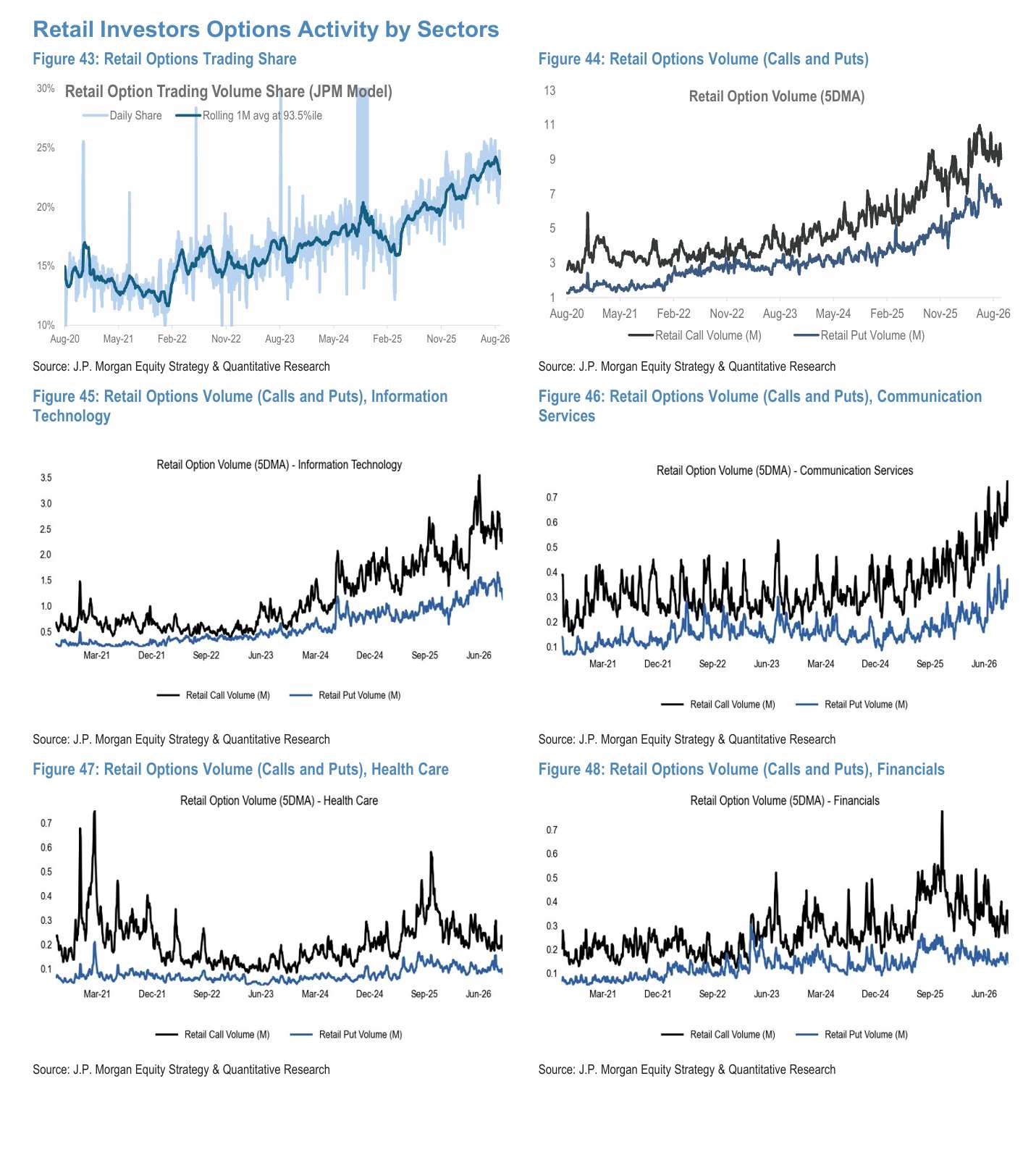
The reason why retail capital flow is increasingly worth investors' close attention is that it not only provides marginal buying in the spot market, but also affects price elasticity through options trading: the brokerage channel transaction agent index listed in the J.P. Morgan Chase report accounted for about 25% of the total stock and ETF trading volume in the US market in June 2026, with the latest data, and retail options market participation as of the end of September is still near the highest level in history. The most valuable sign of this report is that at a time when overall demand for the AI computing power industry continues to expand, retail stock purchases are instead focusing more on AI computing power leaders, and long-term US bonds have become another clear allocation direction.
According to Micron's latest financial report, revenue for the fourth quarter of fiscal year 2026 reached US$54.229 billion, up about 379% year on year. The revenue guide for the next quarter was US$61.5 billion, fluctuating up and down US$1.5 billion; the Philadelphia Semiconductor Index then rebounded 1.59% on October 1, providing an echo of the strong boom in the AI storage and computing power industry in terms of performance and price. What's even more significant is that Micron executives bluntly stated “there is no end in sight to the balance between supply and demand” during the earnings call — 26 long-term orders of about 150 billion US dollars have been signed, and it is expected that the 2027 and 2028 memory chip supply and demand markets will be more scarce than the record level of tension in 2026. Supported by strong cash flow, Micron announced capital expenditure of US$25 billion for the first half of fiscal year 2027 and promised to return 100% of the excess cash to shareholders in the future.
According to J.P. Morgan's calculation data, retail net purchases from September 24 to 30 were 4.1 billion US dollars, which is about 40% lower than the average weekly average of 6.8 billion US dollars in the past 12 months; of these, net purchases of ETFs were 3.4 billion US dollars, and individual stocks were only 700 million US dollars. The total weekly capital flow of retail investors in the US stock market is at the 12th percentile in history, and ETF and individual stock capital flows are in the 3rd and 35th percentiles respectively; daily purchases generally remained at the 15-30th percentile, with limited response to changes in stock prices during the week, ultimately making September the weakest month for retail activity since December 2024. “Weakness” here indicates a decline in net buying intensity, and the total amount of capital is still positive.
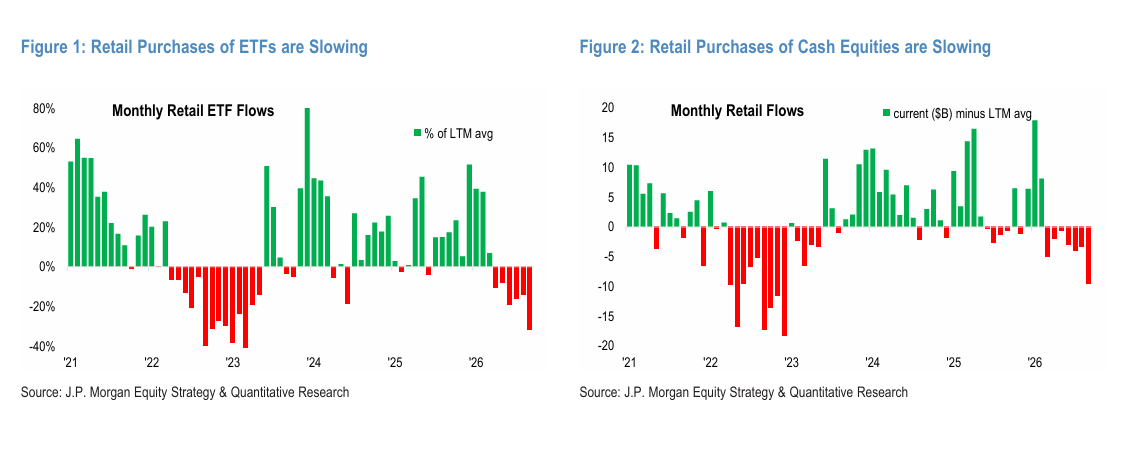
Within the market allocation, large-cap broad-based stock ETFs absorbed about 1.4 billion US dollars in retail capital, and sell-option strategy ETFs, multi-market capitalization broad-based ETFs, and EAFE international stock ETFs absorbed 188 million, 169 million, and 148 million US dollars respectively. However, the overall capital flow of international stocks, crypto assets, and commodity ETFs is weaker than before. Non-retail futures traders, also listed in the J.P. Morgan Chase research report, bought about $33 billion that week, mainly focusing on S&P 500 and Nasdaq futures, highlighting the need to consider different trading groups at the same time to observe the momentum of the rebound. As far as the market structure is concerned, the decline in net retail purchases will weaken the support for the spread of the market to more stocks, and the index may still be driven by large weighted stocks and other funding channels.
Long-term bonds have become a prominent direction for retail investors to buck the trend. What is behind this is a repricing of interest rates and financing costs. The long-term US Treasury bond ETF received $260 million in net purchases during the week. The report recorded a long-term buying slope of +5.4z, and TLT of +6.1z. It should be noted, however, that these figures measure the strength of the anomalous relative to history and cannot be interpreted as a record of yield, allocation ratio, or absolute net inflow of dollars.
In an environment where US bond yields are testing a 22-year high in the J.P. Morgan Chase research report, buying TLT means increasing long-term US bond yields and exposure to the US bond price rebound layout for more than 10 years. It can be understood as seeking price flexibility with higher yields and falling future interest rates. The actual motivation still cannot be determined based on capital flow alone.
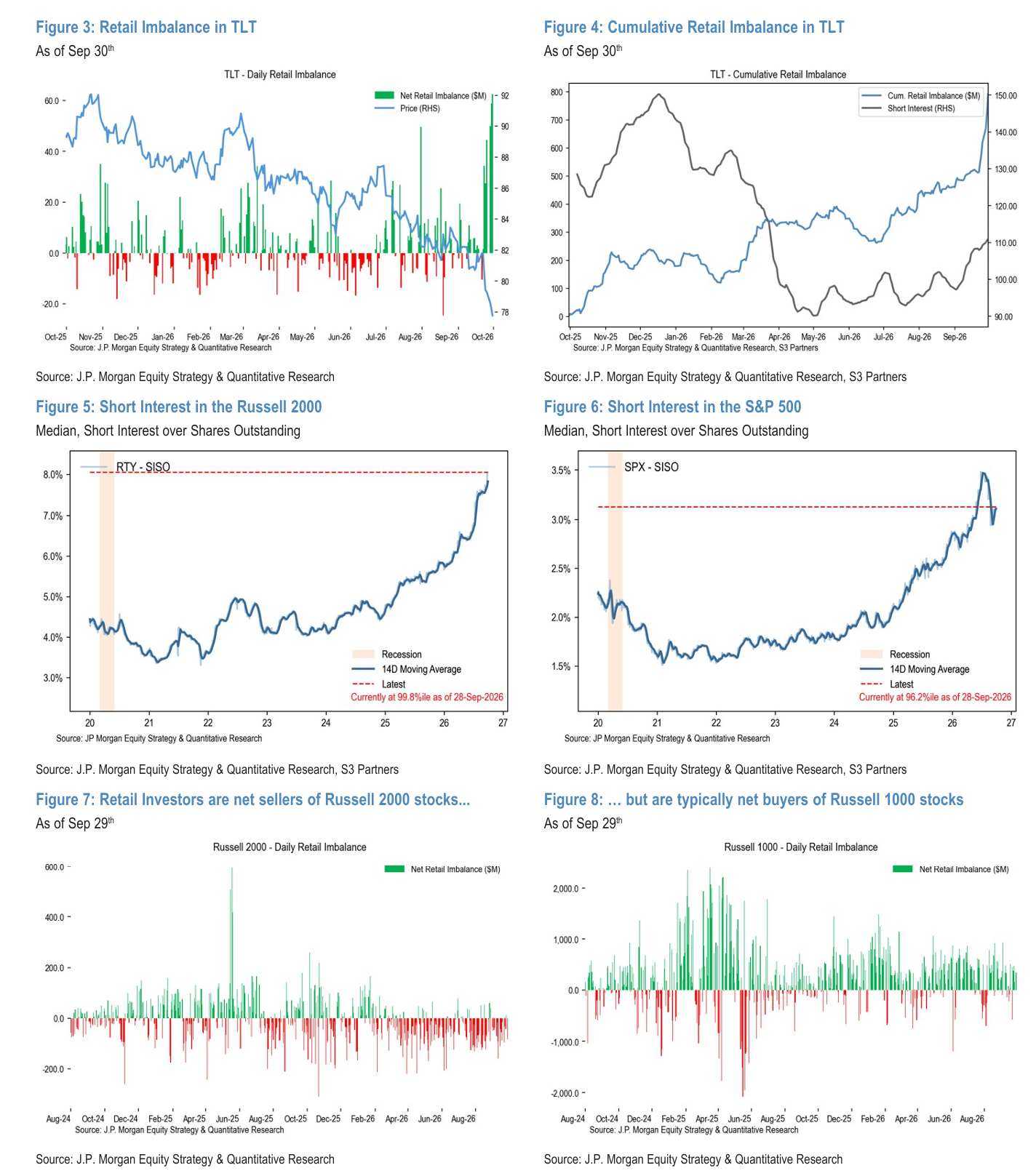
The high interest/high yield curve also delineates financing costs within stocks: the capital flow of small business retail investors that rely more on short-term and floating rate bank financing is clearly under pressure, and the trend of retail net buying Russell 1000 and net selling Russell 2000 has accelerated since March; the median shorting ratio of Russell 2000 and S&P 500 constituent stocks is at the 99.8th and 96.2 percentiles of history, respectively. The specific indicators for both types of stocks are also close to the 92nd percentile, highlighting individual stock differentiation.
The energy-type sector of the stock market experienced another kind of cooling: after Saudi Arabia's east-west pipeline resumed, energy stocks and ETF purchases turned slightly net sales; although oil prices were still around $100, Middle East crude oil exports had recovered to 98% before the war, while exports of refined oil products only recovered to 58%. This shows that retail investors are trading separately against the backdrop of AI growth and a sharp rise in yield, expectations of a sharp rebound in US bond prices and a recovery in energy supply. There is a clear structural difference in the direction of capital.
Demand for computing power has spread, but retail stock purchases have converged — AI trading has entered the “naming era”?
The topic of AI computing power, which has supported the super bull market trajectory of the US stock market since 2023, is still an important stock main line for retail investors, but “having the AI technology label” is no longer enough to explain the buying list.
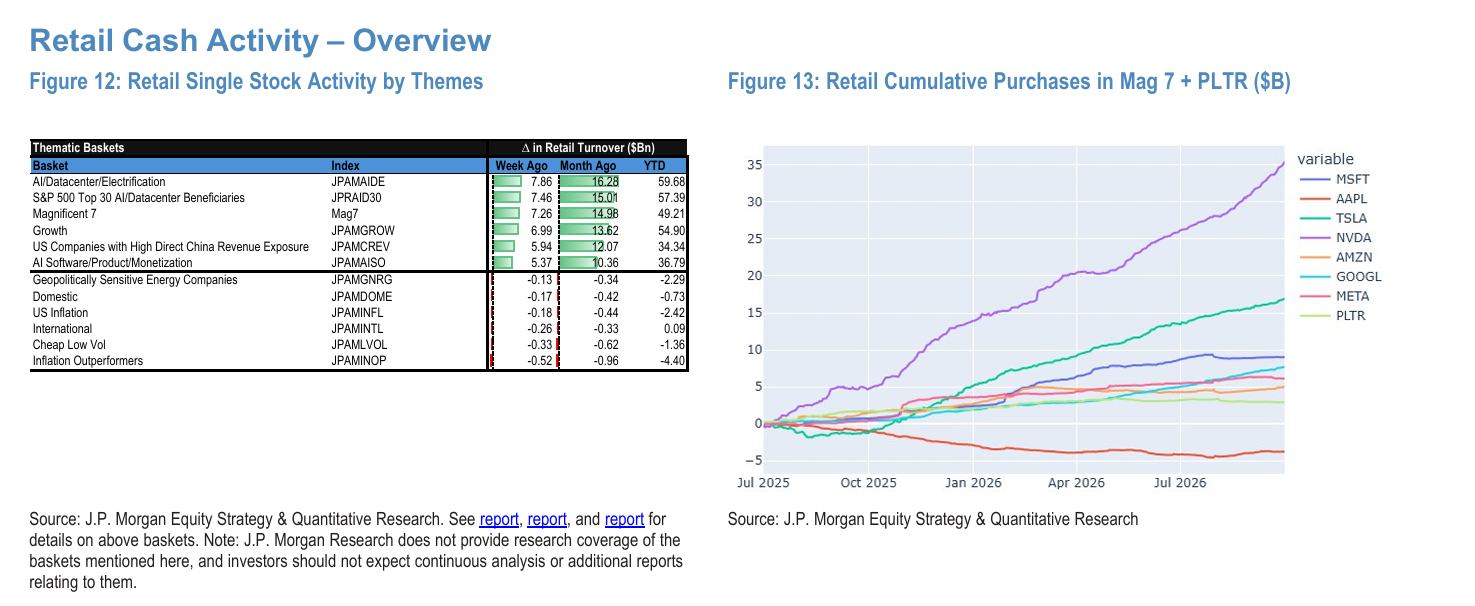
The report clearly indicates that retail investors prefer semiconductors and hardware, and software is relatively backward; after excluding the big seven tech giants in the US stock market, the technology industry still had a net purchase of 194 million US dollars that week, and the rest of the industries were heavily net sold. The top five retail net purchases up to the week were Nvidia's 1,286 million US dollars, Tesla's 514 million US dollars, Sandisk's 327 million US dollars, Alphabet 153 million US dollars, and Amazon 146 million US dollars. On September 30, Micron received net purchases of 19.8 million US dollars from retail investors in a single day. The report found no abnormal increase in positions before the financial report. What is particularly noteworthy is that Nvidia's net purchases alone exceeded the total net purchase scale of 700 million US dollars of individual stocks in the entire market, indicating that sales of other stocks have offset quite a bit of AI computing power's leading buying power.
Meanwhile, Intel, SpaceX, Oracle, Nebius, and Bloom Energy had net sales of 199 million, 171 million, 88 million, 60 million, and 54 million US dollars by retail investors last week; Apple, Microsoft, and Meta also showed net sales. In the AI investment theme basket, AI computing power core infrastructure supply, data center construction/computing power leasing, data center electrification, growth stocks, AI software monetization, and US companies with high revenue exposure in China have still received long-term attention from retail investors.
In terms of the derivatives market, although the one-month rolling average of retail options trading shares has left the high point, it is still at the historical 93.5% level. The actual share of about 23% is still in a historically high position. Tesla, Meta, Micron, Nvidia, AMD, SanDisk, etc. are still the focus of options trading. Nvidia is at the top of the net spot purchase list, but it is also at the top of the options delta sales; SpaceX spot sales were net, and the options delta purchase list is still active, indicating that there is differentiation among trading instruments.
According to J.P. Morgan Chase, the latest social media discussions among retail investors focused on names such as CIFR, WULF, HUT, AKAM, and CoreWeave, but the actual sales of retail investors in high-short stocks surged, reducing the overall risk of emptying; ALOY, EU, and EVTL are examples of incidents requiring separate observation. There are also clear divisions in the non-AI sector: the favorable performance of Carnival drove up the stock price by 13%, and retail investors instead sold a net sale of US$14.4 million; Veeva received customer progress from large pharmaceutical companies and was still net sold; successful KOD clinical trials attracted 5 million dollars in purchases, with an abnormal intensity of 11.4z; MGM considered the acquisition of PPLI, which held about 27% of its shares, activating event transactions with a potential buyback nature.
“Demand for computing power spreads and stock purchases converge” is the summary phrase of the J.P. Morgan Chase research report on retail capital flows. The beneficiaries of core AI computing power infrastructure such as Nvidia and SanDisk and memory chips in the context of a blowout expansion in AI computing power demand have become representatives of concentrated capital purchases — Nvidia and SanDisk correspond to AI computing and NAND storage links respectively; at the same time, long-term US bonds, which continue to be under pressure, have received significant contrarian increases from retail investors.
OpenAI is negotiating a pre-investment valuation of about 1.4 trillion US dollars; the valuation judgment given by Anthropic's potential IPO investors reached 1.8 trillion to 2 trillion US dollars, and there are expectations that match or exceed the scale of SpaceX's issuance. These are still within the scope of the IPO listing expectations promoted by financing negotiations and Silicon Valley venture capital.
Compared with AI application valuation narratives, the AI computing power supply chain already has a more specific basis for strong demand: the media revealed Anthropic's infrastructure arrangement of about $518 billion over the next ten years, of which about 80% is irrevocable or agreed upon. Anthropic's revenue in 2025 increased to about 12 times the previous year, close to 4.6 billion US dollars, operating losses exceeded 8 billion US dollars, and computing power and infrastructure expenses reached 7.33 billion US dollars, about 58% of the total operating expenses of US$12.65 billion; Nvidia's latest quarter Data center revenue was US$89 billion, up 117% year on year; South Korea's semiconductor exports in September were US$60.3 billion, up 262.8% year on year. Officials also indicated an increase in the number of storage exports and contract prices.
From the perspective of heavyweight AI inference workloads, Muse's continuous back-office execution and Astra's ability to perform complex computer tasks have expanded the scope of work that AI can handle; multi-step tasks, tool calls, and parallel agents may also increase model calls and context processing corresponding to each user. Anthropic has observed in its research system that multi-agent tasks use about 15 times more tokens than normal chats. What can be deduced from this is that with the full penetration of cutting-edge AI agents such as Muse, AI computing power requirements will spread along GPU computing, HBM and DRAM capacity bandwidth, KV cache and SSD storage, CPU tool execution, and network transmission; overall resource requirements ultimately depend on the combined effects of increased task volume and improved unit task efficiency. This also explains why AI hardware still has fundamental appeal, yet there is no guarantee that all relevant stocks will receive incremental capital at the same time. J.P. Morgan's data supports “retail investors continue to selectively buy AI computing power and storage leaders while increasing long-term US debt exposure”; there is no evidence of retail funding for a full return to technology, highly flexible small-cap stocks, or all AI infrastructure stocks.