
- PRICING
- LIVE QUOTES
- LEARN
- HELP


EN
3 Stocks To Watch As Bond Yields Reshape Fixed Income Trading
Bond markets are rewriting the rulebook in real time, with UK gilts and long dated US Treasuries offering yields that pull attention away from equities and toward fixed income. That shift creates pressure for many shares, yet it can also create pricing gaps where expectations and reality disconnect. This article examines three stocks from our Global Fixed-Income Trading and Prime Brokerage Intermediaries screener that are closely exposed to this bond market storm.
The three stocks below are just a sample from this fixed income heavy corner of the market, and the full screen surfaced 30 more large trading and brokerage groups with equally compelling business stories that are not covered here. To identify your own highest conviction ideas in this space, head straight into the Global Fixed-Income Trading and Prime Brokerage Intermediaries screener.
Moelis (MC)
Moelis sits in this fixed income focused screen as an adviser rather than a trader, with its fortunes tied to how bond market stress reshapes mergers, capital raising and restructuring decisions across global markets.
Moelis is a pure investment banking advisory firm, generating about US$1.6b from advice across M&A, capital structure and capital markets transactions, and is valued at roughly US$4.7b in market cap.
"Heavy reliance on transaction-based revenues exposes the firm to pronounced cyclicality. If capital markets activity reverses or macro conditions deteriorate, Moelis's earnings and net margins could experience sharp contractions due to a lack of diversification into more stable business lines such as asset or wealth management."
What happens to Moelis’s earnings power if a single key assumption about future deal appetite quietly shifts in the background?
If that shift in appetite is on your mind, read the full narrative for Moelis to see how Moelis’s deal cycle risk and upside potential could be decoupling.

Japan Exchange Group (TSE:8697)
Japan Exchange Group runs the main securities and derivatives markets in Tokyo, handling trading, clearing and settlement for everything from equities to bond futures. It generated ¥221,028 million from its financial instruments exchange business in Japan and carries a market value of about ¥2.37 trillion, giving investors pure exposure to listed trading infrastructure.
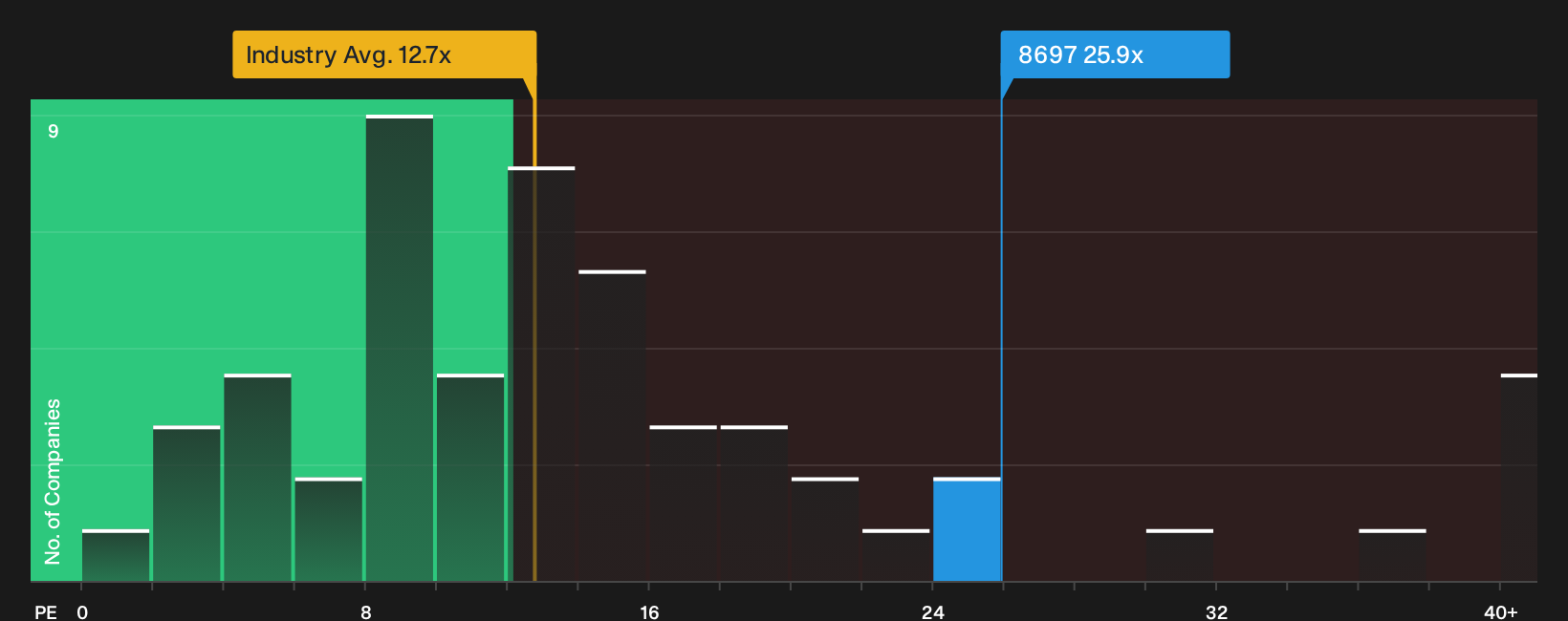
Japan Exchange Group offers a pure play on trading infrastructure at a time when global bond volatility is pushing more volume through listed fixed income and derivatives markets. Profitability metrics and volume leverage are attractive, yet the premium P/E and funding profile keep margins sensitive to what happens if a single assumption about trading appetite shifts.
If that single assumption about volumes is nagging at you, run it through the DCF valuation analysis for Japan Exchange Group to see how pricing shifts when trading intensity changes.
Daiwa Securities Group (TSE:8601)
Daiwa Securities Group plugs directly into the screen’s bond trading theme, with a full service securities franchise that channels fixed income volatility, institutional flows and advisory work through a broad platform. That breadth is exactly why its current positioning in this bond storm matters.
Daiwa Securities Group runs a global brokerage, asset management and investment banking operation, drawing ¥321,098 million from Wealth Management and ¥284,080 million from Global Markets & Investment Banking, with ¥119,157 million from Asset Management, and carries a market value of about ¥2.50 trillion.
"Growing investor use of diversified portfolios, wrap accounts and investment trusts can reduce high margin transactional activity. This may cap revenue growth in the Wealth Management segment if equity trading flow stays subdued."
The bigger question is how its fixed income and capital markets engine holds up if a single funding side assumption quietly shifts in the background.
When that funding assumption changes, the whole picture for Daiwa Securities Group can shift rapidly, and the full narrative for Daiwa Securities Group highlights where resilience and potential upside may be hiding.
Curious About Alternative Opportunities?
Fresh ideas move first. Breakout momentum, quietly flying under the radar for now, often gets caught late once prices start running, so do your homework early and act now.
- Spot reliable cash generators before the crowd by scanning a curated list of solid balance sheet and fundamentals (25 results) that keeps financial strength front and centre while it still matters.
- Target income opportunities that aim to keep payouts flying while prices are dropping by tracking a hand picked set of 7 dividend fortresses built for staying power.
- Chase secular momentum where robots quietly reshape whole industries with a focused pool of 89 robotics and automation stocks that screens for quality, not just hype.
This article by Simply Wall St is general in nature. We provide commentary based on historical data and analyst forecasts only using an unbiased methodology and our articles are not intended to be financial advice. It does not constitute a recommendation to buy or sell any stock, and does not take account of your objectives, or your financial situation. We aim to bring you long-term focused analysis driven by fundamental data. Note that our analysis may not factor in the latest price-sensitive company announcements or qualitative material. Simply Wall St has no position in any stocks mentioned.
Have feedback on this article? Concerned about the content? Get in touch with us directly. Alternatively, email editorial-team@simplywallst.com