
- PRICING
- LIVE QUOTES
- LEARN
- HELP


EN
Tokyo's inflation surpassed expectations! The Bank of Japan's “overadjustment alert” sounded. Has the December interest rate hike stabilized?
The Zhitong Finance App learned that as the impact of some of the Japanese government's temporary measures subsided, Tokyo's key inflation indicators rose sharply, which provided support for the Bank of Japan's position of continuing to raise interest rates after speeding up the pace of policy normalization.
According to data released by Japan's Ministry of Internal Affairs and Communications on Friday, Tokyo's consumer price index excluding fresh food rose 2.7% year on year in September. This reading is higher than economists' median forecast of 2.3%, and also higher than the 1.8% increase last month. This is the first time since January that the indicator has hit a level of 2% and above.
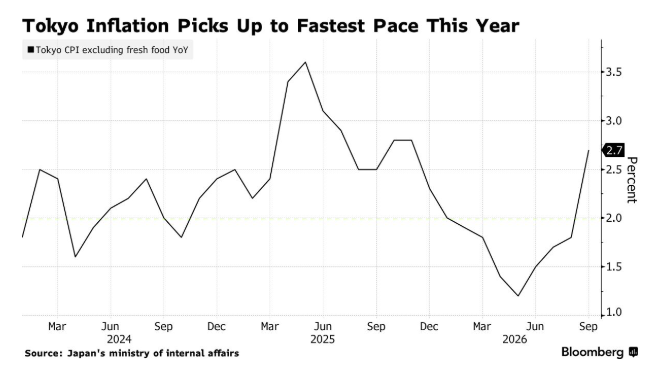
The sharp rise in CPI confirms the Bank of Japan's concerns about upward inflation risks — risks that could drive the core price trend beyond its 2% target. After speeding up the pace of normalization last month at the pace of a second rate hike in three months — the shortest interval since 1990 — the Bank of Japan will look for the right time for the next rate hike.
The jump in the cost of living occurred while Prime Minister Takaichi Sanae's energy subsidy still lowered the overall target by nearly 0.4 percentage points. Tokyo's inflation rate, which excludes energy and fresh food — a key measure of underlying inflation — rose to 3% from 2% a month ago.
Economist Taro Kimura said, “The report will reinforce the Bank of Japan's view that core inflation is stabilizing near its 2% target — and heighten concerns about the rising risk of overregulation. We expect the next 25 basis point rate hike to be in December.”
“This is strong data. The impact of childcare and water relief is a major factor, but even without these factors, inflation is strong,” said Yoshiki Shinke, senior executive economist at the First Life Economics Research Institute. “Rising costs due to the Middle East conflict are driving up the cost of living, and unlike the era of deflation, companies are passing on rising costs to consumers.”
Shinke said he expects the Bank of Japan to raise interest rates in December to maintain the current pace of rate hikes.
Previously, inflation in Tokyo was suppressed by the expansion of childcare allowances and summer water bill relief policies, and the market already generally predicted that inflation would rebound. The biggest driver of the overall increase was processed food costs, which rose 3.6% year over year. According to the Imperial Database report, major Japanese food and beverage companies raised the prices of 4,965 products last month, more than double that of a year ago.
Among the factors driving the rise in inflation, water bills rose sharply, about 66% year on year, while accommodation prices changed from a 1.4% drop last month to a 4.6% increase.
Service prices — a key indicator of demand-driven inflation — rose 2.3% year over year, the biggest increase since November 2023.
The Bank of Japan released a short quarterly survey on Thursday, showing that Japan's large corporate sentiment judgment index has improved for the sixth consecutive quarter. Benefiting from global AI demand, compounded by changes in corporate behavior — companies began to pass on rising investment costs to end consumers, and corporate profits reached a record high in the second quarter, which also indicates that inflation expectations are taking root.
Furthermore, high oil prices and a weak yen are likely to keep inflationary pressure high. Despite coordinated exchange rate intervention and continued warnings from the US and Japan in July, the yen hovered near the critical psychological threshold of $160 to the US dollar. The yen strengthened slightly after the data was released, and trading was around 158.19 yen per dollar on Friday.
The yen weakened for a while earlier this week. The reason was that a summary of opinions from the Bank of Japan's September monetary policy meeting showed that the central bank had no desire to raise interest rates urgently this month. The summary also shows that the Japanese government is still cautious about the central bank's interest rate hike path. Earlier, several cabinet ministers stated that the market once anticipated that the government's attitude might weaken, but this record dispels this conjecture.
“The upward trend in prices is likely to spread further from October,” said Shotaro Kugo, a senior economist at the Institute of International Monetary Affairs. “The Bank of Japan expects prices to rise in the second half of the fiscal year, and the trend in corporate procurement costs clearly indicates an upward trajectory.”