
- PRICING
- LIVE QUOTES
- LEARN
- HELP


EN
What Broke In NAVER After A 24% Loss While Profits Improved
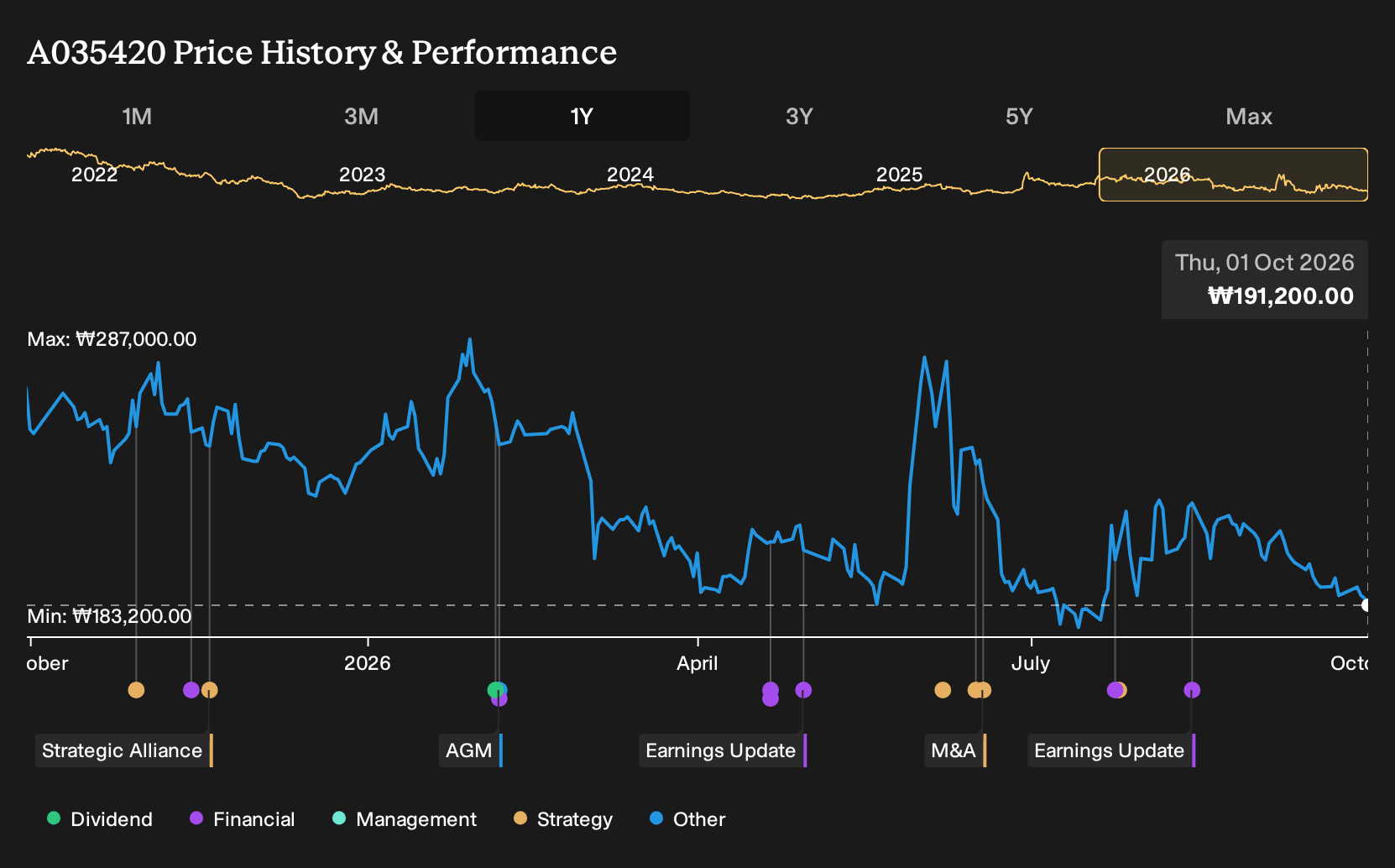
If NAVER’s business delivered stronger revenue and higher net income, you might expect the share price to have rewarded that progress. Instead, the outcome was harsh. Investors who held NAVER over the past year are down 23.6%, including dividends. Analysts at the start of the period were split, with upbeat AI growth stories set against warnings on regulation and aging demographics. If you were weighing those arguments in late 2025, what would have tilted your call?
Narratives are how investors here put a case on the record, with explicit assumptions about revenue, margins and the multiple. Those assumptions imply an estimated Fair Value.
The easy part of this move is behind NAVER. Zero in on 196 high quality undervalued stocks for companies trading below our estimates.
What NAVER Investors Were Really Arguing About
The shares cost ₩253,500 at the start of the period, and anyone looking at NAVER then had to choose between two very different stories about where value might sit.
The upbeat case put Fair Value at ₩293,703. It leaned on NAVER weaving generative AI through search, ads and commerce while assuming revenue growth of 9.3% and a future P/E of 22.7x.
The cautious view set Fair Value at ₩203,333 and focused on rising regulatory and compliance costs. That narrative assumed profit margins shrinking to 14.3% and heavier capital needs for AI and global expansion.
What The Results Changed For NAVER’s Story
The clearest datapoint came from the Q2 2026 report. NAVER’s revenue moved from ₩2,915,085.06m in Q2 2025 to ₩3,388,755.08m, while net income shifted from ₩488,780.97m to ₩698,619.54m and net margin rose from 16.8% to 20.6%. That pattern leaned toward the optimistic case, although it did not address longer term regulatory and demographic worries.
The lesson is simple. When a thesis hangs on margins, you test it by tracking net margin and profit, not just revenue, against what was originally assumed for the next few years.
What NAVER’s Price Drop Is Asking You To Believe Now
With NAVER now at ₩191,200, the selected Narrative argues that Fair Value sits above the current price and leans on AI infrastructure and data advantages to explain that gap.
The fall over the past year only looks like an opening if you think NAVER’s sovereign AI buildout and proprietary data can support stronger long-term earnings power than today’s price implies.
"NAVER's rapid AI innovation and deep proprietary data give it an edge in advertising, commerce integration, and high-margin SaaS, outpacing market and analyst expectations. NAVER's unique end-to-end AI stack and full-stack GPU/cloud infrastructure have positioned it as the national AI champion for sovereign projects in Korea and abroad, enabling multi-billion won contracts with governments and enterprises across Asia and the Middle East, representing an opportunity not yet fully priced in that can rapidly increase high-margin SaaS and B2B revenue."
That disagreement has a full argument behind it. → Uncover the higher Fair Value this Narrative argues for
Find Your Own Contrarian Opportunity
This company's disappointment is already part of the story. Your next idea could come from looking where the price and the possibilities still seem far apart. Here are three companies priced below our estimates.
- Company 1 - 46% below our estimate - builds long term engine servicing, retrofit solutions and routing tools into recurring contracts.
- Company 2 - 28% below our estimate - adds sales staff to win maintenance work that drives higher margin modernization projects.
- Company 3 - 44% below our estimate - shifts recruitment advertising onto one platform connecting HR systems with AI-based matching.
That is three of the list. See the full list of 206 financially solid companies →
This article by Simply Wall St is general in nature. We provide commentary based on historical data and analyst forecasts only using an unbiased methodology and our articles are not intended to be financial advice. It does not constitute a recommendation to buy or sell any stock, and does not take account of your objectives, or your financial situation. We aim to bring you long-term focused analysis driven by fundamental data. Note that our analysis may not factor in the latest price-sensitive company announcements or qualitative material. Simply Wall St has no position in any stocks mentioned.
Have feedback on this article? Concerned about the content? Get in touch with us directly. Alternatively, email editorial-team@simplywallst.com