
- PRICING
- LIVE QUOTES
- LEARN
- HELP


EN
3 Dividend Stocks With Yields Over 3%
With the 10-year US Treasury yield at its highest level since 2002, income from government bonds now competes directly with dividends on your stock portfolio. Reliable cash payouts from well covered, steadily growing dividend payers can look especially appealing when market swings feel uncomfortable. This article highlights three high yielding dividend stocks from our income screen that currently offer yields above 3%, and explains what makes their payouts look more resilient.
The three stocks highlighted below are just a sample from this income idea, while the full screen surfaced roughly 180 more companies with similarly robust dividend stories that are not covered here.
If you want to quickly identify which of those higher yielding payers best fits your portfolio, head straight to the Dividend Powerhouses (3%+ Yield) screener to filter, analyze and focus on your highest conviction dividend ideas.
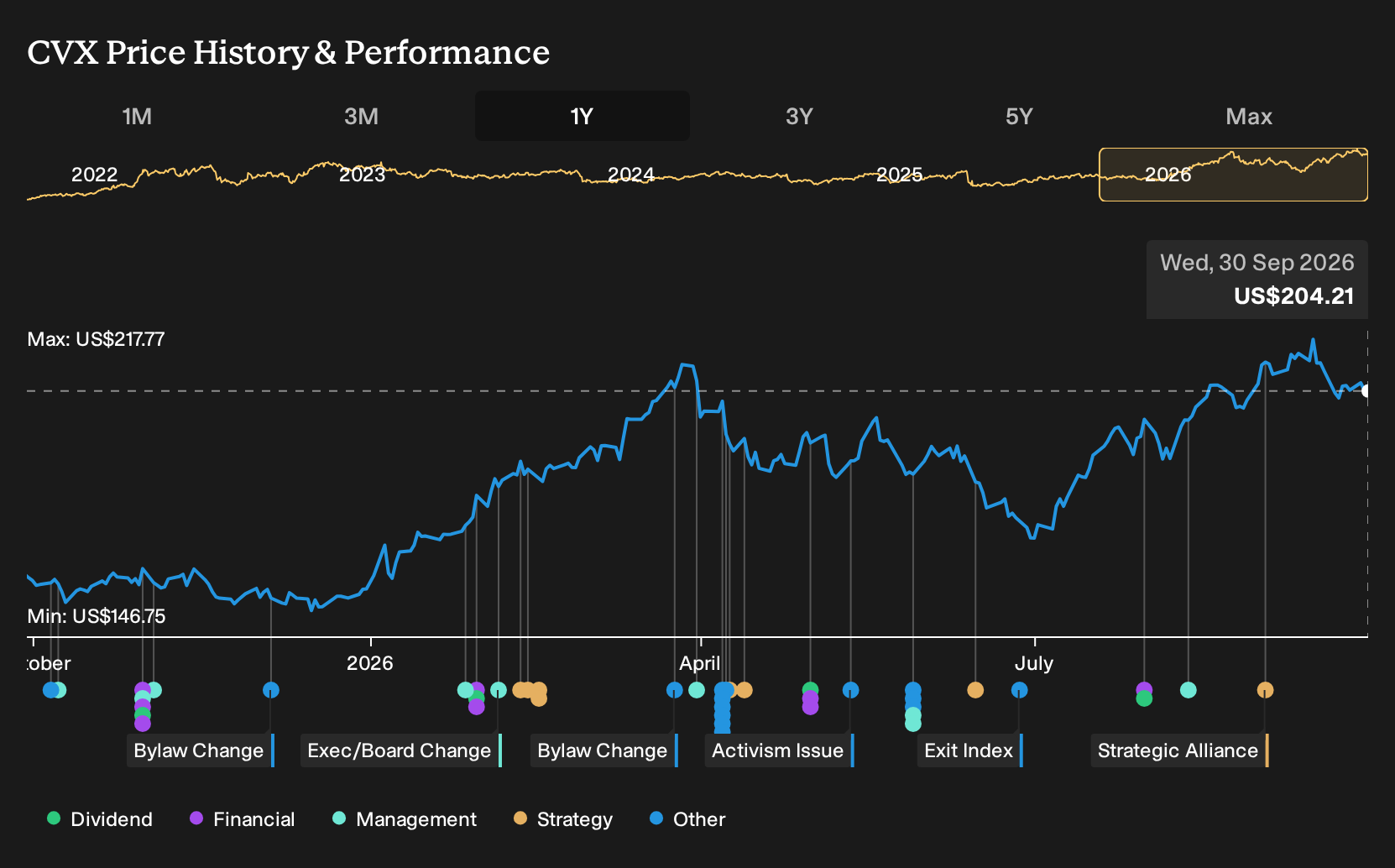
Chevron (CVX)
Overview: Chevron is a global integrated energy company that explores for, produces, refines, and markets oil, gas, fuels, and petrochemicals. It uses these large-scale operations to underpin its role as a high-yield dividend payer.
Operations: Chevron generates most of its revenue from Downstream in the United States and internationally at about US$82.5b and US$78.8b respectively, with substantial additional sales from US$55.1b international and US$52.6b US Upstream activities.
Market Cap: US$400.9b
Chevron appears in this Dividend Powerhouses screen because its large Upstream and Downstream franchises generate meaningful cash that supports a high, recurring payout even when energy markets move around.
"Record production growth, especially in the Permian and from the Hess acquisition in areas such as Guyana and the Bakken, now sits on top of capital and drilling programs that aim to keep Permian volumes around 1 million barrels per day with lower CapEx per barrel. This supports future revenue and free cash flow."
What matters next for income investors is how one quietly building pressure in the business shapes future margins and dividend headroom.
That pressure point is exactly what the full narrative for Chevron unpacks, showing how Chevron’s cash engine, capital plans and risks could be decoupling from headline oil price noise.
United Parcel Service (UPS)
Overview: United Parcel Service runs global package delivery and logistics operations, moving time-sensitive parcels and freight for businesses and consumers worldwide while funding a sizable dividend.
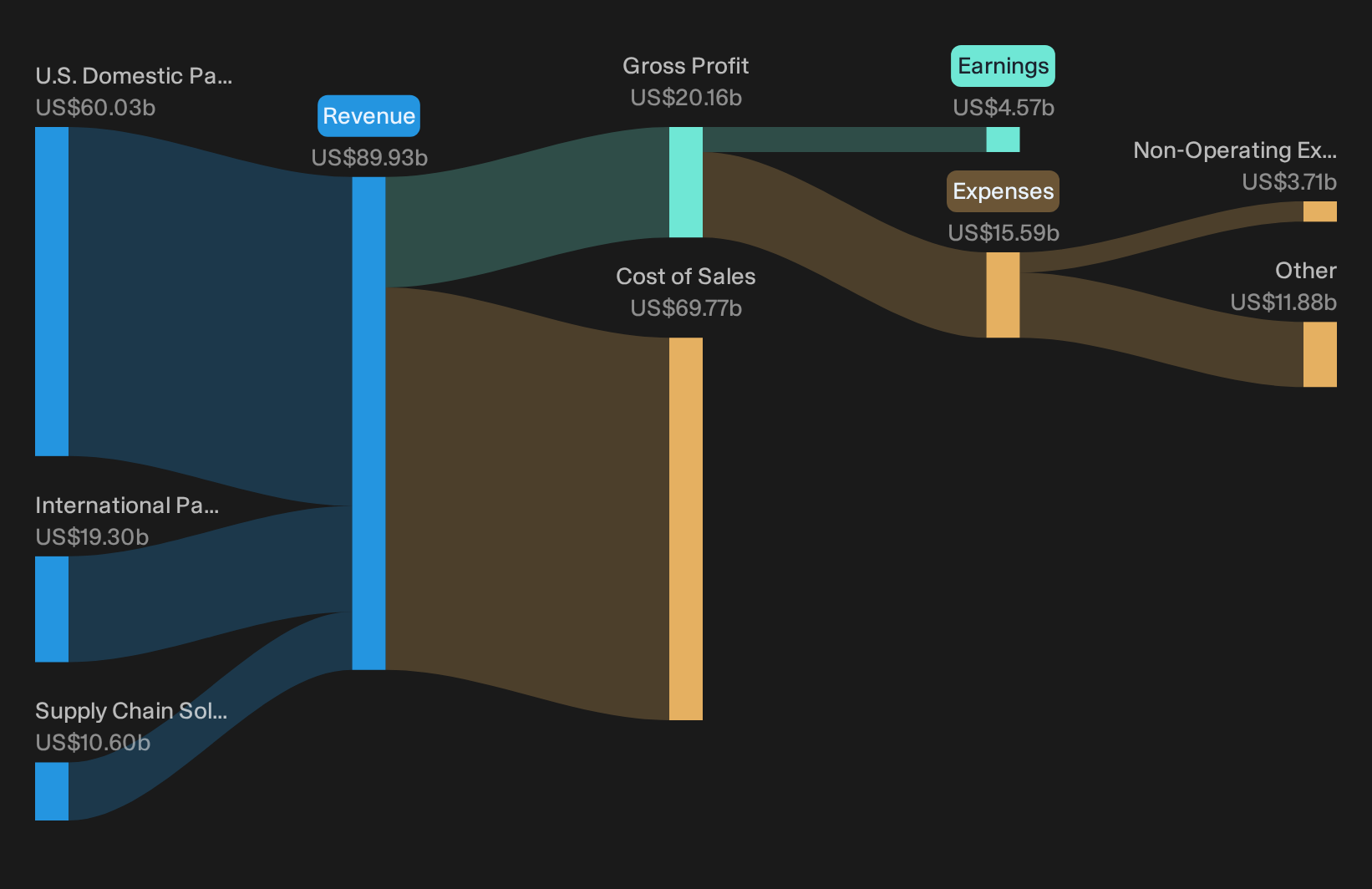
Operations: UPS generates about US$60b from U.S. Domestic Package services, US$19.3b from International Package, and US$10.6b from Supply Chain Solutions.
Market Cap: US$79.9b
For a Dividend Powerhouses screen, United Parcel Service matters because its recurring parcel volumes and logistics contracts feed the free cash flow that underpins a dividend yield above 3%.
"Launched in early 2025, UPS's "Efficiency Reimagined" outlined the company’s largest network overhaul in company history. This multi-year initiative presents management's goals to streamline domestic operations. UPS has announced cost reduction plans to cut nearly 20,000 jobs via buyouts and layoffs and has initiated a new "Ground Saver" product aiming to provide businesses more operational flexibility to improve per-package costs and operating revenue."
For dividend-focused investors, what really matters is how one unresolved cost and cash flow pressure ultimately shapes UPS’s margin headroom.
That margin question is where the real story starts, and the full narrative for United Parcel Service shows how UPS’s overhaul could turn today’s cost pressure into tomorrow’s cash engine.
VICI Properties (VICI)
Overview: VICI Properties is a real estate investment trust that owns casino and experiential properties, collecting long-term rent that supports its dividend.
Operations: VICI Properties generates about US$4.1b from real estate investment activities, with all reported revenue coming from properties in the United States.
Market Cap: US$25.5b
For income investors, VICI Properties matters because its triple-net casino and hospitality leases provide contractual rent that can underpin a covered, high-yield dividend through different market cycles.
"Given the historical data presented, my assumption is that the company will be able to growth its revenues ~3.5 to 4.5% during Year 1 and ~3.5 to 5.5% each year from Year 2 to 5."
What really shapes that income profile is how pressure around leverage and refinancing costs interacts with those long-dated rental contracts.
That refinancing risk is exactly what the full narrative for VICI Properties unpacks, showing how VICI Properties’ long leases and interest costs could be quietly reshaping its income profile.

Seeking Curious Alternatives Before Others
Fresh ideas move first. Once momentum builds, entry points can slip away while prices keep flying. Scan these under the radar for now opportunities before the crowd and consider acting early if they fit your strategy.
- Catch early movers in quality turnarounds by running the 31 high quality undervalued stocks that surfaces financially solid companies where fundamentals and price action have not fully aligned yet.
- Spot potential category leaders using the 28 top founder-led companies curated around owner-operators whose incentives align closely with long term business performance.
- Target resilient balance sheets with the list of solid balance sheet and fundamentals (25 results) and quickly focus on companies where strong finances support flexibility when markets are dropping.
This article by Simply Wall St is general in nature. We provide commentary based on historical data and analyst forecasts only using an unbiased methodology and our articles are not intended to be financial advice. It does not constitute a recommendation to buy or sell any stock, and does not take account of your objectives, or your financial situation. We aim to bring you long-term focused analysis driven by fundamental data. Note that our analysis may not factor in the latest price-sensitive company announcements or qualitative material. Simply Wall St has no position in any stocks mentioned.
Have feedback on this article? Concerned about the content? Get in touch with us directly. Alternatively, email editorial-team@simplywallst.com