
- PRICING
- LIVE QUOTES
- LEARN
- HELP


EN
Why Bank of America Is Betting That Nike Stock Will Fall from Here
Sportswear giant Nike (NKE), whose shares have already been under heavy pressure in recent years, tumbled again on Sept. 25 after Bank of America downgraded NKE stock to “Underperform” from “Neutral.” Analyst Lorraine Hutchinson cut the firm's price target for the stock to $30 from $47 per share.
BofA also slashed its fiscal 2027 and 2028 EPS estimates, and now expects negative sales growth through fiscal 2027, pushing the company's sales turnaround into fiscal 2028. The pressure isn’t limited to the top line, either. BofA noted that North American wholesale growth has yet to translate into comparable sell-through, while declines in both new and old styles are putting “forward order books at risk” as retailers become more cautious. At the same time, Greater China sales fell last quarter. Bank of America also flagged growing pressure on earnings, which increasingly depend on gross-margin expansion and cost control, while dividend coverage remains another concern.
With the latest downgrade adding to Nike’s growing list of challenges, the key question for investors now is whether this beaten-down stock offers enough upside to justify the uncertainty surrounding its turnaround. Let's take a closer look.
About Nike Stock
Nike may be synonymous with sportswear, but NKE stock has become a very different story. The company has built a massive global business around athletic footwear, apparel, equipment, accessories, and consumer services. Based in Beaverton, Oregon, and originally founded as Blue Ribbon Sports in 1964, the company adopted the Nike name in 1971.
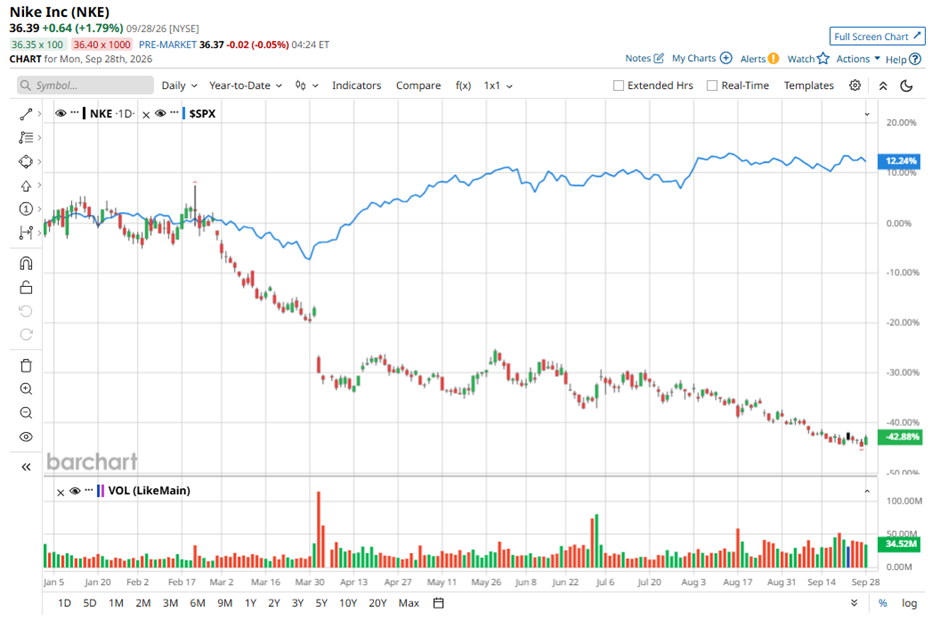
Today, Nike's offerings span everything from performance and lifestyle shoes to sportswear, athletic clothing, bags, socks, equipment, eyewear, and digital fitness services, with the Nike, Jordan, and Converse brands forming the core of its portfolio. That brand strength, however, has not been enough to keep investors on board. Nike currently commands a market capitalization of around $53 billion, but shares have fallen 49% over the past year and 44% in 2026.
The gap with the broader market is striking. The S&P 500 ($SPX) has risen about 14% over the past year and 12% so far this year. Nike is being squeezed by a tougher consumer environment, as persistent inflation has made shoppers more selective about discretionary purchases such as footwear and apparel. Plus there is China, where the company is facing an increasingly difficult battle for consumers.
Nike’s revenue in the market dropped nearly 12% in its latest quarter, with local brands gaining ground among Chinese shoppers. These challenges are piling onto an already difficult turnaround story, making a sustained recovery harder to achieve. NKE stock’s long-term slide puts the damage into even sharper perspective; Nike now trades about 80% below its 2021 peak of $179.10.
For a brand that once represented one of the safest names in global sportswear, the scale of that decline shows just how much work remains before Nike can restore its former momentum — and, crucially, investor confidence.
Nike’s Q4 Earnings Snapshot
Nike’s fiscal 2026 finish offered some encouraging pockets, but hardly a clean win. The sportswear giant reported $10.97 billion in fourth-quarter revenue on June 30, representing a 1% year-over-year (YOY) decline on a reported basis and a 4% decline on a currency-neutral basis. For the full fiscal year, revenue totaled $46.4 billion, essentially unchanged from the prior year on a reported basis but down 2% on a currency-neutral basis.
Still, Nike managed to squeeze past expectations, with quarterly revenue coming in ahead of Wall Street’s roughly $10.86 billion consensus estimate. A closer look at the business reveals a clear divide between where Nike is finding traction and where it is struggling. Nike Brand revenue reached $10.7 billion, flat YOY on a reported basis but down 3% on a currency-neutral basis, as weakness across Greater China and EMEA offset growth in North America.
Wholesale was one of the brighter spots, with revenue increasing 4% to $6.6 billion. Nike Direct, meanwhile, continued to lose momentum. Revenue declined 7% to $4.1 billion, or 9% on a currency-neutral basis, as Nike Brand Digital fell 12% and sales from Nike-owned stores dropped 7%. North America provided some relief, with revenue increasing 3% YOY to $4.83 billion, but China remained a significant drag. Greater China revenue plunged 12% YOY to $1.3 billion, underscoring the challenges Nike continues to face in one of its key international markets.
The bottom line looked considerably stronger, although tariffs played a major role. Gross margin jumped 890 basis points to 49.2%, largely due to the expected recovery of IEEPA tariffs. The anticipated $986 million tariff recovery alone contributed roughly 900 basis points to gross margin. Diluted EPS came in at $0.72, including a $0.52 benefit tied to the expected tariff recovery. Nike finished the quarter with $9 billion in cash, cash equivalents, and short-term investments, roughly $100 million below the year-ago level.
Operating cash flow included approximately $300 million received from IEEPA tariff recoveries, but that cash generation was “more than offset by cash dividends and capital expenditures.” Shareholders nevertheless continued to receive capital returns, with Nike paying out approximately $609 million in dividends during the quarter, up 3% YOY.
For fiscal 2027, management is not promising an immediate rebound. CFO Matthew Friend reiterated expectations for earnings to remain “flattish” during the first two quarters, while Nike expects Q1 fiscal 2027 gross margin to be slightly positive. The next major checkpoint is already on the calendar. Nike is set to release its Q1 fiscal 2027 results after the market closes on Oct. 1. With the turnaround still a work in progress, investors will be watching closely for signs that the company is finally moving from stabilization toward sustainable growth.
How Do Analysts View Nike Stock?
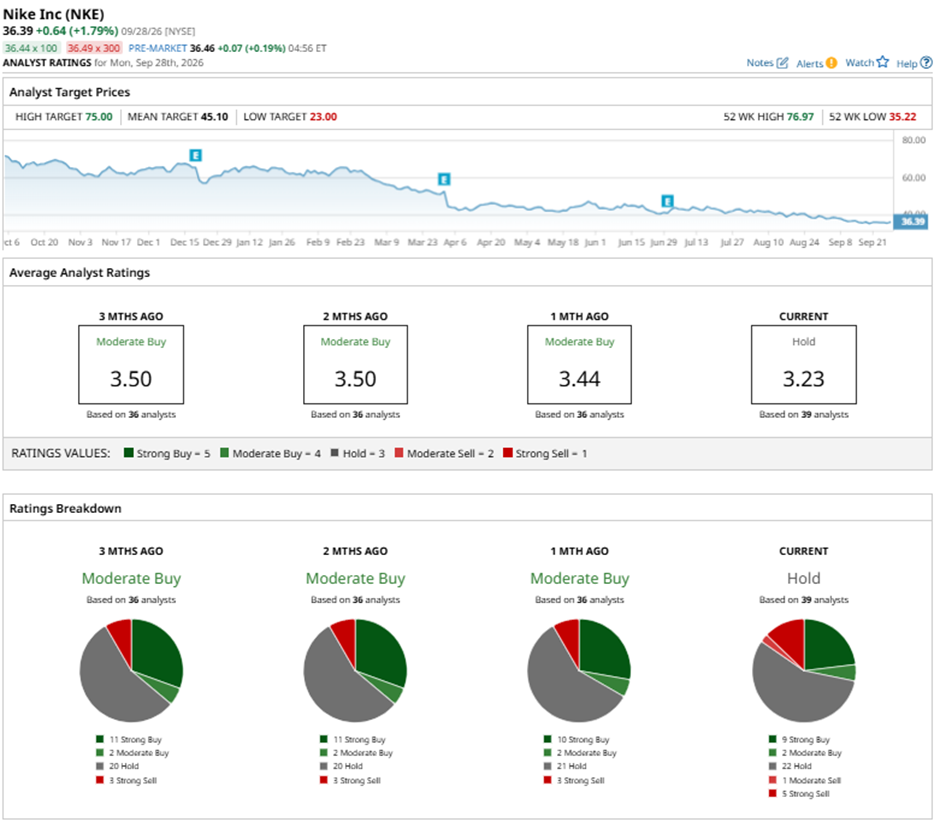
Bank of America’s bearish stance is not an isolated call. Wall Street remains divided on Nike, with NKE stock currently carrying a consensus “Hold” rating. Of the 39 analysts covering the company, nine have a “Strong Buy” rating, two recommend a “Moderate Buy,” 22 have a “Hold” rating, one has a “Moderate Sell,” and five analysts have a “Strong Sell” rating.
Yet the targets suggest that some analysts still see substantial recovery potential if Nike can turn its business around. The average price target of $44.71 represents roughly 26% potential upside from current levels, while the highest target of $75 implies a potential 112% gain from here.
On the date of publication, Anushka Mukherji did not have (either directly or indirectly) positions in any of the securities mentioned in this article. All information and data in this article is solely for informational purposes. For more information please view the Barchart Disclosure Policy here.