
- PRICING
- LIVE QUOTES
- LEARN
- HELP


EN
NIO Stock Slides as Rival Geely Takes 30% Stake in Battery Unit
Chinese electric-vehicle (EV) maker Nio (NIO) just landed a deal that could reshape its battery-swapping ambitions. Recently, Nio announced definitive agreements with certain subsidiaries of Zhejiang Geely Holding Group (GELHY), under which Geely will acquire a 30% stake in Nio Power, Nio’s battery-swapping unit. The deal gives Geely access to China’s largest network of battery-swapping stations and values Nio Power at roughly 16 billion yuan, or $2.4 billion.
For Nio, the partnership brings much-needed fresh funding while potentially increasing utilization of its expensive battery-swapping infrastructure by opening the network to Geely vehicles. For Geely, which sold 1.25 million vehicles in China during the first eight months of this year, the deal offers a shortcut into Nio’s established swapping technology and network, allowing the automaker to expand battery swapping for its own vehicles without having to build a competing system from the ground up.
On paper, the deal looks like a major vote of confidence in Nio’s battery-swapping technology and its position in China’s EV ecosystem. Yet investors have delivered a surprisingly cool response. Nio shares are down nearly 5% since the announcement, reflecting concerns over a transaction that also changes the ownership structure of one of the company’s most distinctive assets.
With fresh capital, a major strategic partner, and broader potential utilization of its battery-swapping network on one side and investor concerns over the ownership shift on the other, the question now is whether Nio’s latest deal strengthens the long-term investment case or introduces new risks investors need to weigh. So, given this latest development, how should investors approach Nio stock now?
About Nio Stock
Headquartered in Shanghai, China, Nio is a pioneer and leading player in the global smart electric vehicle market. Founded in November 2014, the company is driven by its mission of “Blue Sky Coming” and aims to shape a more sustainable, brighter future. Nio positions itself as a user-focused enterprise where cutting-edge technology meets an exceptional ownership experience. It designs, develops, manufactures, and sells smart electric vehicles while pushing the boundaries of next-generation core technologies.
With a focus on continuous technological breakthroughs, standout products and services, and a community built around shared growth, Nio operates across three brands: NIO, which offers premium smart electric vehicles; ONVO, which brings premium smart EVs to families; and FIREFLY, which focuses on high-end, compact smart electric cars. Currently valued at roughly $8.52 billion, Nio is having a tough time winning back Wall Street’s confidence.
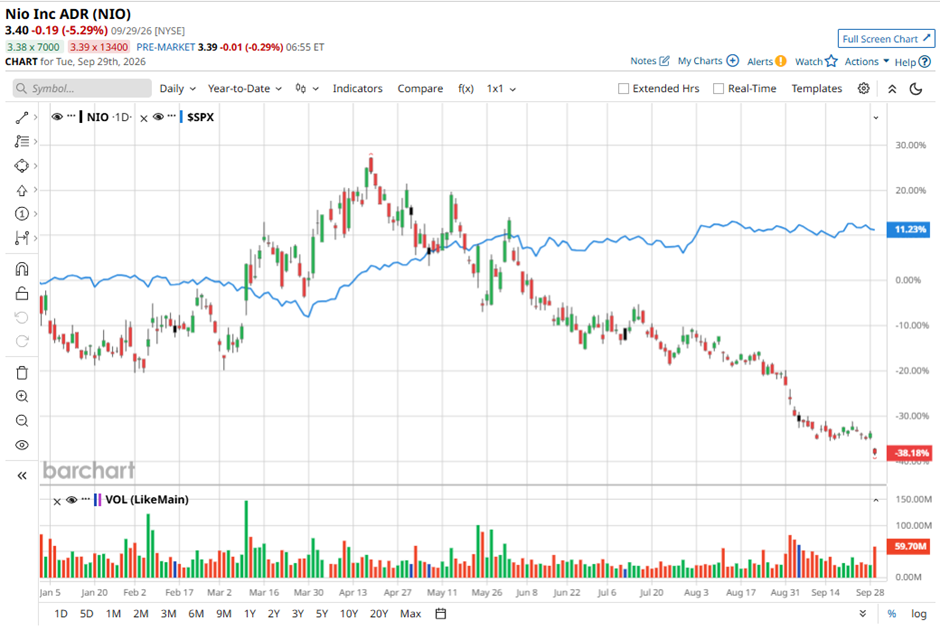
The Chinese EV maker faces intensifying competition at home, a cooling economy, and tariff uncertainty that has clouded its growth prospects in Europe. At the same time, persistent cash burn and mounting losses have further weighed on investor sentiment, taking a heavy toll on the stock. So far in 2026, Nio shares have tumbled nearly 33.3%, dramatically underperforming the broader S&P 500 Index ($SPX), which has advanced about 12.1% over the same period.
Inside Nio’s Q2 Earnings Report
Nio put up a strong showing in the second quarter of fiscal 2026, published on Sept. 1, with revenue accelerating, margins expanding, and losses narrowing sharply. Total revenue surged 69.1% year over year and 25.9% from the previous quarter to $4.74 billion, while vehicle sales jumped 80.1% year over year to $4.28 billion. Vehicle margin climbed to 18.5%, a significant improvement from 10.3% in the second quarter of 2025, though slightly below the 18.8% recorded in the first quarter of 2026.
Gross margin followed a similar trajectory, rising to 18.4% from 10% a year earlier, but edging down from 19% in the prior quarter. At the same time, net loss per ADS narrowed to just $0.04 from the year-ago quarter. Nio’s stronger financial performance was backed by a sharp increase in vehicle deliveries, with 107,658 vehicles delivered during the quarter, a 49.4% year over year and 29% sequentially.
The total included 60,945 vehicles under the NIO brand, 29,124 under ONVO, and 17,589 under FIREFLY. Nio also ended June with a substantial liquidity cushion, holding $8.4 billion in cash and cash equivalents, restricted cash, short-term investments, and long-term time deposits as of June 30.
The momentum is expected to continue into the third quarter, with Nio projecting total revenue between $4.91 billion and $5.02 billion. That would represent growth of approximately 52.7% to 56.2% from the same period last year. The company also expects third-quarter deliveries to range between 108,000 and 111,000 vehicles, translating into year-over-year growth of 24% to 27.5%.
How Do Analysts View Nio Stock?
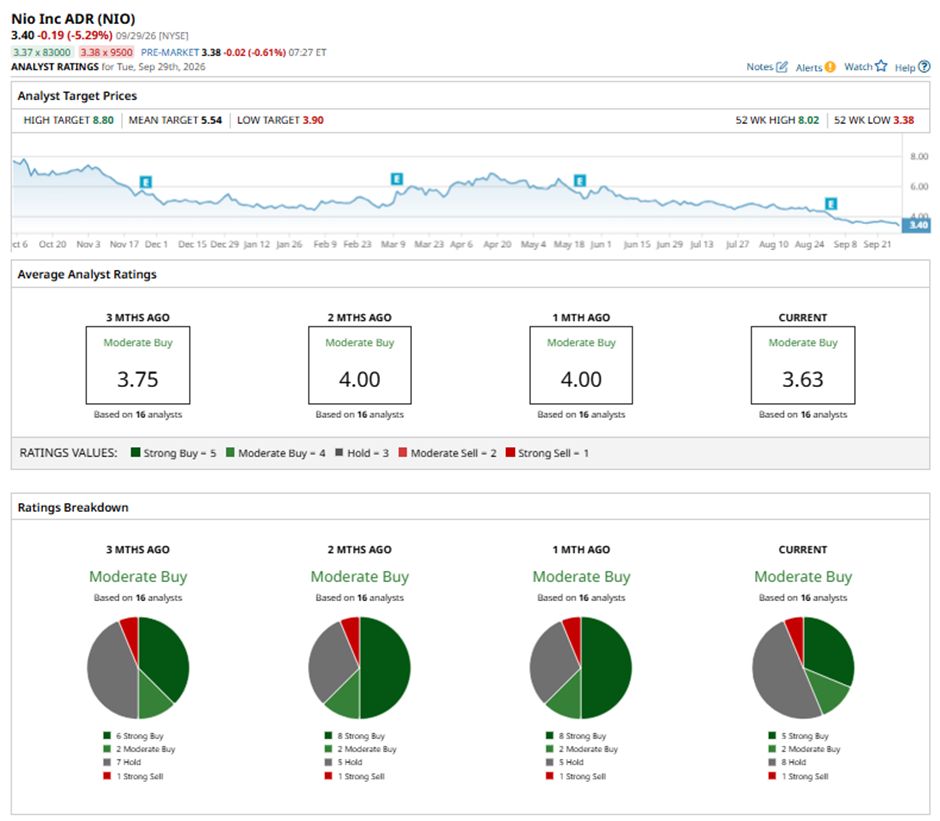
Nio may have had a rough ride on the stock market this year, but Wall Street analysts remain relatively positive on its prospects. The stock carries a consensus “Moderate Buy” rating, with five of the 16 analysts covering Nio calling for a “Strong Buy,” two issuing a “Moderate Buy,” eight recommending “Hold,” and one giving the stock a “Strong Sell” rating.
Price targets also point to significant potential upside, with the $5.54 average target suggesting a 63% gain from current levels. At the upper end of the Street’s expectations, the $8 target implies that Nio shares could climb as much as 135.3%.
On the date of publication, Anushka Mukherji did not have (either directly or indirectly) positions in any of the securities mentioned in this article. All information and data in this article is solely for informational purposes. For more information please view the Barchart Disclosure Policy here.