
- PRICING
- LIVE QUOTES
- LEARN
- HELP


EN
The US labor market continues to be “reckless”: the number of layoffs in September was the lowest in the same period in four years, and recruitment intentions returned to 2011
The Zhitong Finance App learned that US companies' layoff plans fell to their lowest level in the same period in four years, but recruitment plans also returned to the level of 2011 — this report released on Thursday further explains the “no decisions, no recruitment” state in the labor market. According to data from the job placement and executive coaching agency Challenger, Gray & Christmas, US employers announced 43,281 layoffs last month, a decrease of nearly 20% from the same period last year, the lowest value for any September since 2022. This figure was 18% lower than the 52,881 in August.
Looking at it longer, companies announced a total of 573,195 layoffs in the first nine months of this year, down 39% from 946,426 in the same period in 2025 — a 15% drop after excluding jobs in government departments; the total number of people in the third quarter was 129,591, down 43% from 226,242 in the second quarter.
The recruitment side is a completely different picture. The employer announced a recruitment plan of 90,787 people in September. Although it is far higher than the 12,325 people in August, it is a 23% drop from 117,313 in September last year, the weakest September since 2011. According to Challenger's caliber, the recruitment plan for the first nine months of this year totaled 210,612 people, which is only 3% higher than the 204,939 in the same period last year.
“The company is currently in a wait-and-see period. “Employers are facing high energy costs, uncertain war in Iran, interest rate hikes that may make recruitment more expensive, and medical costs are likely to rise sharply,” Andy Qianlinjie, the company's chief revenue officer, said in a press release. “The layoffs have indeed been slowing down this year, and the September data continues to show that.”
Fewer layoffs, fewer hires: a low-turnover market
The number one reason for the September layoffs was market and economic conditions, corresponding to 8,789 jobs. Seasonal recruitment was supposed to start in September, but this year's efforts are clearly insufficient: out of 90,787 recruitment plans, the retail industry accounts for 65,150 (about 70%), mainly from the Halloween pop-up chain Spirit Halloween and handicraft retailer Michaels. The two companies announced a total recruitment of 62,000 people this year, down from nearly 101,000 last year.
The combination of low layoffs and weak recruitment can also be matched in more detailed indicators. According to the US Bureau of Labor Statistics, the number of jobless claims fell to 197,000 at the beginning of the week ending September 19, which is close to a decades-long low, indicating that companies have not initiated large-scale layoffs; the number of JOLTS job vacancies in August decreased by 256,000 to 7.079 million, corresponding to 1.01 vacant jobs per unemployed person, down from 1.06 in July. In other words, job opportunities are dwindling, but the number of people working is not being pushed out in large numbers — what the labor market is losing is mobility, not total volume.
Consumers feel even worse about this. Consumer confidence in the US fell to a low of nearly 12 and a half years in September, according to a survey published by the World Conference Board (Conference Board) on Tuesday.
“There has been a year-on-year increase in recruitment plans, but we haven't seen a surge in recruitment plans as expected during the holiday season. This shows that the company's attitude is very cautious,” Qian Linjie said.
The technology industry bucked the trend, and AI became the number one reason for layoffs throughout the year
The overall reduction in layoffs has not covered all industries. The technology industry announced 10,799 layoffs in September, 77% more than 6,103 in August. It was the industry with the most layoffs in that month; the food industry had 7,326 people and the service industry had 3,306 workers. The technology industry has laid off 165,925 workers since this year, accounting for 29% of all layoff announcements, higher than any other industry.
What is more noteworthy is the change in the reason structure. According to Challenger data, the number of layoffs clearly attributed by companies to artificial intelligence from January to August of this year reached 116,175, accounting for about 22% of all layoffs announced during the same period, more than double the 54,836 people in 2025, and about nine times that of 12,742 in 2024. AI-related layoffs peaked in May, with 38,579 people in a single month, accounting for 40% of that month; since then, they have declined month by month, falling to 3,462 in August, falling to fourth place in the list of reasons for leaving, and the restructuring returned to the top position. However, extending the timeline to September, AI is still the most mentioned reason for layoffs since this year, accounting for about 21% of all planned layoffs — this is the conclusion of the report quoted in this newspaper's original article.
The structural aspects of employment data echo this. According to August non-agricultural data, employment in the information industry decreased by 23,000 and the financial sector by 11,000 in the same month. The former has continued to decline since November 2022, and the latter has continued to decline since May 2025, all of which were attributed by the agency to AI; at the same time, the increase in staff in the commodity production department for the sixth month in a row may reflect the employment demand for data center construction. What AI is changing is not the total number of layoffs, but who gets laid off.
Resilience of employment and stickiness of inflation: how much room is left for the Federal Reserve to raise interest rates
The reason this report is important is because it comes just after the Federal Reserve raised interest rates in September. The Federal Reserve raised the benchmark interest rate to the 3.75% to 4.00% range this month, the first rate hike in three years, and suggests that borrowing costs may continue to rise in the coming months. However, the prerequisite for raising interest rates is that the labor market does not deteriorate rapidly.
The motivation on the employment side is still there. According to the US Bureau of Labor Statistics, non-farm payrolls increased by 162,000 in August, the biggest increase in five months, significantly higher than market expectations of about 56,000; a total of 55,000 people increased in June and July. The unemployment rate remained at 4.1% for the third month in a row, the labor participation rate rebounded from 61.4% to 61.6%, and the average hourly wage rose 3.1% year on year. According to a survey of economists, non-farm payrolls are expected to add 90,000 jobs in September (some institutions look at 100,000, while Bank of America only sees 60,000), and the unemployment rate is expected to remain at 4.1%; data released by ADP on Wednesday showed that 90,000 new jobs were added in the private sector in September, which is also higher than expected.
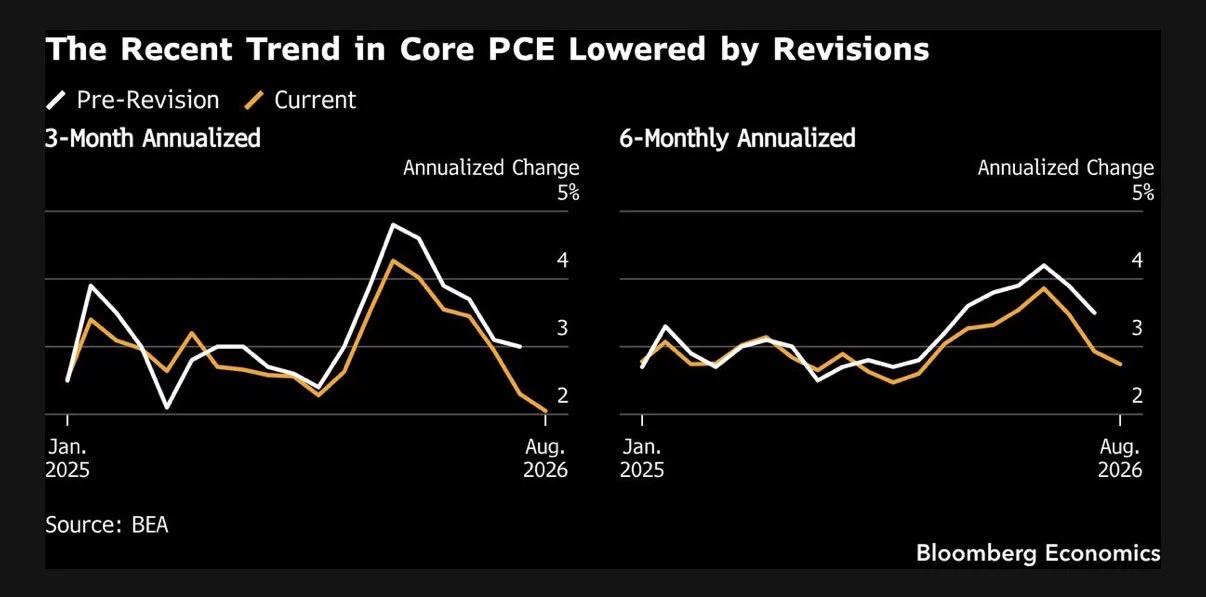
The inflation side, on the other hand, showed signs of loosening in the last two days. According to data released by the US Department of Commerce's Bureau of Economic Analysis (BEA) on September 30, the August personal consumption expenditure (PCE) price index rose 3.4% year on year, lower than market expectations of 3.7%. The July data was also revised down from 3.7% to 3.4%; core PCE excluding food and energy rose 3.0% year on year, and the July data was revised down from 3.3% to 3.0%. BEA adjusted the price calculation method for software and accessories, portfolio management fees, and legal services during the same period, and retroactively revised it to 2021 — the methodological adjustment alone lowered the core PCE by about 36 basis points year over year, higher than economists' expectations of 20 to 30 basis points.
Growth data has also been revised up. According to the final revised data, the actual GDP of the US increased by 2.2% in the second quarter, down from 2.5% in the first quarter — it should be noted that this 2.2% is the final value after the annual revision, while the second reading on August 26 was 1.5%. Personal consumption expenditure increased 3.8% month-on-month and non-residential fixed asset investment increased 9% in the second quarter. Consumption and investment are still the main drivers; the first GDP estimates for the third quarter will be announced on October 29.
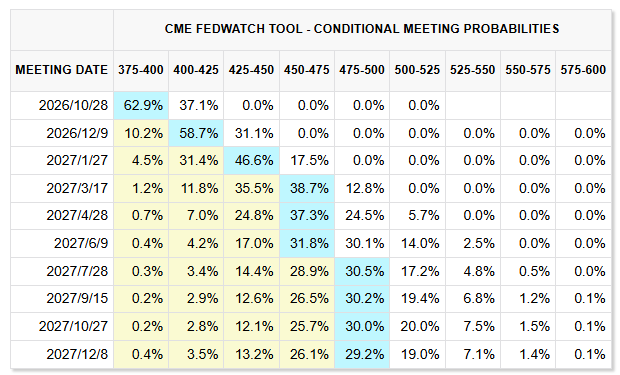
After the data was released, market bets on the October rate hike clearly declined. According to the CME FedWatch tool, the probability of interest rate hikes at the October 27-28 meeting dropped from 51.5% before the data was released and 70% this Monday to a half to 40% range. This change stems in part from New York Federal Reserve Chairman Williams's statement on Tuesday — he believes there is “no urgency” for immediate further action after the early policy tightening.
Federal Reserve Officials and Wall Street Signals
But the Federal Reserve is not uniformly moderate. Chicago Federal Reserve Chairman Goulsby said that inflation is “playing with fire” for five and a half years above the target; Director Lisa Cook believes that the increase in productivity will bring about a moderate cooling of inflation, but the impact will not come fast enough to offset the price pressure that will expand later this year; Governor Barr said that high energy prices combined with a sharp increase in AI-related investments have caused the US to “deviate from track” on the path to achieving the 2% inflation target.
The institutional differences also centered on the same point. BMO capital market senior economist Sal Guatieri believes that the August “unimaginably scary” price data may give the Federal Reserve time to wait for more data and stay on hold in October, but inflation is still high, consumption and the economy are still resilient, and it is still possible to raise interest rates one more time before the end of the year.
Stephen Stanley, chief US economist at Santander's US capital market, cautioned that the two-month data was not enough to form a trend. In particular, the monthly reading for August actually accelerated again. “But there are at least some reasons to be slightly optimistic — at least, the Federal Reserve can act calmly; it may not require much increase to lead inflation to the target.”
For investors, Qian Linjie's statement is still the key to understanding this report: the company is not laying off employees, but it is not recruiting people either. This state of affairs is inflation-friendly — it suppresses upward momentum in wages and service prices; but it also means that once there is a rift on the demand side, employment data may deteriorate faster than before. According to Friday's non-agricultural data, what the market depends on is not whether it rises or not, but how big the gap is.