
- PRICING
- LIVE QUOTES
- LEARN
- HELP


EN
Micron (MU.US) earnings report “exploded” but stock prices fluctuated: the storage supercycle is far from peaking, so why is the market no longer excited?
The Zhitong Finance App learned that after the US stock market on Thursday EST, Micron Technology (MU.US) ended its 2026 fiscal year with an almost impeccable financial report.
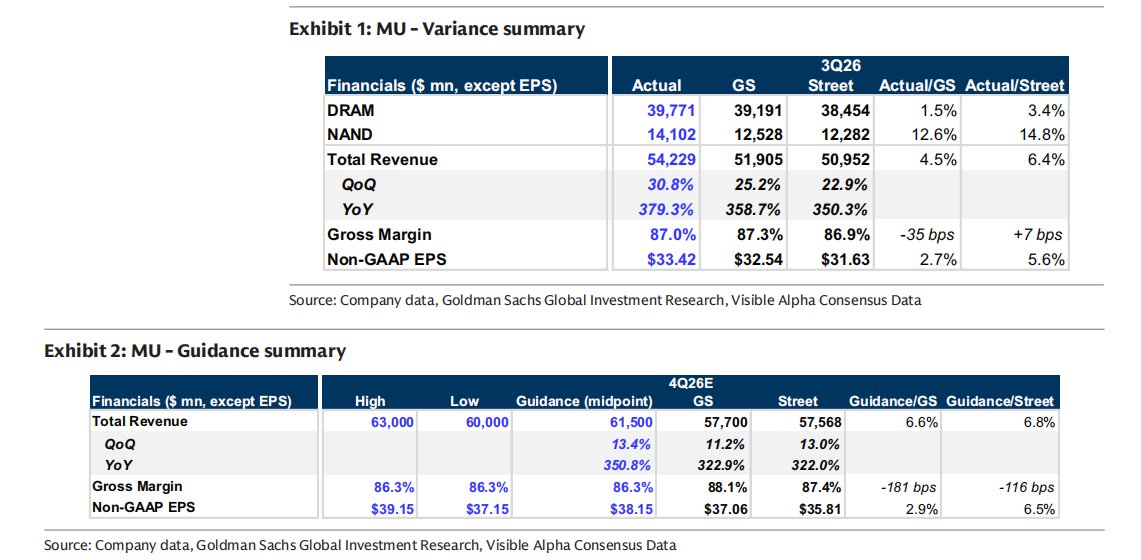
According to financial reports, the company's revenue for the fourth fiscal quarter was US$54.23 billion, up 379% year on year, up 31% month on month, setting a record for six consecutive quarters; adjusted earnings per share of US$33.42, up more than tenfold year on year; gross margin climbed to 87%, up 2.1 percentage points from the previous quarter. Looking at the entire fiscal year, Micron's total revenue reached US$133.19 billion, 3.5 times the previous fiscal year's record level. Among them, data center revenue quadrupled year-on-year, and DRAM's annual revenue surpassed $100 billion for the first time.
The guidance for the next fiscal quarter also far exceeded expectations: the median revenue guide was $61.5 billion, higher than Wall Street's estimate of $57.57 billion; the adjusted median earnings per share guide was $38.15, higher than Wall Street's forecast of $35.81.
However, after the financial report was announced, Micron's stock price rose by about 2% after the market, then quickly turned down, repeatedly tugging between long and short periods. As of press release, the pre-market trading price of the stock remained around 1,060 US dollars, a decrease of about 0.5%.
Why did a financial report with almost a “perfect score” fail to ignite the enthusiasm of the market?
Strong performance: More than numbers
The strength of Micron's financial report is first reflected in qualitative changes in the revenue structure. In the fourth fiscal quarter, core data center business (CDBU) revenue reached US$18 billion, up 56% month-on-month, and gross margin reached 90%, increasing more than tenfold year-on-year. Demand for AI servers was the core driving force.
The data center business currently accounts for 33% of the company's total revenue, while the cloud storage business's revenue is 16.3 billion US dollars, accounting for 30%. Together, the two have exceeded 60% of total revenue. In terms of DRAM, revenue reached 39.8 billion US dollars, up 343% year on year. Shipment volume increased by mid-single digits, but the price increase reached a high single digit, indicating that growth was mainly driven by price rather than simply stacked shipments. This reflects the extreme tightness of supply and demand in the industry. NAND's revenue was US$14.1 billion, up 526% year on year, 42% month-on-month, shipment volume increased by about 10%, and price increased by about 30%, which also confirmed the severity of supply bottlenecks.
Also worth noting is that Micron revealed key information on future production capacity during the conference call: more than 75% of shipments in fiscal year 2027 have already been locked through long-term agreements, the number of strategic customer agreements (SCA) increased from 16 to 26 in the previous quarter, total customer advance payments increased from $22 billion to $32 billion, and remaining performance obligations (RPO) reached about 150 billion US dollars, a significant increase from about 100 billion US dollars in the previous quarter. These agreements are expected to cover more than 35% of Micron's revenue by 2030. About three-quarters of these have determined pricing frameworks, most have set price ranges, and some agreements have even been extended to 2031.
In terms of capital expenditure, Micron announced that capital expenditure for the first half of fiscal year 2027 was about US$25 billion, of which the first quarter was about US$11.5 billion, and will increase further in the second half of the year. Most of the increase will be used to build new fabs rather than simply purchasing equipment. In terms of the pace of production capacity implementation, the production time of the first Idaho plant was brought forward to mid-CY27, the Singapore plant is expected to produce 2HCY28, the Hiroshima plant's clean room was completed ahead of schedule until the end of CY28, and the New York plant has already broken ground.
Chief Financial Officer Mark Murphy revealed in a conference call that the fourth fiscal quarter generated $44 billion in operating cash flow and $33.2 billion in free cash flow, and promised to return 100% of the excess cash to shareholders in the future.
Storage is defining the boundaries of AI
Micron CEO Sanjay Mehrotra defined the current industry transformation as “Superintelligence is creating the most compelling opportunity in Micron's history” during the conference call. This is not an empty rhetoric.
Judging from industrial logic, the expansion of AI models brings not only demand for computing power, but also exponential growth in demand for memory capacity and bandwidth. Mehrotra pointed out during the conference call that running AI applications on platforms with stronger memory capabilities can achieve more scalable growth and improve the end user experience. In other words, storage is not only an important role in AI infrastructure, but also a key variable that determines the upper limit of AI system capabilities.
In the HBM field, Micron has partnered with Nvidia (NVDA.US) to develop the industry's first customized HBM solution. In the first quarter of 2026, Micron began mass production of the HBM4 12-layer stacked 36GB product for the Nvidia Vera Rubin platform, achieving a bandwidth of over 2.8 TB/s. Mehrotra revealed that most of HBM's supply agreements have been signed in 2027, and “prices have risen sharply year over year, which has narrowed the gross margin gap between HBM and traditional DRAM.” This means that HBM's business is shifting from “strategic investment” to “profit contribution.”
In the long run, Mehrotra outlined a new growth pole for “physical AI” during the conference call. He stressed that the memory capacity of L4 and above autonomous vehicles usually exceeds 200GB, and the storage capacity reaches several terabytes, which is an order of magnitude higher than the current L2+/L3 level; humanoid robots are also expected to have similar demand. He emphasized that by the end of this century, physical AI will be an important driver of storage demand.
According to the supply and demand analysis released by J.P. Morgan Chase before the financial report, the HBM market's supply and demand gaps in 2026, 2027, and 2028 were 20%, 19%, and 16%, respectively. The cumulative shortage will reach 23 weeks until 2028. Citi's analysis is more aggressive, and the supply-demand gap is expected to widen from -21% in 2027 to -36% in 2028. According to Deutsche Bank's estimates, the DRAM supply and demand gap will expand further in 2027 and 2028, and the market may only reach a balance between supply and demand in 2029.
This data points to the same conclusion: demand for AI-driven storage has entered a structural shortage rather than a cyclical fluctuation.
Why did stock prices fluctuate?
Since the fundamentals are so strong, why is Micron's stock price almost unchanged?
First, the gross margin guide became a “brake” on short-term sentiment. The gross margin of 87% for the fourth fiscal quarter did exceed analysts' expectations (86.9%), but the gross margin guidance for the next fiscal quarter is about 86.25%, which is lower than market expectations of 87.4%. CFO Murphy explained that the first fiscal quarter will be the low point of gross margin for the full year of fiscal year 2027, mainly due to higher cost inventory sales and higher compensation expenses. The gross margin is expected to gradually rise in each quarter thereafter, but the rate of price increase will moderate. In a situation where expectations are extremely full, even a gross margin guideline drop of 0.45 percentage points is enough to trigger some investors' profit settlement.
Second, the sharp jump in capital expenditure overweighed the benefits of excessive financial reports. The market is beginning to worry that Micron is shifting from a “gross margin expansion model” to a “capacity expansion model.” Some analysts pointed out that as financial results continue to exceed expectations, Micron's stock price may enter a consolidation phase and will no longer rise sharply simply due to favorable earnings reports. A significant increase in capital expenditure means that depreciation costs will rise in the future, and profit margins may face structural pressure, which is an important factor in suppressing short-term stock prices. Some analysts also pointed out that the news of “increased capital expenditure” overweighed the benefits of excessive financial reports after the market.
Goldman Sachs analyst James Schneider's team also pointed out in the latest research report that Micron's latest fiscal quarter results and next quarter guidance were significantly higher than Wall Street expectations. At the same time, the company disclosed more long-term customer agreements and drastically raised capital expenditure plans. These factors are expected to support a moderate rise in stock prices; however, gross margin was slightly lower than Goldman Sachs expectations, and investors' previous expectations were high, limiting the room for further valuation expansion.
From an investor's perspective — and probably the most fundamental reason — the market's focus is shifting from “how high is the boom” to “how long the boom lasts.” Morgan Stanley pointed out after the earnings report that the focus of the market is shifting. Investors are no longer only concerned about how good the current performance is, but are beginning to examine whether this supercycle can continue after 2028. Micron's stock price has risen sharply since this year, and the market is quite adequate in pricing performance that exceeds expectations. Despite strong fundamentals, Micron's stock price is still trading at a forward price-earnings ratio of about 7 times, far below the average of about 10 times over the past two years. The market's expectations for a sharp slowdown in the 2027-2028 growth rate have already been partially reflected in the valuation.
Furthermore, expectations management may have even reached a stage where “exceeding expectations is not enough”. Some analysts pointed out that analysts have seen Micron surpass its own guidelines as the norm, and what the market expects is to “surpass and exceed expectations.” Options market data shows that in the past 10 financial reports, the average fluctuation of Micron's stock price was 9.4% the next day, with a median of 9.1%. However, the current options only fluctuated by about 6.3%, indicating that the market's expectations for drastic fluctuations after the financial report have declined markedly.
Goldman Sachs maintained a “neutral” rating after Micron announced its earnings report, but raised the target price from $1,100 to $1,250, based on an 18-fold price-earnings ratio and normalized earnings of $70 per share after the increase. The Schneider team concluded that the current level of risk and return is roughly balanced, but if they see the industry continue to maintain supply growth discipline in 2028 and beyond, they will consider a more positive view of Micron.
In fact, the significance of Micron's financial report has surpassed the performance of individual companies. The core signal it sends is that the demand for storage in AI infrastructure construction is not a short-term pulse, but a long-term structural trend that may continue until 2028 and beyond.
However, for investors, the challenge is that when a company's fundamentals are strong, the source of excess revenue is no longer confirming prosperity itself, but rather determining whether the continued performance of this cycle exceeds market expectations. The current valuation level of about 7 times the forward price-earnings ratio not only reflects market concerns about a slowdown in growth, but may also contain undervalued long-term value.