
- PRICING
- LIVE QUOTES
- LEARN
- HELP


EN
Warren Buffett's Record: $1,000 Became About $61 Million. Can Greg Abel Keep Compounding It?
Key Points
Buffett stepped away as Berkshire chairman on Sept. 18, nine months after stepping down as CEO.
Berkshire's large size will make it much harder to replicate historical results.
Berkshire's new CEO, Greg Abel, has made notable changes to Berkshire's stock portfolio.
On Sept. 18, Warren Buffett announced he would step down as chairman of Berkshire Hathaway (NYSE: BRKA) (NYSE: BRKB), nine months after stepping down as CEO. Calling Buffett's tenure at Berkshire amazing would be an understatement.
Missed AI’s "Act 1"? Act 2 Could Be 15x Bigger. Most investors think they missed the AI boat because they didn't buy Nvidia in 2005. But according to our analysts, we’re only at the end of "Act 1"—the R&D phase. "Act 2" is the global rollout. Continue »
From 1965 through the end of 2025, Berkshire's stock is up 6,099,294%, meaning a $1,000 investment then would've been worth $61 million at the end of last year. Talk about a return on investment.
Investors who were along for the ride have been rewarded handsomely, but newer and prospective investors may wonder whether Berkshire will continue its magic under new CEO Greg Abel. The answer is yes, but investors should manage expectations.
Image source: The Motley Fool.
Repeating results is a very tough ask
During Buffett's tenure, Berkshire averaged 19.7% annual returns, well above the S&P 500's 10.5% average over the same period.
Unfortunately, Berkshire's performance under Abel likely won't come close to its performance under Buffett, and that has nothing to do with Abel. He's a Berkshire veteran and seems more than equipped to lead the conglomerate. The issue, however, is Berkshire's sheer size.
Going from a $20 million to a $1 trillion company is an amazing -- and generational -- accomplishment. Repeating those returns as a trillion-dollar company is virtually impossible. Over the past decade, Berkshire has underperformed the S&P 500 by 246% to 255%, and this year the stock is virtually flat through Sept. 28, while the S&P 500 is up over 12%.
Berkshire hasn't shown any signs of returning to the high-flying market-beater it was for many years under Buffett, but it doesn't have to be to remain a good investment.
The market is waiting for Berkshire to make a splash
We've begun to see the direction Abel wants to take Berkshire after some notable portfolio switch-ups since taking over. Berkshire dumped its entire stake in companies such as Amazon, UnitedHealth Group, Visa, and Mastercard, and doubled down on Alphabet (its third-largest holding) and companies in industries such as airlines and homebuilding.
Berkshire has been sitting on a massive cash pile for a few years ($365.6 billion at the end of June), and it seems the market is patiently waiting for Berkshire's next blockbuster(-ish) move. You don't want the company spending just to spend, but you have to wonder when "too much" is. In the meantime, rising interest rates will only increase how much Berkshire continues to earn from its cash pile.
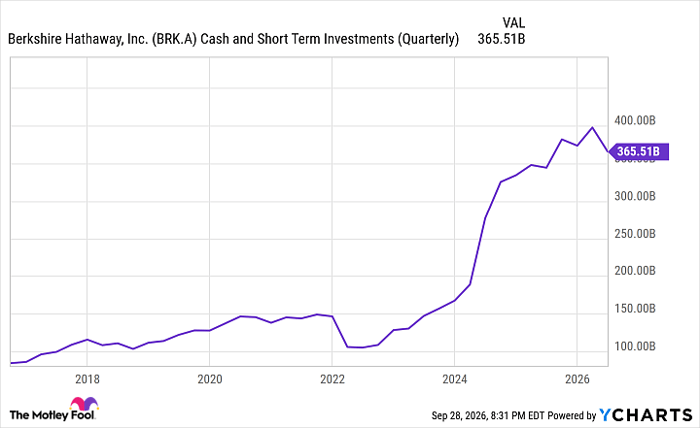
BRK.A Cash and Short Term Investments (Quarterly) data by YCharts
You're never supposed to say never, but $1,000 invested in Berkshire today won't turn into $61 million again. I could, however, see it doubling in the next seven years, with Berkshire's stock averaging at least 10% annual returns over that time.
Comparing Abel's performance to Buffett's isn't fair because the market and Berkshire's scale are very different today than they were decades ago. I've been treating Berkshire Hathaway's stock as a defensive holding lately.
Stefon Walters has positions in Visa. The Motley Fool has positions in and recommends Alphabet, Amazon, Berkshire Hathaway, Mastercard, and Visa. The Motley Fool recommends UnitedHealth Group. The Motley Fool has a disclosure policy.