
- PRICING
- LIVE QUOTES
- LEARN
- HELP


EN
Is Kobe Bussan (TSE:3038) Fully Valued After Its 16 Million Share Buyback Plan?
Kobe Bussan (TSE:3038) has put a sizeable buyback on the table, with plans to repurchase up to 16,000,000 shares for ¥40,000 million through April 2027 after issuing zero coupon convertible bonds due 2033.
Kobe Bussan’s latest buyback plan comes after a mixed run for holders. The share price is ¥3,022 with a 30 day share price return of 7.01% and a 90 day gain of 13.44%. However, the year to date share price return and 1 year total shareholder return are both down more than 20%, so recent momentum has picked up from a lower base while longer term returns remain weak.
Capitalize on Kobe Bussan's buyback theme by scanning a curated set of resilient consumer-facing businesses in our 21 resilient stocks with low risk scores.The buyback and bond issue land at an awkward intersection, where Kobe Bussan’s underlying food retail and energy operations are growing, yet long term returns are weak. Is this rerating about business value, or is it about changing sentiment around the stock?
Preferred P/E of 23.1x for Kobe Bussan: Is it justified?
Kobe Bussan trades on a P/E of 23.1x while the last close was ¥3,022. That valuation sits well above both its industry and peer averages.
The P/E ratio compares the current share price to earnings per share. For a consumer retailing group like Kobe Bussan, where investors often focus closely on profit resilience and cash generation, this measure gives a quick read on how much the market is willing to pay for each unit of earnings.
Over the past 5 years, earnings have grown by 11.3% per year, and the business reports high quality earnings. At the same time, net profit margins moved from 6% to 5.1% and earnings declined 11.5% over the most recent year. This suggests the richer valuation may be pricing in a return to the higher profit trend. The estimated Fair P/E of 17.4x is well below the current 23.1x, which points to a level the valuation could move toward if expectations cool.
Compared to the JP Consumer Retailing industry average P/E of 12.7x and a peer average of 11.5x, Kobe Bussan trades at a heavy premium. The stock is currently priced far richer than sector norms.
Explore the SWS fair ratio for Kobe Bussan.
Result: Price-to-earnings of 23.1x (OVERVALUED)
Still, Kobe Bussan’s weak 1 year and 5 year total returns, along with any setback in its food retail or energy projects, could quickly undermine the current rich P/E story.
Find out about the key risks to this Kobe Bussan narrative.
Another view on Kobe Bussan’s value
The P/E story paints Kobe Bussan as expensive, yet the SWS DCF model points the other way. With the shares at ¥3,022 and an estimated future cash flow value of ¥4,810.31, this approach frames the stock as trading at a wide discount. Which lens should carry more weight for you?
Look into how the SWS DCF model arrives at its fair value.
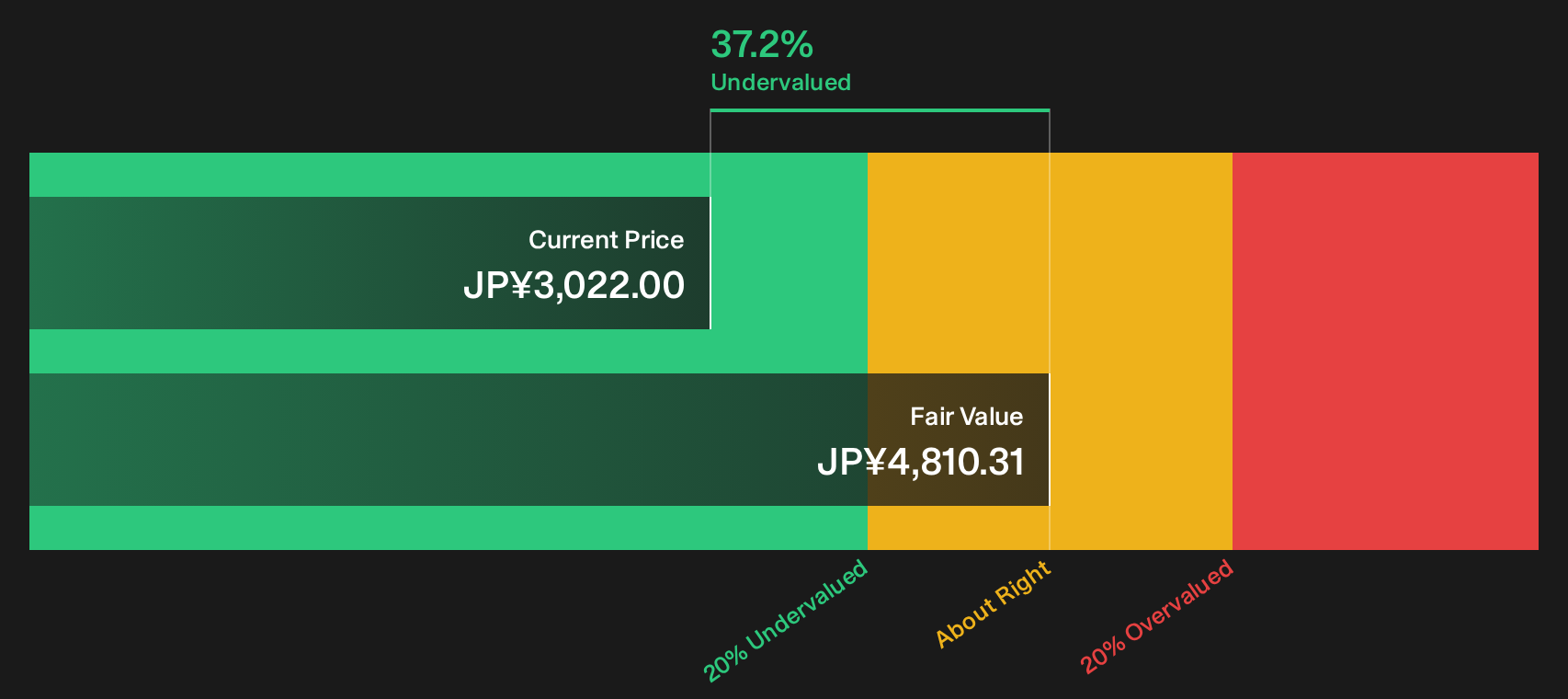
Simply Wall St performs a discounted cash flow (DCF) on every stock in the world every day (check out Kobe Bussan for example). We show the entire calculation in full. You can track the result in your watchlist or portfolio and be alerted when this changes, or use our stock screener to discover 18 high quality undervalued stocks. If you save a screener we even alert you when new companies match - so you never miss a potential opportunity.
Next Steps
Wondering how this mix of rich multiples and discounted cash flow views around Kobe Bussan really stacks up for you personally? Move quickly from reading to testing the numbers yourself, then pressure test that view against the 2 key rewards.
Looking for more Kobe Bussan style investment ideas?
If Kobe Bussan has sharpened your view on valuation and quality, do not stop here. Put that perspective to work by testing other opportunities with the Simply Wall Street Screener.
- Target strong value potential by checking companies that currently screen as 18 high quality undervalued stocks.
- Prioritise balance sheet strength and financial resilience by running a focused search through the list of solid balance sheet and fundamentals (23 results).
- Hunt for future candidates before the crowd by reviewing a hand picked pool of 76 high quality undiscovered gems.
This article by Simply Wall St is general in nature. We provide commentary based on historical data and analyst forecasts only using an unbiased methodology and our articles are not intended to be financial advice. It does not constitute a recommendation to buy or sell any stock, and does not take account of your objectives, or your financial situation. We aim to bring you long-term focused analysis driven by fundamental data. Note that our analysis may not factor in the latest price-sensitive company announcements or qualitative material. Simply Wall St has no position in any stocks mentioned.
Have feedback on this article? Concerned about the content? Get in touch with us directly. Alternatively, email editorial-team@simplywallst.com