
- PRICING
- LIVE QUOTES
- LEARN
- HELP


EN
Apple's Market Value Grew From $350 Billion to $4.75 Trillion During Tim Cook's 15 Years as CEO. Here's What That Growth Curve Means for Betting on Apple's Next Chapter Under John Ternus.
Key Points
Tim Cook grew Apple through a combination of operational excellence, successful new products, and help from the market.
It'll be much more difficult for Apple to keep growing from here, but investors have been saying that for years.
Tim Cook took over as full-time CEO of Apple (NASDAQ: AAPL) from Steve Jobs on Aug. 24, 2011, when it had a market cap of about $350 billion. He spent 15 years in charge of Apple, expanding the production and sales of Apple's top products and turning the company into a massive cash-generating machine.
John Ternus took over for Cook at the start of September, inheriting a company worth $4.75 trillion. Many thought building on a $350 billion business was a tall order for Cook at the time. Can Ternus repeat history and take the near-$5 trillion Apple to even higher highs?
Missed Nvidia in 2009? This Rare Signal Is Flashing Again. In 2009, a "Double Down" signal flashed for a little-known chipmaker called Nvidia. For the first time in years, that same "Total Conviction" signal is flashing for a company 1/100th the size of Nvidia. Continue »
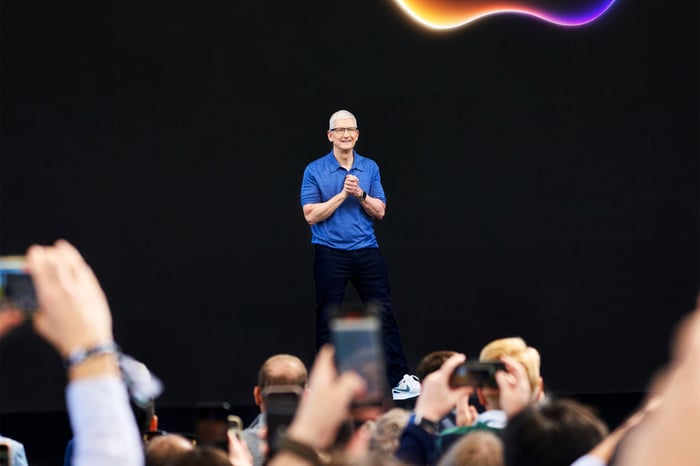
Former Apple CEO Tim Cook. Image source: Apple.
The law of large numbers
The law of large numbers states that as a company grows, its growth rate must slow. To grow a business generating $1 billion in annual revenue by 20% takes just $200 million in incremental sales. But growing a business generating $100 billion in revenue by 20% requires $20 billion in additional sales.
Naysayers have been arguing that Apple must fall prey to the law of large numbers since Tim Cook took over as CEO. A 2012 article in the New York Times argued that if Apple's value increased "just" 20% per year, it would reach a market cap of $3 trillion by 2022. That ridiculously huge number is "bigger than the 2011 gross domestic product of France or Brazil." In fact, Apple's market cap reached $3 trillion at the start of 2022. It's since touched $5 trillion.
That was the result of a few things.
First, Tim Cook led a massive expansion of Apple's iPhone sales, boosted sales of its other product lines, and introduced the new wearable segment, including Apple Watch and AirPods. He also developed the high-margin services segment into a massive money maker. The result was that revenue climbed from $108 billion in 2011 to $467 billion over the last four quarters, and net income climbed from $26 billion to $129 billion.
Second, Cook initiated record-sized share repurchases. As a result, Apple's share count declined 44% since he took over as CEO. Combined with the fantastic earnings growth, earnings per share climbed nearly 600% under his watch.
Cook also got some help from the market. As he proved capable of growing Apple even larger than the behemoth it was when he took over, the earnings multiple assigned to the stock expanded from about 11 times earnings to 37 times forward earnings expectations.
Ternus takes over a much larger tech company with a much higher earnings multiple. For Apple to keep growing at the pace it did under Cook, it would have to accelerate earnings growth and maintain a high earnings multiple. That will likely require a new ultra-successful product line (possibly artificial intelligence services or augmented reality hardware) and excellent operations management. Ternus, with his engineering background, could be up for the task, but the law of large numbers might finally catch up with Apple, and slower stock price appreciation could be ahead.
Adam Levy has positions in Apple. The Motley Fool has positions in and recommends Apple. The Motley Fool has a disclosure policy.