
- PRICING
- LIVE QUOTES
- LEARN
- HELP


EN
3 European Industrial Decarbonisation Stocks Investors Are Watching As Carbon Costs Rise
Europe is tightening the screws on industrial emissions, and the EU Emissions Trading System is turning carbon from a side cost into a central line item. That shift is already changing how capital is spent, where factories are built, and which decarbonisation enablers investors pay attention to. This article walks through three stocks tied to that policy shock, showing where the pressure might create opportunity and where it could expose hidden risk.
The stocks in this piece are only a sample, and the full screen surfaced 28 more European industrial decarbonisation enablers with similarly detailed stories that are not covered here. To go straight to the source to identify, compare, and analyze those opportunities, head into the European Industrial Decarbonisation Enablers screener.
Schneider Electric (ENXTPA:SU)
Overview: Schneider Electric is a global energy management and industrial automation group that helps factories, buildings, and infrastructure electrify and run more efficiently to cut energy use and emissions.
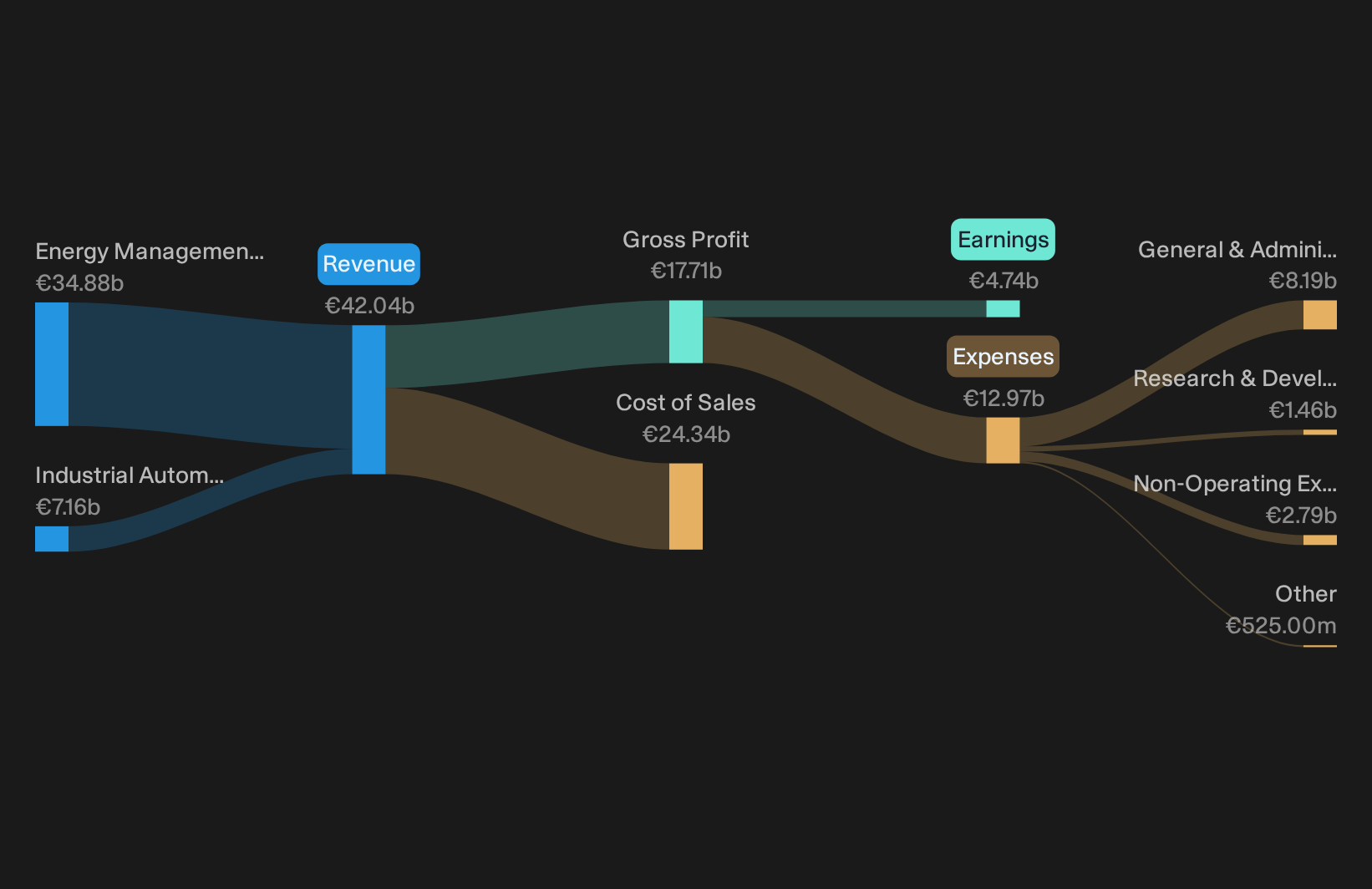
Operations: The business generates about €34.9b from Energy Management solutions and €7.2b from Industrial Automation, pointing to a primarily electrification focused revenue mix.
Market Cap: €166.6b
Schneider Electric sits right in the sweet spot of this screener, selling the electrification and automation hardware and software heavy emitters now need to keep EU carbon costs in check.
"The accelerating global shift towards electrification, renewable energy, and energy efficiency, supported by both corporate and government sustainability initiatives, continues to expand Schneider's addressable market and supports steady long-term revenue growth, particularly in energy management and grid modernization."
What happens to that promise for cleaner grids and factories if a single unseen pressure on profitability tightens more than expected.
If that pressure on profitability is what you are weighing, the full narrative for Schneider Electric shows how Schneider Electric could still accelerate as carbon costs bite harder.
Technip Energies (ENXTPA:TE)
Overview: Technip Energies designs and delivers process plants and technologies that help heavy industry cut emissions, including carbon capture, low carbon hydrogen and cleaner petrochemical facilities.
Operations: The group earns about €5.7b from Project Delivery and €1.7b from Technology, Products and Services, largely serving clients in Africa and the Middle East, the Americas and Europe.
Market Cap: €5.0b
Technip Energies matters for this decarbonisation screen because it sells the engineering, process technology and project skills heavy emitters now need when EU carbon costs start to bite harder.
"Significant recent growth in decarbonization-related orders (now nearly 40% of total intake and over €5 billion in the last 18 months), combined with global net-zero commitments and increasing government incentives for clean energy infrastructure (like CCUS and blue hydrogen), indicates substantial forward demand that should support backlog expansion and sustained top-line revenue growth."
What that growing pipeline really means for Technip Energies' future margins and earnings depends on how one crucial project mix tension plays out.
That project mix question is exactly what the full narrative for Technip Energies unpacks, showing where Technip Energies’ decarbonisation backlog could accelerate earnings or quietly compress returns.

Alfa Laval (OM:ALFA)
Overview: Alfa Laval supplies heat transfer, separation, and fluid handling equipment that helps industrial customers cut energy use and emissions in complex processes.
Operations: Alfa Laval earns about SEK23.3b from Ocean, SEK22.0b from Energy, and SEK24.8b from Food & Pharma, with smaller segment adjustments.
Market Cap: SEK233.1b
Alfa Laval fits this decarbonisation screen because its heat exchangers and process equipment sit inside the energy hungry parts of factories where EU ETS costs are rising fastest. This turns efficiency gains and heat recovery into line items that matter for profitability.
"Alfa Laval is well positioned to benefit from the growing global need for energy efficiency and decarbonization solutions, with expanding order books in segments like heat exchangers, electrolyzers, heat pumps, and marine environmental equipment."
What that opportunity means for future returns depends on how one developing pocket of energy transition project demand ultimately feeds through to margins.
That margin story is where the full narrative for Alfa Laval really goes to work, unpacking how Alfa Laval’s transition projects could accelerate earnings rather than just soak up capital.

Curious About What You Might Be Missing?
Fresh ideas move first. Once momentum hits, entries get messy and the easy upside gets caught by faster hands. Scan these under the radar lists while it matters and get in early.
- Spot cash generative compounders before the crowd by running the 197 high quality undervalued stocks that couples sturdy balance sheets with valuations that have not yet caught up.
- Ride the automation breakout by tracking the 93 robotics and automation stocks packed with industrials wiring factories, warehouses and logistics into higher productivity while attention is still elsewhere.
- Position ahead of the grid upgrade wave through the 39 power grid technology and infrastructure stocks focused on equipment makers and infrastructure players tied to modernising electricity networks.
This article by Simply Wall St is general in nature. We provide commentary based on historical data and analyst forecasts only using an unbiased methodology and our articles are not intended to be financial advice. It does not constitute a recommendation to buy or sell any stock, and does not take account of your objectives, or your financial situation. We aim to bring you long-term focused analysis driven by fundamental data. Note that our analysis may not factor in the latest price-sensitive company announcements or qualitative material. Simply Wall St has no position in any stocks mentioned.
Have feedback on this article? Concerned about the content? Get in touch with us directly. Alternatively, email editorial-team@simplywallst.com