
- PRICING
- LIVE QUOTES
- LEARN
- HELP


EN
At a time when FSD experienced transition and Optimus Prime sprint was mass-produced, it was protected by a backup credit of 30 billion US dollars! Tesla (TSLA.US) accelerates Musk's “physical AI supermap”
The Zhitong Finance App learned that US artificial intelligence, humanoid robots, autonomous driving technology and electric vehicle manufacturing giant Tesla (TSLA.US) announced that it has implemented new loan and credit line arrangements totaling US$30 billion while increasing the scale of investment in artificial intelligence and humanoid robot-related technology updates, iteration and manufacturing mass production processes, which is expected to strongly support the “physical AI superplan” led by the company's CEO Musk for a long time in the future.
Tesla, under Musk's leadership, is allocating funding in advance for a long-term investment in the expansion from automobile manufacturing to “physical AI”: the company has implemented new loans and credit lines totaling US$30 billion to promote FSD (fully autonomous driving software platform), Cybercab fully driverless taxis (i.e. Robotaxi), and Optimus humanoid robots (or “Optimus” humanoid robots) while providing backup financing resources for AI computing power infrastructure, mass production lines for Robotaxi and humanoid robots, and operating fleets.
However, it is worth noting that none of these amounts have yet been withdrawn, and the company has no plans to use them in 2026; after replacing the original $5 billion limit, the usable borrowing capacity will increase by a net of 25 billion US dollars. Therefore, this arrangement reflects the financial reserves needed to expand investment and cannot be directly equivalent to an immediate increase of 30 billion US dollars in actual debt. At the time of disclosure of the announcement, Tesla had not used any of the above financing amounts, and currently has no plans to withdraw funds in 2026.
Tesla, under Musk's leadership, is simultaneously advancing FSD technology upgrades, European FSD and RoboTaxi official regulatory approval and adoption, and breakthrough car software monetization, and Cybercab fully driverless taxis (that is, Robotaxi) and humanoid robots to accelerate the launch of Musk's “physical AI supermap” to draw up Tesla's growth prospects.
According to Nvidia CEO Hwang In-hoon's opinion, “physical AI” (physical AI) emphasizes that autonomous robotics/car operating systems can sense, reason, and complete a complete set of actions in the real world, and an era where “physical AI” assists the evolution of human civilization is coming soon. “Physical AI” emphasizes enabling robotics/autonomous systems to sense, reason, and complete a complete set of actions in the real world, and these three types of capabilities are the key AI tool chain to advance the AI language model from “only dialogue” to “can work in the physical world.”
Accelerate expansion, advance financing: As spending increases, Tesla implements a $30 billion loan arrangement
As the electric vehicle manufacturer increases its investment in artificial intelligence and robotics, Tesla has implemented new loan and credit line arrangements totaling $30 billion.
The company said it has signed three credit agreements, including a $20 billion term loan with deferred withdrawals, a $8 billion credit line for five years, and a $2 billion credit line for one year. The company stated in an application document that it currently does not plan to use any of the above financing amounts this year.
These financing arrangements replaced a previous $5 billion credit line scheduled to expire in January 2028. Citigroup acted as the administrative agent for the new deferred withdrawal term loan, and Wells Fargo acted as the administrative agent for the above credit lines.
Tesla is drastically increasing capital expenditure to advance CEO Elon Musk's plans to transform the electric car maker into a leader in humanoid robots and artificial intelligence. The company plans to invest more than $25 billion this year to expand the factory business and its Cybercab driverless taxi fleet, and plans to invest more in the future.
“We should spend capital as quickly as possible — invest capital as quickly as possible without causing too much waste,” Tesla CEO Musk said on the company's July earnings call at the time.
Tesla lengthens funding runway for “physical AI” Hongtu
As described above, Tesla is allocating funds in advance for a long-term investment in large-scale expansion from automobile manufacturing to a “physical AI superplan.”
Behind capital preparation, the pressure between capital expenditure and commercial repayment is showing. Tesla expects capital expenditure to exceed US$25 billion in 2026; by the end of June, the company held about US$43.52 billion in cash, cash equivalents and short-term investments, but operating cash flow for the first half of the year was US$8.634 billion. After deducting US$8.282 billion in capital expenditure, only US$352 million remained in free cash flow. The company still has considerable liquidity reserves; however, the expansion of AI and robotics is increasing the requirements for the ability to continuously supply capital.
Looking at engineering and business models, this round of investment aims to establish a system that runs through real-world data collection, model training, end-side reasoning, hardware manufacturing, and continuous operation. Automobiles and robots collect complex scene data, data center training models, and vehicle and robot chips perform sensing and control in real time, and then improve the system through actual operation feedback. Tesla revealed that in the first half of the year, on-site computing power in Texas had more than doubled in terms of megawatts, and Cortex 2 simultaneously served the autonomous development of cars and humanoid robots. The potential return also extends from one-time hardware sales to FSD paid services, driverless travel revenue, and the economic value created by robots replacing some manual tasks.
Wall Street financial giant Morgan Stanley's latest research report can be described as providing a concrete and optimistic sample of the FSD experience improvement and Tesla's RoboTaxi mass production plans and determination: Adam Jonas, a well-known analyst from Morgan Stanley, has used the FSD for the past 12 months to drive 2,713 miles, accounting for 33% of the car's annual mileage; in his recent personal trips, the system completed an estimated 98% — 99% of the mileage, and completed a 28-mile round trip without human intervention.
However, Dama analysts also said that the time ranges for these two groups of ratios are different from the statistical caliber and cannot be combined into “close to complete driverless driving throughout the year.” Personal experience can reinforce commercial expectations, but it is not enough to prove that the autonomous driving problem has been fully solved; Tesla officials still clearly require that the FSD supervised version must be continuously and intensively supervised and used by the driver.
The commercialization process of the FSD software platform driven by Tesla's exclusive AI supercomputing system is progressing, while showing clear regional and product differences. On September 29, the FSD supervised version was approved by Croatia, but the EU-wide approval vote has been postponed, and the next possible decision is no earlier than December. Cybercab began providing ride-hailing services to the public in parts of Austin on September 3; as of the evening of September 2, Texas records showed that Tesla had registered 45 Cybercabs. For investors, the next stage of more meaningful verification is the continued expansion of operating areas, actual mileage paid, and vehicle utilization, and whether revenue per mile can cover depreciation, insurance, maintenance, and operational support costs.
Optimus's latest mass production plan and technology update iteration process require a distinction between production line construction, initial production, and mature commercial mass production. According to quarterly materials released by Tesla in July, Fremont is installing the first-generation Optimus humanoid robot production line, which is expected to be put into production within the year, and mass production is expected soon thereafter. The first batch of robots will be used for internal training data collection and function development; the Optimus projects in California and Texas were both listed as under construction at the time. The latest developments in these humanoid robots all mean that Tesla has actually invested in mass production preparations, but large-scale foreign sales and profits have yet to be verified. From a specific engineering perspective, Tesla's unique accumulation of super autonomous driving technology can provide robots with visual learning, computing platforms, and manufacturing experience, but dexterous operation, contact control, task generalization, and long-term reliability still need separate breakthroughs.
Wall Street analysts are now betting that humanoid robots will move from small-scale trials to large-scale delivery in the next few years, and that industrial and commercial scenarios will take the lead in meeting demand. The Bank of America predicts that global annual shipments of humanoid robots will increase from about 90,000 units in 2026 to 1.2 million units in 2030 and 10 million units in 2035; Goldman Sachs's latest forecast shows that global annual shipments may be about 6.48 million units in 2035, indicating that institutions are generally optimistic about the long-term expansion of the humanoid robot market.
These also actively constitute Tesla's most notable “physical AI cash out time difference” — capital is invested first, commercial capacity is gradually formed, and cash returns are later realized. Backup credit can help span this period, but whether the valuation can move up depends on whether the probability of successful commercialization and future returns improve at the same time. According to the latest target price and valuation split from the Damo analyst team, of the $400 target price given by the agency — significantly higher than the latest closing price of $352.84, the core automobile business contributed $45, and network services, mobility, and humanoid robots contributed a total of $320, accounting for 80%; these are valuation contributions based on long-term assumptions, and are not the current profit structure. While affirming the FSD experience, Damo still maintains a “neutral” rating, which just shows that technological optimism and stock pricing need to be judged separately.
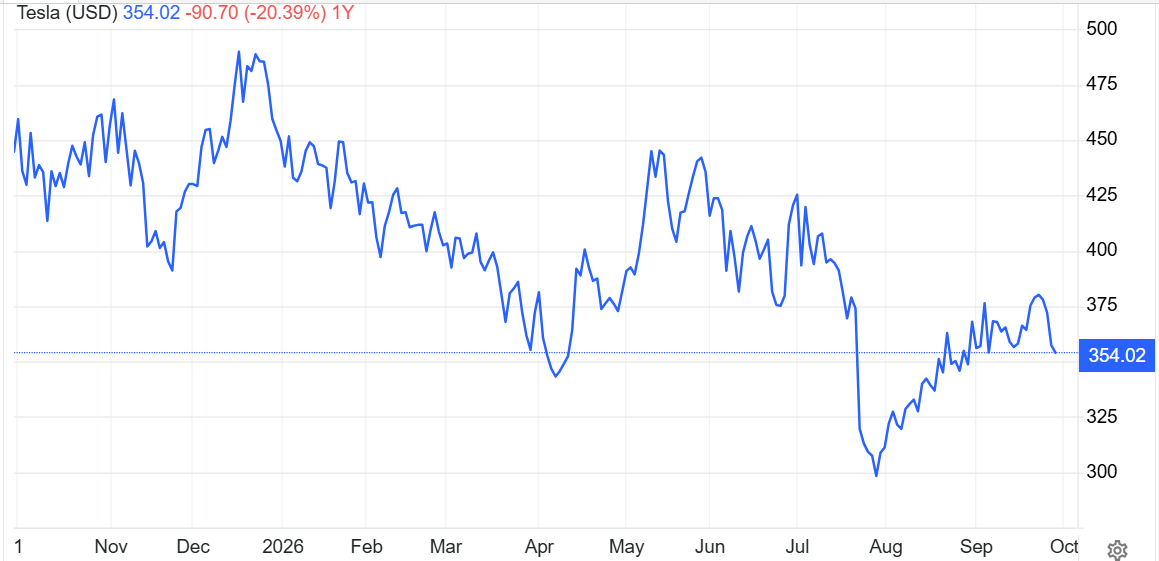
As technology advances and capital consumption accelerates simultaneously, the market will pay more attention to whether the company can survive the investment phase before large-scale profits. Financing can undoubtedly enhance expansion capacity, but the new round of revaluation of Tesla's basic outlook and stock price still depends on how fast FSD, Robotaxi, and robots turn investment into return.
The latest financing related to this $30 billion loan arrangement has more direct significance for Tesla's stock price and basic outlook, and is undoubtedly a significant increase in financial endurance. Short-term stock prices may still be constrained by cash flow consumption and high valuations. Continued increases require continuous implementation of paid use, operational efficiency, and robot delivery — in other words, if increased investment is accompanied by accelerated commercialization, financing can support new growth; if capital expenditure continues to increase and repayment time continues to lag, the market may drastically lower the valuation of forward businesses. The “bull market engine” that is really worth tracking is the efficiency of converting new capital into sustainable profits.