
- PRICING
- LIVE QUOTES
- LEARN
- HELP


EN
How I Traded the QQQ ETF for a 20X Gain – and What It Taught Me About Managing Risk
On Thursday, Sept. 17, 2026, as momentum indicators flashed a short-term oversold condition, I placed a simple tactical trade using short-dated out-of-the-money call options. I bought 5 contracts of the QQQ 09/22/2026 $730 strike price call options at an average price of $0.456 per contract.
My total capital risk was just $231, the limit I was willing to put on what was essentially a lottery ticket trade. It is key that I never risk anything more than I’m willing to lose, since losing it all is possible, especially with near-term options trades.
Using this trade as an example, I could have instead bought 500 shares of the Invesco QQQ ETF (QQQ).
That would cost a tidy sum of $365,000! I afforded myself the opportunity to control that much stock (500 shares of QQQ), but with a worse-case outcome of losing $231.

Just three trading days later, on Monday, Sept. 21, following a sharp surge in mega-cap technology stocks, I saw that my little trade had surged in value to $4,662. About three seconds later, I hit SELL. I sold those 5 QQQ call option contracts at $9.332 per contract. 20x, done.
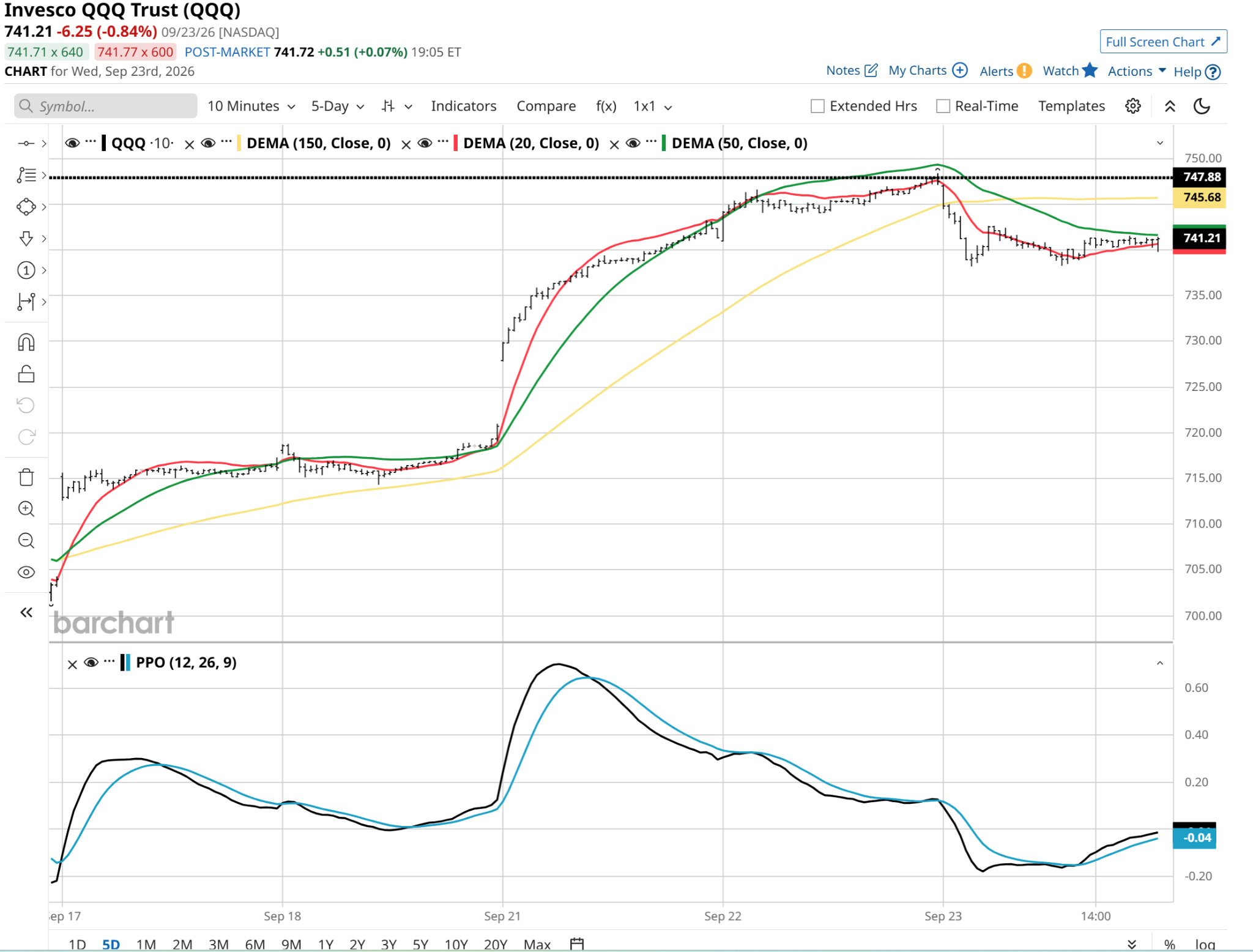
Now, the investment lesson in all of this is that the ONLY WAY THIS HAPPENS is if the rest of my portfolio is very defensively positioned. You can’t talk out of both sides of your mouth in this business. I’m about “avoiding big losses.” And that is not limited to hedging my equity or bond portfolio positions.
It includes “taking big shots with small amounts of money.” My portfolio was close to being “offsides” in that I was starting to profit on down stock market days and losing on up days. That happens from time to time, given my investing style.
However, investing is a “serial learning” experience. And so this time around, while I continue to believe the more likely stock market path is down, that actually made it a great time for a “counter position” like my 20x swing trade. In very small size, and in a way that if QQQ had dropped 5%, instead of losing 5% of $365,000 ($18,250), I lost 100% of $231.
The concept is simple: Take big shots to add value to your portfolio using smaller amounts of capital.
In the all-weather portfolio I run for subscribers using my own live portfolio as the example, I typically have anywhere from one to a few of these lottery-ticket trades within the broader stock and ETF mix. I also will do the “toes in the water” thing with 1% stock positions.
I have written ad nauseum that WHAT we choose to buy and sell is at most half the battle in successful investing. HOW MUCH we own of a security is often what determines portfolio performance over time.
Call it position-sizing, risk management, a lottery ticket, or just dumb luck from a blind squirrel. The point of highlighting a 20x trade isn’t to brag about catching a short-term move. It is to demonstrate the power of managing a portfolio, a step-by-step process, instead of simply “picking stuff I think will go up.”
Rob Isbitts is a semi-retired CIO, former fiduciary investment advisor, and Barchart columnist. Check out his other work at ETFYourself.com (featuring the Fresh Charts weekly trading post), and ROAR.PiTrade.com, helping investors to better-manage their own portfolios.
On the date of publication, Rob Isbitts did not have (either directly or indirectly) positions in any of the securities mentioned in this article. All information and data in this article is solely for informational purposes. For more information please view the Barchart Disclosure Policy here.