
- PRICING
- LIVE QUOTES
- LEARN
- HELP


EN
Does New AI Laptops Change The Bull Case For HP (HPQ)?
- HP Inc. recently announced two AI focused laptops: the HP Googlebook 14, built around Google Gemini and Snapdragon X Elite, and the ZBook Ultra G3a mobile workstation, designed to run large local AI models with high unified memory capacity.
- These PCs push more AI workloads directly onto HP hardware, which could influence device mix, cost structure, and demand for higher specification systems across its portfolio.
- The next section will examine how HP's investment narrative could be affected by this push into AI centric local computing.
HP Investment Narrative Recap
To own HP, you need to believe its PC centric model can offset structural pressure in printing and a slow revenue growth profile. The near term story is about mix. Management is leaning into higher spec AI PCs and premium notebooks, which can support pricing and margins if demand holds up and competitors do not trigger another round of discount driven share grabs.
The key risk is that these AI focused launches fail to offset ongoing print headwinds and intense hardware competition, leaving earnings growth closer to flat than forecast. High debt and negative equity add sensitivity. If pricing pressure returns or the AI PC refresh cools quickly, HP's margin ambitions come under strain.
The ZBook Ultra G3a looks most relevant for the current catalyst. It targets professionals who want to run large local AI workloads, which fits directly into HP's push toward AI PCs and already represents a sizeable share of its mix. Interest here ties into the wider theme of on device compute, higher average selling prices, and potentially richer service bundles around workstation fleets.
For investors, the question is whether HP can execute at scale on this kind of AI centric workstation without eroding profitability through higher component costs or discounting. The device supports demanding workloads and aims to reduce customer cloud usage, which can matter for enterprise buyers. It also raises expectations for HP's support, software partnerships and the long term reliability of this higher end line.
HP Earnings and Revenue Assumptions Behind the AI PC Push
HP's AI centric PC story is being layered on top of analyst expectations that revenue stays broadly flat over the next three years, with profit margins edging from 4.4% today to 4.6% by 2029. Consensus points to earnings of US$2.7b by 2029 compared with US$2.6b today, which is an increase of about US$0.1b, and sits inside a wide range of US$2.3b to US$3.2b across the analyst set. Forecasts assume HP is valued on a P/E of 9.8x those 2029 earnings, down from 10.2x today, and that the share count gradually shrinks by roughly 2.16% each year.
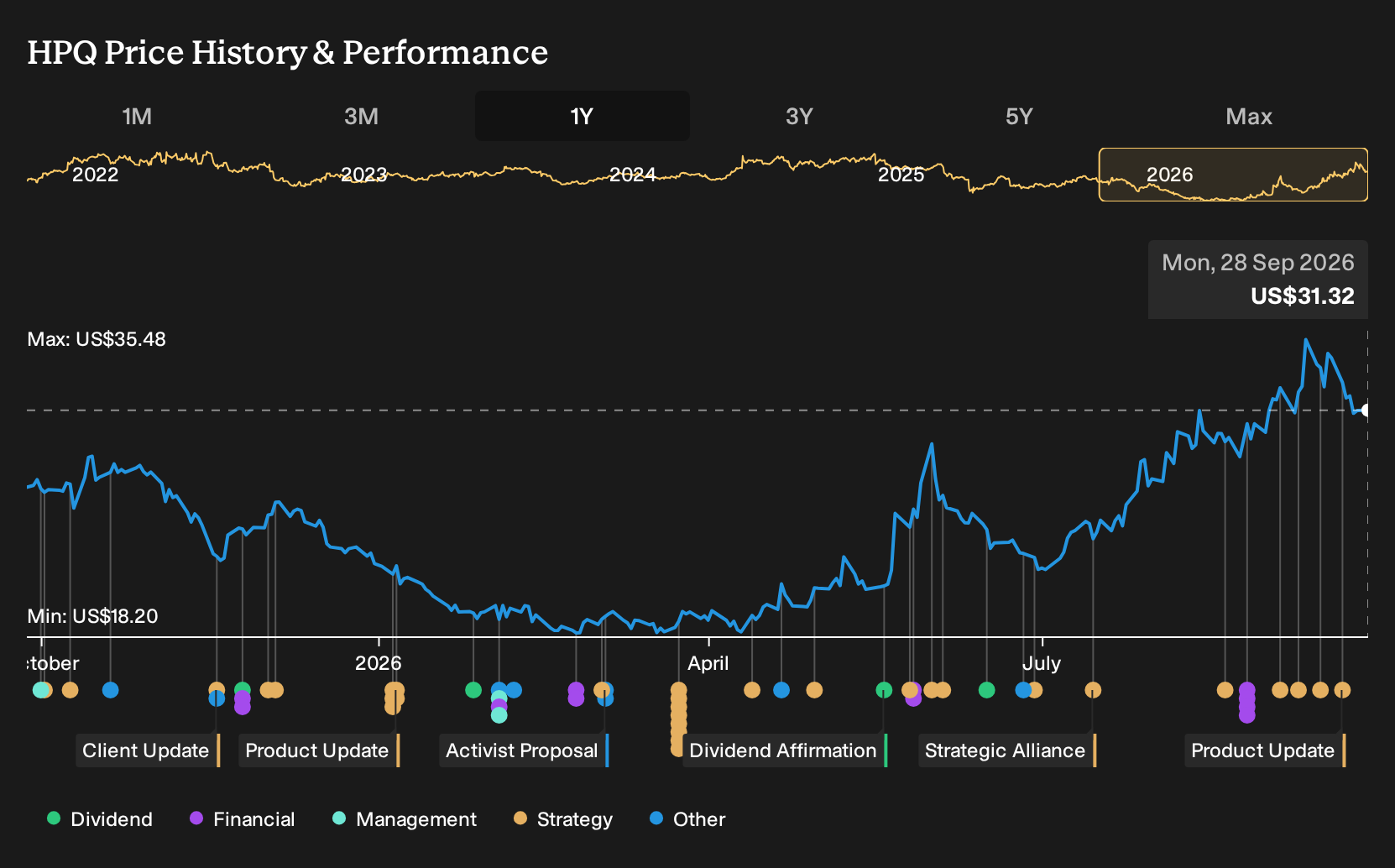
On the valuation side, analysts are effectively tying the AI PC thesis, including devices like the ZBook Ultra G3a, into a broader model that assumes 2029 revenue of US$58.3b and earnings of US$2.7b. That view sits behind a consensus price target of US$23.41, with individual targets stretching from US$17.00 up to US$32.00. This implies the market is currently pricing HP at richer levels than this scenario, given the recent share price of US$28.58. For anyone assessing the HP story as an AI hardware play, the key interpretive step is whether those relatively modest margin gains and steady top line can coexist with the higher component load and potential pricing pressure that often come with more powerful, AI ready devices.
HP's narrative projects US$58.3b revenue and US$2.7b earnings by 2029. Analysts are assuming fairly flat yearly revenue growth, and that would mean an earnings increase of about US$0.1b from US$2.6b today.
Uncover why HP's fair value indicates a 25% potential downside to its current price, leaving little room for error.
Exploring Other Perspectives
You can interpret the new HP AI laptops as a potential catalyst, yet the most bearish analysts were already outlining a different story. They were assuming revenue drifts to about US$56.0b by 2029 with earnings near US$2.7b. That view supports a US$19.0 fair value and suggests a much tougher margin path. Those forecasts were all set before this AI hardware push, so treat them as one possible scenario and consider how this news might influence the range of opinions.
Explore 6 other HP fair value estimates, including one that suggests as much as 39% downside from the current price!
The Verdict Is Yours
Disagree with existing narratives? Extraordinary investment returns rarely come from following the herd, so consider relying on your own analysis.
- A great starting point for your HP research is our analysis highlighting 4 key rewards and 2 important warning signs that could impact your investment decision.
- See our latest analysis for HP. The report includes a comprehensive fundamental analysis summarized in a single visual, the Snowflake, making it easy to evaluate HP's overall financial health at a glance.
Looking For More Ideas Beyond HP?
If the HP story leaves you wanting a broader watchlist, it can help to scan other companies that fit clear, fundamentals based filters. The Simply Wall St Screener lets you quickly sort through markets by quality, risk profile, and income potential so you can line up a few next candidates to research in depth.
- For investors hunting for future standouts before they gain wider attention, start with a focused set of 16 high quality undiscovered gems that already show strong fundamental traits.
- If capital preservation and steadier profiles matter most to you, narrow the field to a curated group of 30 resilient stocks with low risk scores that score well on resilience.
- Income focused readers who care about both yield and durability can zero in on our hand picked 6 dividend fortresses that aim to pair higher payouts with solid underlying businesses.
This article by Simply Wall St is general in nature. We provide commentary based on historical data and analyst forecasts only using an unbiased methodology and our articles are not intended to be financial advice. It does not constitute a recommendation to buy or sell any stock, and does not take account of your objectives, or your financial situation. We aim to bring you long-term focused analysis driven by fundamental data. Note that our analysis may not factor in the latest price-sensitive company announcements or qualitative material. Simply Wall St has no position in any stocks mentioned.
Have feedback on this article? Concerned about the content? Get in touch with us directly. Alternatively, email editorial-team@simplywallst.com