
- PRICING
- LIVE QUOTES
- LEARN
- HELP


EN
FuelCell Energy Stock In Focus As Securities Lawsuits Allege Misleading Disclosures
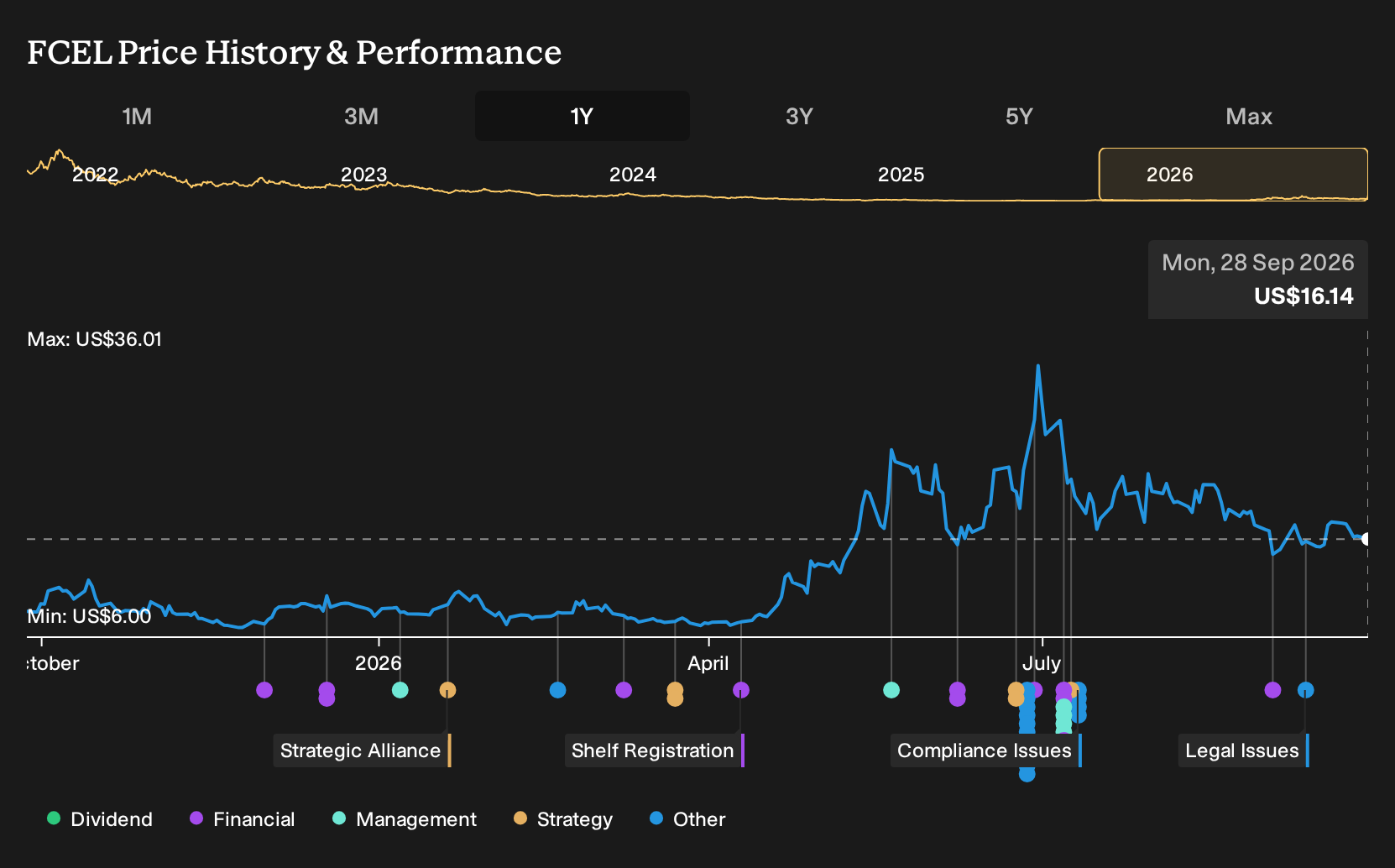
- Earlier this month, FuelCell Energy disclosed multiple federal securities class action lawsuits alleging false and misleading statements about manufacturing capacity, production rates, costs, and financial risks tied to its CEPA with Fit Energy.
- The lawsuits put a spotlight on how FuelCell Energy measures, reports, and manages real world production and contract risk, which directly affects execution on large clean energy partnerships.
- We will now examine how FuelCell Energy’s investment narrative could be affected by the alleged misstatements around manufacturing capacity and CEPA risk disclosure.
FuelCell Energy Investment Narrative Recap
For FuelCell Energy, you need to be comfortable with a story built on scaling fuel cell and electrolyzer platforms while the business is still loss making. The recent lawsuits go straight to that execution question, because they challenge how manufacturing capacity and contract risk have been described. If the alleged issues are isolated to disclosure rather than operations, the long term build out thesis stays intact.
In the near term, the key swing factor is whether management can keep projects and cost reduction plans on track while dealing with litigation and already heavy losses, including a reported US$29.1 million net loss in Q1 2025. The biggest immediate risk is that any operational or financing friction from the CEPA disputes slows commercialization, which would pressure already stretched funding and delay expected scaling benefits.
The KeyBanc Energy Transition Symposium appearance on 17 September 2026 sits directly alongside this controversy. Investors will likely care less about marketing language and more about whether FuelCell Energy offers clearer detail on production throughput, cost trajectories, and CEPA related exposure during that session.
If management uses that forum to quantify factory run rates, unit economics, and contract structures across data center, carbon capture, and hydrogen projects, it could help you judge the real catalysts. You get a better lens on whether forecast revenue growth and cost reductions look operationally achievable, or whether the lawsuits highlight deeper execution and disclosure risks that could weigh on the outlook.
What The Forecasts Assume For FuelCell Energy
FuelCell Energy's narrative projects US$690.6 million in revenue and US$77.6 million in earnings by 2029. This rests on analysts baking in 64.9% yearly revenue growth and an earnings swing of about US$256 million, from a current loss of US$178.3 million to the forecast profit level.
Uncover why FuelCell Energy's fair value indicates a 27% potential upside to its current price that may not last much longer.
Exploring Other Perspectives
You see a very different story if you focus on competition risk. The most pessimistic analysts already expected slower progress, with revenue only reaching about US$324.0 million and earnings of roughly US$36.2 million by 2029. Those views were set before the lawsuits and conference, so you should expect opinions to move as new information lands.
Explore 5 other FuelCell Energy fair value estimates, including one that suggests as much as 50% downside from the current price.
Form Your Own Verdict
Don't just follow the ticker. Dig into the data and build a conviction that's truly your own.
- A great starting point for your FuelCell Energy research is our analysis highlighting 1 key reward and 3 important warning signs that could impact your investment decision.
- See our latest analysis for FuelCell Energy. The report includes a comprehensive fundamental analysis summarized in a single visual, the Snowflake, making it easy to evaluate FuelCell Energy's overall financial health at a glance.
Looking For More Ideas Beyond FuelCell Energy?
If the FuelCell Energy story feels high risk for your taste, it can help to line it up against other opportunities with different balance sheet strength, income profiles, or valuation angles. The Simply Wall St Screener lets you scan wider across the market and spot businesses that better match your tolerance for volatility, capital structure, and dividends.
- For readers who care most about resilient financial foundations, start with a list of solid balance sheet and fundamentals (25 results) that can help you focus on companies with sturdier capital positions and cleaner funding profiles.
- If you want potential mispricings instead, cast a wider net across 32 high quality undervalued stocks that may trade below what their cash flows and fundamentals imply.
- Income focused investors can concentrate on cash return potential by reviewing 6 dividend fortresses that combine higher yields with a focus on sustainability.
This article by Simply Wall St is general in nature. We provide commentary based on historical data and analyst forecasts only using an unbiased methodology and our articles are not intended to be financial advice. It does not constitute a recommendation to buy or sell any stock, and does not take account of your objectives, or your financial situation. We aim to bring you long-term focused analysis driven by fundamental data. Note that our analysis may not factor in the latest price-sensitive company announcements or qualitative material. Simply Wall St has no position in any stocks mentioned.
Have feedback on this article? Concerned about the content? Get in touch with us directly. Alternatively, email editorial-team@simplywallst.com