
- PRICING
- LIVE QUOTES
- LEARN
- HELP


EN
Why You Should Stay on the Sidelines for Now With Palo Alto Networks Stock
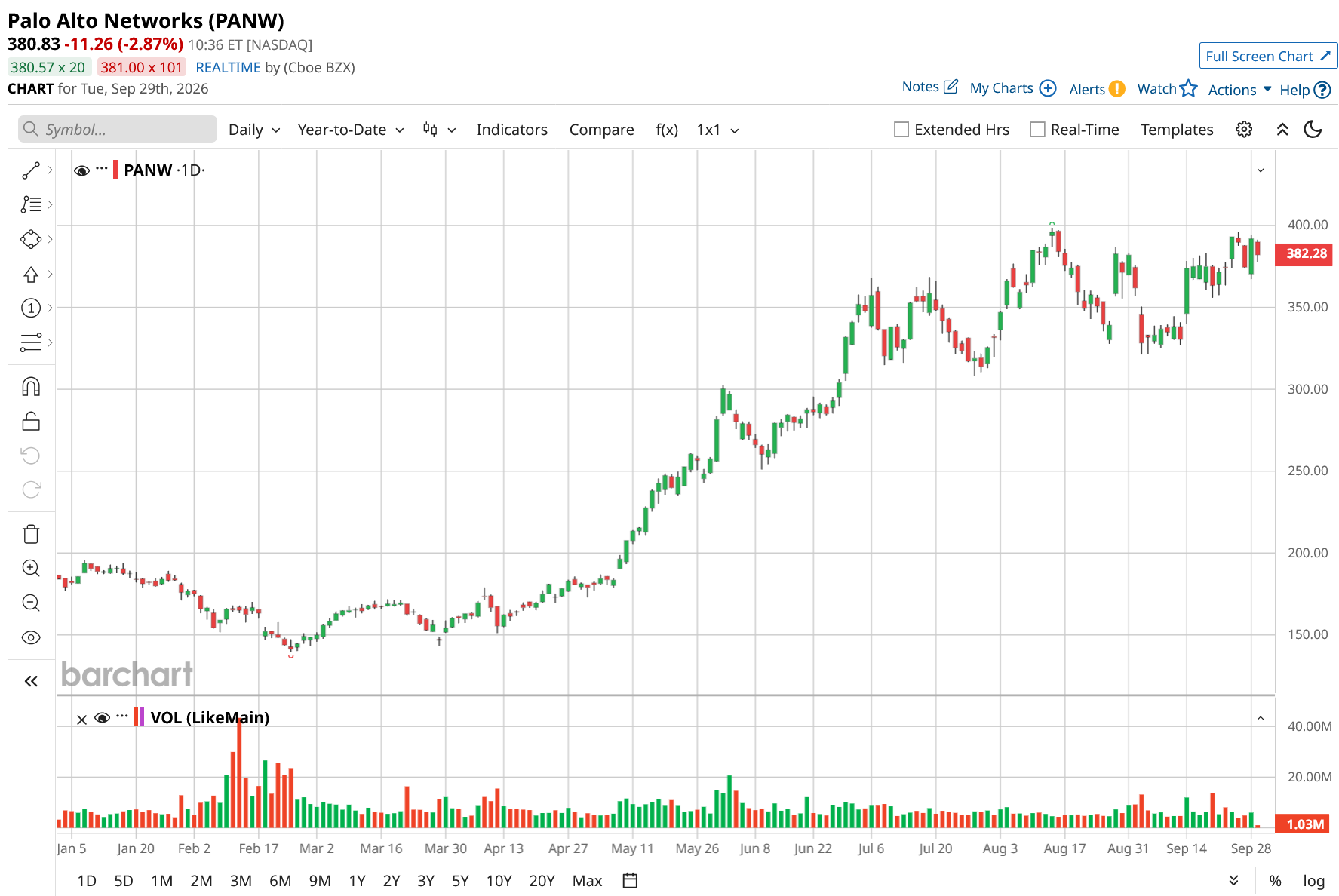
Shares of Palo Alto Networks (PANW) have more than doubled in 2026, driven largely by two key factors, including its platformization strategy and the rising demand for cybersecurity solutions driven by artificial intelligence (AI).
Palo Alto Networks’ platformization strategy brings a broad range of cybersecurity products and services together under an integrated offering. By consolidating security capabilities onto a unified platform, the company can deepen relationships with existing customers while capturing a larger share of their cybersecurity spending.
Meanwhile, the rapid adoption of AI models, autonomous agents, and AI-enabled applications is expanding the cybersecurity attack surface. As organizations deploy more AI systems, they must secure increasing volumes of data, digital identities, access permissions, and interconnected systems. This is creating additional demand for cybersecurity products and services.
The shift toward integrated security platforms is also accelerating, as organizations increasingly favor vendors that can address a broader range of security needs through a unified platform. Palo Alto Networks is well positioned to benefit from this industry-wide consolidation.
While Palo Alto’s growth trajectory and long-term prospects remain compelling, its valuation remains elevated, implying caution.
Delivering Strong Strong Growth
Palo Alto Networks enters fiscal 2027 with strong operating momentum, supported by rising cybersecurity demand, its platformization strategy, and contributions from recent acquisitions. The company’s fiscal 2026 performance indicates that customers are increasingly consolidating security requirements onto integrated platforms, while rapid AI adoption is creating additional demand for advanced cybersecurity solutions.
A key indicator of this momentum is remaining performance obligations (RPO), which exceeded $20 billion for the first time and reached $21.2 billion, up 34%. Next-Generation Security (NGS) annual recurring revenue (ARR) increased 63% to $9.1 billion, with almost $1 billion of net new NGS ARR generated during the fourth quarter alone.
Growth was broad-based across the portfolio. Network Security delivered strong performance across SASE, software firewalls, and hardware firewalls, while XSIAM continued to expand. Prisma AIRS also demonstrated rapid market adoption, exceeding $100 million in ARR within four quarters of its general availability, making it the company’s fastest-scaling product to date.
Platformization is becoming an increasingly important driver of growth and retention. Palo Alto added approximately 220 new platformized customers in Q4. The platformized customer cohort generated net revenue retention above 120%, indicating meaningful opportunities for expansion within existing accounts. Management is targeting more than 4,000 platformized customers by fiscal 2030, supporting its long-term ambition of reaching $20 billion in NGS ARR.
The acquisitions of CyberArk and Chronosphere further strengthen this strategy. Both businesses are reportedly performing ahead of initial expectations and gaining traction within Palo Alto’s broader platform architecture, accelerating cross-selling and customer consolidation.
Looking ahead, AI infrastructure represents a structural growth opportunity for Network Security. The expansion of AI data centers increases the need for security controls across cloud, hardware, and software environments, expanding Palo Alto’s addressable market.
For fiscal 2027, management expects NGS ARR to increase by 22% to 23%. RPO is projected to grow 19% to 20%, and its top line is likely to grow 23% to 24%. The company also projects adjusted EPS between $4.16 and $4.19, up from $3.84 reported in fiscal 2026.
Palo Alto Stock’s Valuation Appears Stretched
While Palo Alto’s fundamentals and growth prospects remain solid, the stock’s valuation looks stretched. After more than doubling this year and reaching a record high, the shares appear to reflect much of the company’s anticipated future growth.
Palo Alto Networks currently trades at a price-to-earnings (P/E) ratio of 168.9, which appears elevated relative to its expected earnings growth and compared with industry peers. Analysts project earnings growth of 14.3% in 2027 and 19.9% in 2028, suggesting much of the expected improvement may already be reflected in the stock price. Moreover, Palo Alto’s forward P/E multiple remains significantly higher than CrowdStrike’s (CRWD), which stands at 125.3.
PANW Stock: Why Stay on the Sidelines
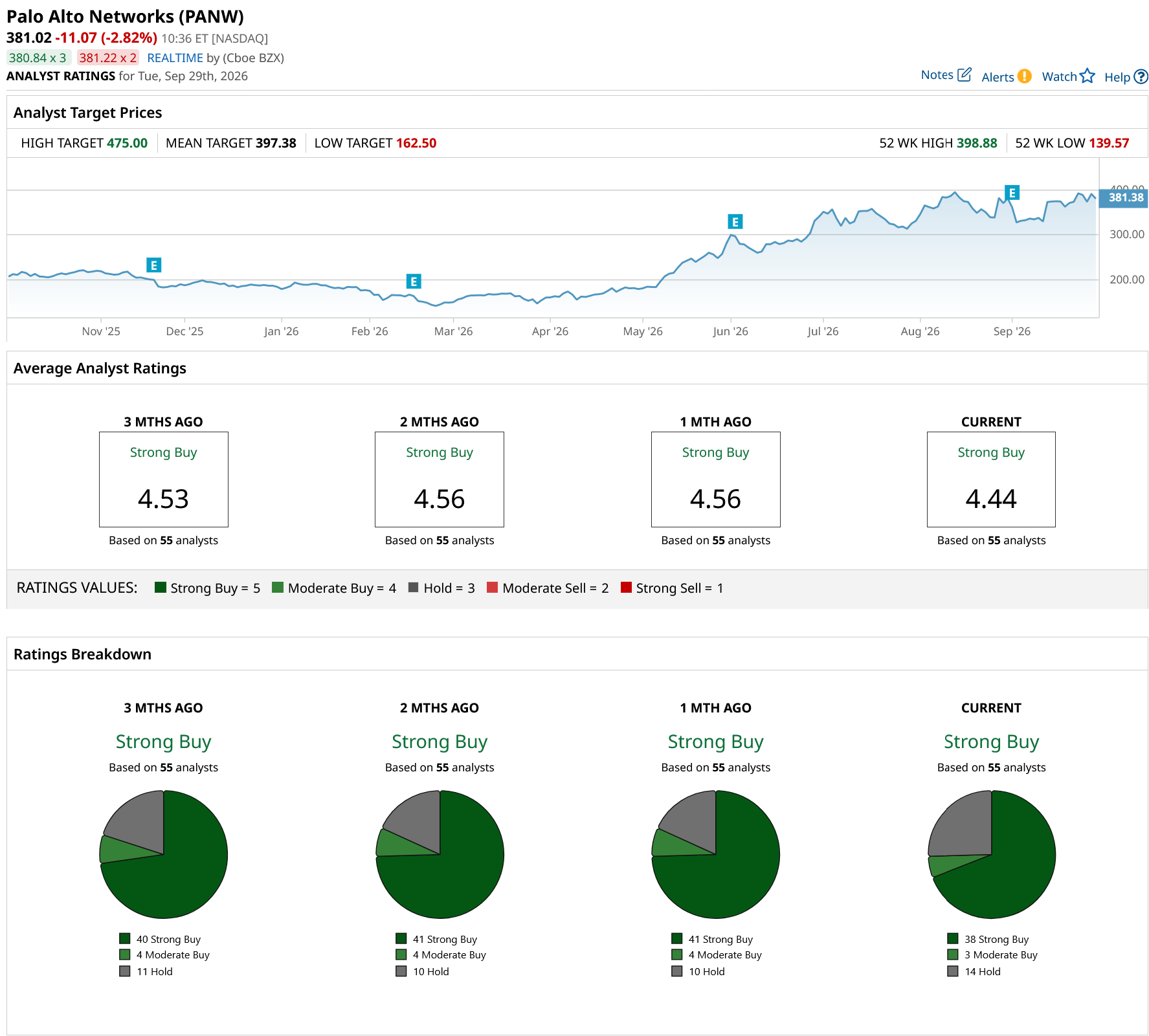
Palo Alto Networks continues to benefit from strong cybersecurity demand, rapid AI adoption, and the expansion of its platformization strategy. Its robust RPO and NGS ARR growth suggest that the underlying business remains on a solid trajectory. This indicates why analysts are bullish and maintain a “Strong Buy” consensus rating on PANW stock.
However, PANW’s sharp 2026 rally and elevated valuation indicate that much of the company’s long-term potential is already reflected in the share price. As a result, investors should wait for a more attractive entry point and remain on the sidelines.
On the date of publication, Amit Singh did not have (either directly or indirectly) positions in any of the securities mentioned in this article. All information and data in this article is solely for informational purposes. For more information please view the Barchart Disclosure Policy here.