
- PRICING
- LIVE QUOTES
- LEARN
- HELP


EN
3 Australian Bank Stocks To Watch As Higher Rates Test Lending Margins
Australia’s cash rate is now 4.6%, a 15 year high, and that shift is quietly reshaping which bank stocks may benefit and which could feel squeezed. Higher borrowing costs can widen lending margins for some institutions, while slower growth and stressed borrowers can pressure others. This article examines three Australian bank stocks exposed to these RBA moves and explains where the risks and potential areas of resilience might sit for investors watching this sector closely.
The three Australian bank stocks discussed below are just a sample drawn from a wider pool. The full screen surfaced six more lenders with equally compelling narratives that are not covered in this article.
If you want to identify which banking businesses best fit your own risk and income goals, head straight to the Australian Bank Stocks screener to filter and analyze the full set of highest conviction candidates.
ANZ Group Holdings (ASX:ANZ)
ANZ Group Holdings is one of the biggest Australian lenders in this screener, with a broad mix of household, business and institutional customers that ties its earnings closely to how higher interest rates flow through to lending and deposit margins.
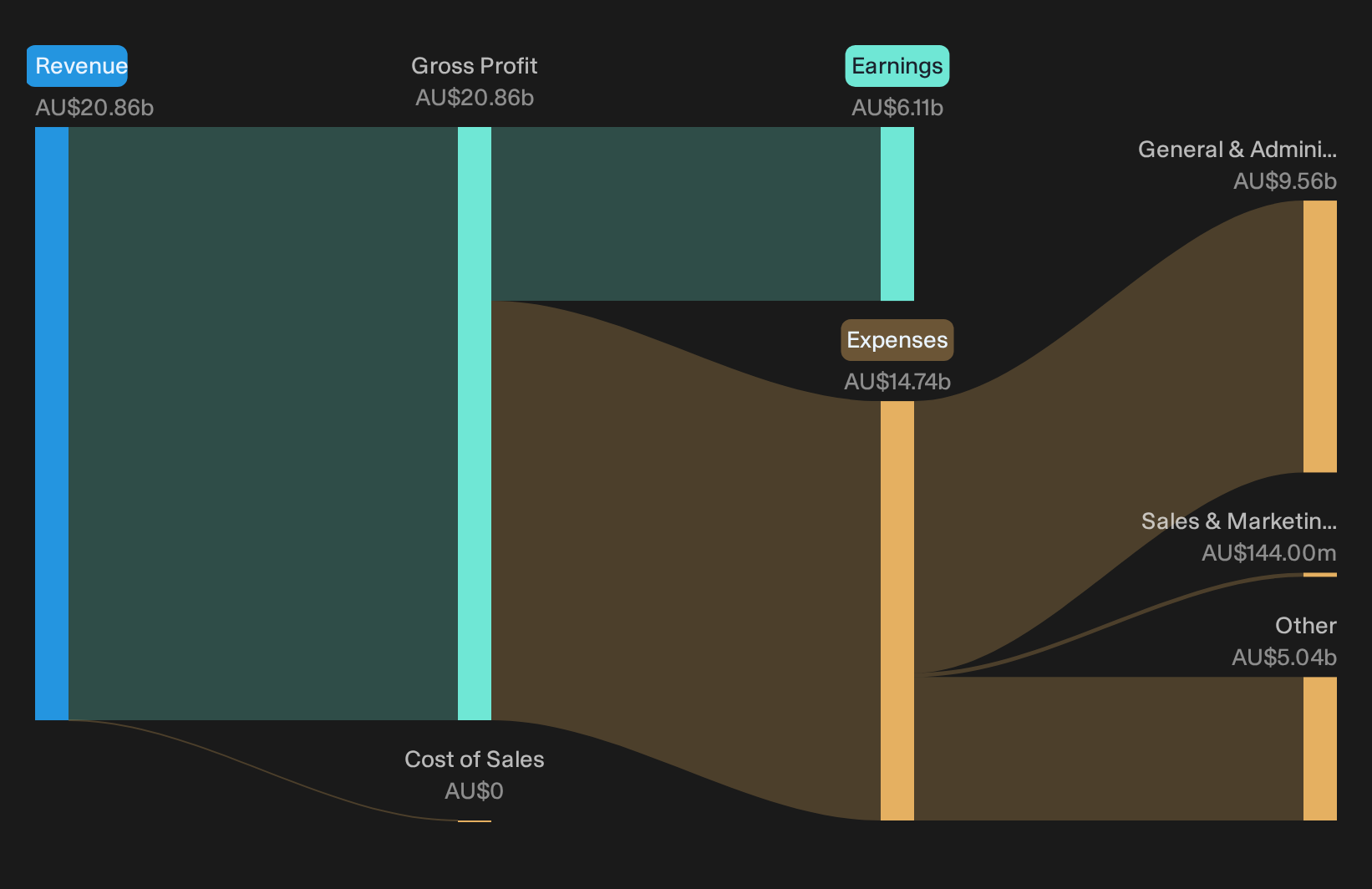
ANZ Group Holdings runs large retail and business banking operations in Australia and overseas, with revenue led by Institutional at A$6.6b, Australia Retail at A$5.7b and Australia Commercial at A$3.4b, and the group valued at about A$115.8b by the market.
"These companies may be positioned to benefit if interest-rate dynamics improve margins, but inclusion reflects screening criteria rather than a guarantee of exposure or outcomes."
For ANZ Group Holdings, what happens when one pressure point in this higher rate setting moves even slightly could matter a great deal for profitability.
When those pressures start to shift, the full narrative for ANZ Group Holdings shows how ANZ Group Holdings could see margins, credit costs and capital demands move in unexpected directions.

Westpac Banking (ASX:WBC)
Westpac Banking gives investors direct exposure to how higher Australian interest rates flow through to everyday banking, from mortgages to business loans. This makes it a key stock in this Australian Bank Stocks theme, where net interest income is a central driver.
Westpac Banking is a full service lender across consumer, business, wealth and institutional banking, with revenue led by Consumer at A$8.4b, Business & Wealth at A$6.0b, Institutional at A$3.8b and Westpac New Zealand at A$2.8b, and the group valued at about A$119.7b.
"Heightened mortgage competition in Australia and New Zealand is putting pressure on lending margins at the same time that Westpac Banking expects lending margins to contract, which can weigh on revenue growth and earnings if pricing pressure persists."
For Westpac Banking, a shift in a single cost of funding assumption could meaningfully alter how much of each extra rate move drops to profit.
When funding costs and pricing pressure start to decouple, the full narrative for Westpac Banking lays out where Westpac Banking could still find accelerating profit drivers and overlooked risks.

National Australia Bank (ASX:NAB)
National Australia Bank is one of the anchor stocks in this Australian Bank Stocks theme, with a broad loan book across households and businesses that ties its earnings closely to how RBA rate shifts ripple through borrowing costs and deposit pricing.
National Australia Bank is a full service lender across retail, small business and institutional clients in Australia and overseas, and the group is valued at about A$120.7b by the market.
As one of the largest domestic lenders, National Australia Bank is deeply plugged into the Australian interest rate cycle and the cash-rate moves that define this screener, which is why its response to the latest RBA shift deserves closer attention.
"Accelerating shift toward digital payments and banking is driving substantial investment in NAB’s digital platforms and real-time payment solutions (e.g., NAB Pay by Bank, NAB Portal Pay, partnership with MRI Property Tree). This positions the bank to acquire and retain customers as cashless adoption increases, and may support non-interest income and revenue."
What happens if one pressure point in National Australia Bank’s funding and credit costs moves differently to what the current rate backdrop implies.
If that shift is what you are watching, the full narrative for National Australia Bank shows how National Australia Bank’s accelerating digital push could be masking both resilience and risk.
Curious About Alternative Opportunities?
Fresh ideas move first. By the time every investor spots a breakout, the easy entry is usually gone. Scan these under the radar lists while it matters and get in early.
- Spot early momentum in smaller companies that already generate cash, then use the 37 profitable AI stocks that aren't just burning cash to see which ones still fly under most radars.
- Hunt for resilient businesses that hold up when sentiment drops by filtering the 7 resilient stocks with low risk scores before the crowd catches on to their stability.
- Position ahead of potential infrastructure tailwinds by checking the curated 39 power grid technology and infrastructure stocks while these stories are still mostly off the front page.
This article by Simply Wall St is general in nature. We provide commentary based on historical data and analyst forecasts only using an unbiased methodology and our articles are not intended to be financial advice. It does not constitute a recommendation to buy or sell any stock, and does not take account of your objectives, or your financial situation. We aim to bring you long-term focused analysis driven by fundamental data. Note that our analysis may not factor in the latest price-sensitive company announcements or qualitative material. Simply Wall St has no position in any stocks mentioned.
Have feedback on this article? Concerned about the content? Get in touch with us directly. Alternatively, email editorial-team@simplywallst.com