
- PRICING
- LIVE QUOTES
- LEARN
- HELP


EN
How Investors May Respond To Varonis Systems (VRNS) Automated Data Cleanup
- Varonis Systems recently introduced Varonis Data Lifecycle Management, a new capability that automatically finds and removes redundant, obsolete, and trivial data across enterprise data estates to help address storage cost, security, and compliance pressures.
- The launch builds on the existing Varonis Data Security Platform, using data classification, access context, and activity monitoring to determine what can be safely deleted while retaining a full safety net for reversibility.
- We will now look at how Varonis Systems' investment narrative could be influenced by automated ROT data removal at scale.
Scan beyond Varonis Systems and compare how other security focused data platforms are tackling cost and risk by reviewing our hand picked list of solid balance sheet and fundamentals (25 results).
Varonis Systems Investment Narrative Recap
To own Varonis Systems, you need to believe that demand for automated data security and governance justifies ongoing investment in its SaaS transition and product expansion, even while the company remains loss making. The key near term swing factor is whether subscription growth and cross sell can steadily lift annual recurring revenue enough to ease concern around compressed margins and stock based compensation.
The new Data Lifecycle Management tool fits that thesis by trying to tie security to clear cost and compliance outcomes, which can help in budget conversations. It does not directly resolve the biggest risk, which is continued unprofitability and pressure on GAAP results during the transition, but it can support the argument for a broader, stickier platform.
Among recent developments, Varonis Systems receiving FedRAMP authorization for its platform looks especially relevant next to the DLM launch. Government and regulated customers care deeply about both unstructured data security and strict retention rules. FedRAMP status can make it easier for those organizations to evaluate DLM as part of an approved toolkit rather than a one off add on.
That pairing, compliance focused certification plus automated ROT removal, points to a clearer operational path. The business is trying to use new capabilities to deepen wallet share with existing clients across cloud and multi cloud environments. Execution risk stays real, since Varonis is still unprofitable and competing with much larger cloud providers, but the product story now ties more tightly to regulatory and storage pain points that already drive budget decisions.
What The Current Analyst Framework Implies For Varonis Systems
Varonis Systems sits in a very expectations-heavy setup. Analysts are penciling in 15.2% annual revenue growth over the next three years and are also assuming that the firm eventually shifts from a loss-making profile to an earnings level that lines up with the wider US software peer group.
On the earnings side, the reference point is a loss of $141.4 million today, compared with a consensus framework that points to $120.7 million of profit by 2029. That jump of roughly $262 million in earnings rests on profit margins moving from a loss of 20.5% toward an 11.5% margin that mirrors the broader sector.
Varonis Systems' narrative projects revenues of about $1.1 billion and earnings of $120.7 million by 2029. This setup assumes revenue growth of 15.2% per year and an earnings swing of roughly $262 million from current earnings of a $141.4 million loss.
Bringing those assumptions together, the consensus view sketches a 2029 scenario where Varonis Systems is not just profitable but also valued on a rich multiple. The implied P/E of 57.5 times those future earnings is well above the 31.4 times figure used for the US software industry, which means the story is not only about reaching profit but also about sustaining a premium on top of that.
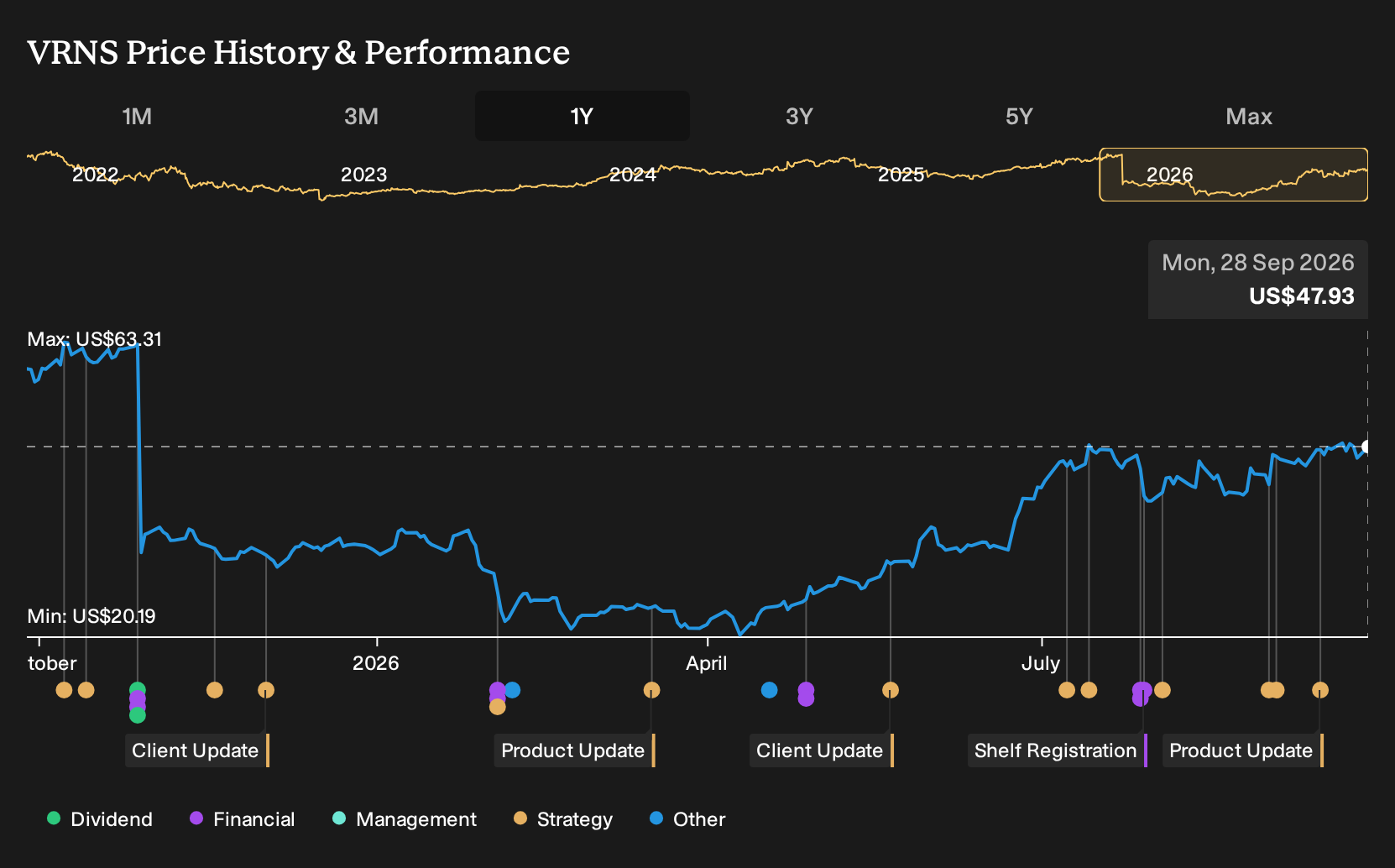
That valuation bridge to a consensus price target of $50.68, a modest 8.2% above the recent share price of $46.51, relies on both the growth and margin pieces holding together. It also assumes a discount rate near 8.8% and a slight reduction in share count, with forecasts pointing to a 2.58% annual decline in outstanding stock over the next few years.
For you as an investor, the key question is how comfortable you are with each leg of this structure. The revenue path, the earnings swing, the margin convergence, and the elevated P/E all have to line up for that 2029 picture to make sense as a working baseline for Varonis Systems.
Uncover why Varonis Systems' fair value indicates a 6% potential upside to its current price before that valuation gap closes.
Exploring Other Perspectives
For Varonis Systems, the more cautious story centers on churn risk as self hosted products reach end of life. The lowest analysts were already assuming roughly 15.6% annual revenue growth and a swing to about US$124.6 million in earnings by 2029, yet still arrived at a US$37.69 fair value. Those views formed before this DLM launch, so opinions may shift as you weigh several competing narratives.
Explore 3 other Varonis Systems fair value estimates, including one that suggests as much as 21% downside from the current price!
Form Your Own Verdict
Don't just follow the ticker. Dig into the data and build a conviction that's truly your own.
- A great starting point for your Varonis Systems research is our analysis highlighting 1 key reward and 1 important warning sign that could impact your investment decision.
- See our latest analysis for Varonis Systems. The report includes a comprehensive fundamental analysis summarized in a single visual, the Snowflake, making it easy to evaluate Varonis Systems' overall financial health at a glance.
Looking For More Investment Ideas Beyond Varonis Systems?
If Varonis Systems has sharpened your thinking about risk, growth, and valuation, it can be useful to widen the lens and compare it with other companies that fit very different profiles. The Simply Wall St Screener lets you scan the market by fundamentals so you can build a watchlist that matches your own return and risk preferences.
- Focus on quality at a reasonable entry point by searching for companies that combine earnings power with attractive valuations through our 33 high quality undervalued stocks.
- Prioritize stability and capital preservation by looking at a 30 resilient stocks with low risk scores that aims to spotlight businesses with more resilient characteristics.
- If you are hunting for overlooked opportunities with strong fundamentals, start with this hand picked set of 16 high quality undiscovered gems that might not yet be widely followed.
This article by Simply Wall St is general in nature. We provide commentary based on historical data and analyst forecasts only using an unbiased methodology and our articles are not intended to be financial advice. It does not constitute a recommendation to buy or sell any stock, and does not take account of your objectives, or your financial situation. We aim to bring you long-term focused analysis driven by fundamental data. Note that our analysis may not factor in the latest price-sensitive company announcements or qualitative material. Simply Wall St has no position in any stocks mentioned.
Have feedback on this article? Concerned about the content? Get in touch with us directly. Alternatively, email editorial-team@simplywallst.com