
- PRICING
- LIVE QUOTES
- LEARN
- HELP


EN
Jensen Huang Just Gave Investors 150 Billion Reasons to Buy Nvidia Stock
Key Points
Nvidia has been using excess cash flow to buy back stock throughout the artificial intelligence (AI) revolution.
The new $150 billion repurchase program brings the company's total authorization to $235 billion.
Nvidia's stock buybacks signal management's confidence in sustained AI-driven growth.
Four years ago, Nvidia (NASDAQ: NVDA) became synonymous with artificial intelligence (AI) nearly overnight. At the time, the company's graphics processing units (GPUs) were the only widely available hardware that could train and run the generative models big tech suddenly needed.
Since then, Nvidia has managed to stay at the center of the AI infrastructure stack: chips, software, networking, and even the model work itself. Every major hyperscaler and frontier lab is buying more Nvidia silicon every year. That demand has propelled the company's revenue and profits to record levels that would have sounded like fantasy back in 2022.
Missed AI’s "Act 1"? Act 2 Could Be 15x Bigger. Most investors think they missed the AI boat because they didn't buy Nvidia in 2005. But according to our analysts, we’re only at the end of "Act 1"—the R&D phase. "Act 2" is the global rollout. Continue »
Now, Nvidia's balance sheet is so flush that the company has the financial flexibility to fund new products, make strategic investments, look at acquisitions, pay a dividend, and retire stock. To me, Nvidia is beginning to look a lot like Apple. Apple spent years proving that a company with more cash than it can productively spend on product innovation alone should simply buy its own shares. Nvidia just did the same thing, announcing a jaw-dropping $150 billion share repurchase program.
Image source: Nvidia.
AI turned Nvidia into a cash machine
Nvidia sits in the middle of a platform shift that is still in its early innings. Year after year, data center customers raise their purchase orders because they cannot get enough accelerated computing. This allows Nvidia to maintain lucrative pricing power for its chips, producing the kind of free cash flow that allows a company to do several things at once.

NVDA Revenue (TTM) data by YCharts
While product innovation comes first, shareholder rewards are a close second. Specifically, share repurchases are an interesting tool because they shrink the outstanding share count while the company's earnings base is still growing.
Why do companies buy back their own stock?
A stock buyback is simple arithmetic with a confidence signal attached. When a company buys its own stock, each remaining share owns a larger slice of future earnings. This means earnings per share (EPS) can rise even if net income is flat. Companies tend to authorize share repurchases when they believe the stock is undervalued relative to the cash management expects the business to generate.
Nvidia has already been buying back stock in large quantities over the last year. During the first two quarters of fiscal 2027, the company bought back roughly $39 billion of stock. The new authorization lifts the remaining capacity to $235 billion, and the company says it expects to work through that amount through fiscal 2028.
This is not a distant, open-ended promise. Nvidia's timeline to complete this buyback is a fairly tight window. Planning to deploy that much capital over the next year or so suggests management has enough visibility to see the cash generation that will pay for it.
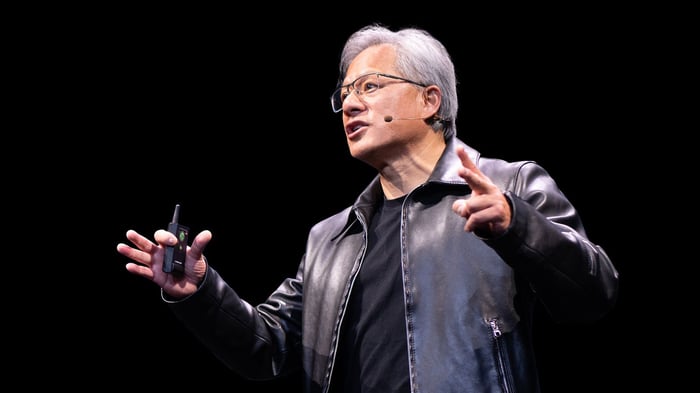
Nvidia CEO Jensen Huang. Image source: Nvidia.
CEO Jensen Huang was blunt about the new buyback. "Nvidia's growth is being driven by a once-in-a-generation platform shift to AI and accelerated computing," he said in the press release. He went on to explain that the company's cash generation is so robust that the authorization "reflects our confidence in the long-term opportunity ahead."
Nvidia stock looks better now than ever before
While earnings keep compounding, Nvidia's share count will be reduced on a schedule the company just published. While the authorization does not guarantee every dollar will get spent tomorrow, it does signal that Nvidia is not treating the AI revolution as a one- or two-quarter spike.
The key takeaway is straightforward: Nvidia is generating more cash than it can usefully reinvest at high returns, so it is shrinking the equity base instead. When paired with the company's attractive valuation profile -- trading at a 10-year low -- plus ongoing revenue and profit growth and a shrinking share count, the bull case around Nvidia is pretty compelling. For these reasons, I see Nvidia as a great stock to buy and hold as the AI boom pushes on.
Adam Spatacco has positions in Nvidia. The Motley Fool has positions in and recommends Apple and Nvidia. The Motley Fool has a disclosure policy.