
- PRICING
- LIVE QUOTES
- LEARN
- HELP


EN
How Investors Are Reacting To Goldman Sachs Stock Board Default Voting Approval
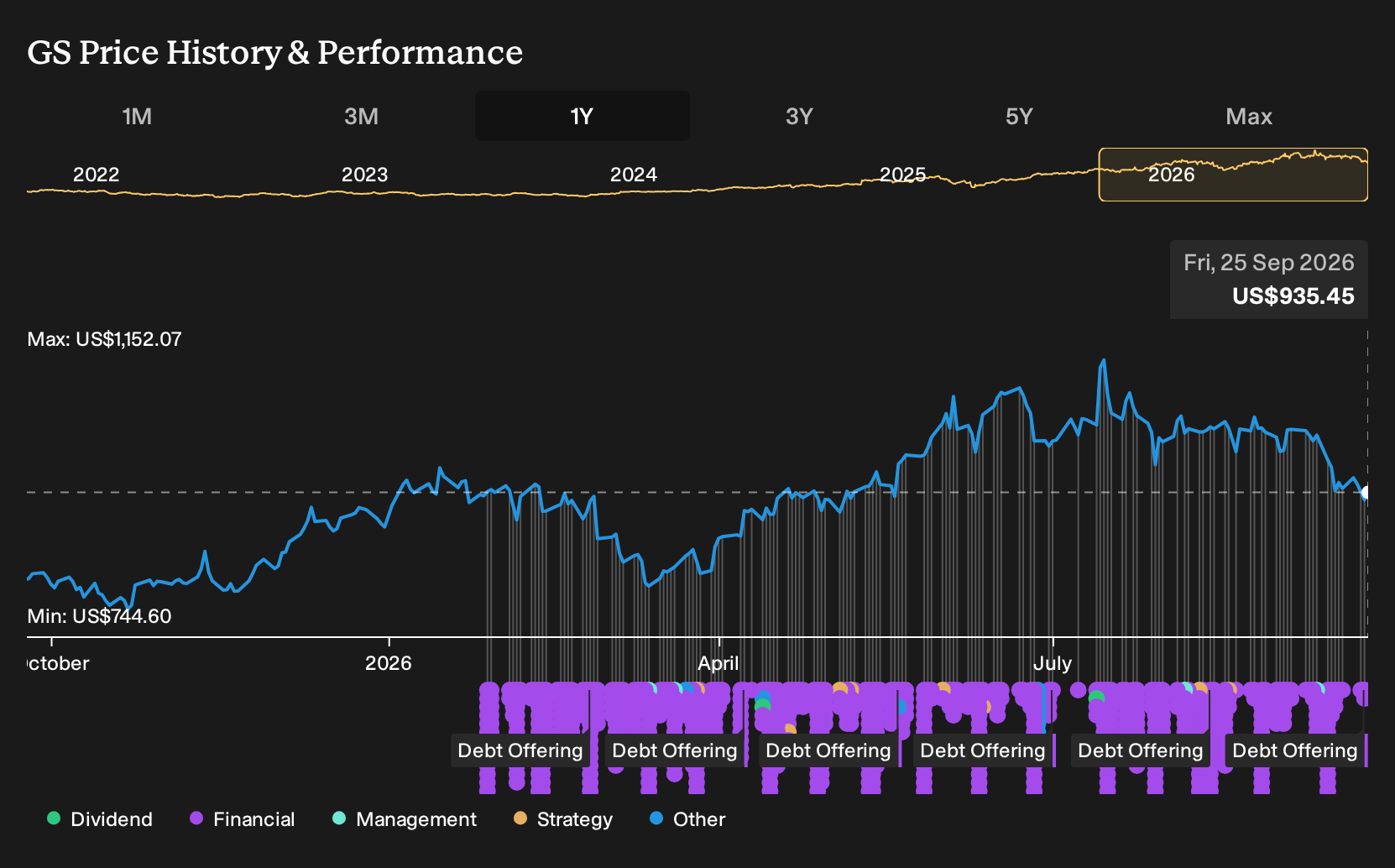
- Goldman Sachs Group recently launched a series of fixed-rate, callable senior notes with maturities ranging from 2027 to 2038, while also exercising an early redemption option on an existing issue.
- Regulatory approval to let retail shareholders default their votes to the board could reshape how Goldman Sachs Group manages executive pay debates and governance friction.
- We will now see how Goldman Sachs Group's long-term advisory and fee-based growth narrative interacts with this new shareholder voting structure.
Scan how Goldman Sachs Group’s fresh round of callable notes compares to other balance-sheet focused issuers by reviewing the hand-picked list of solid balance sheet and fundamentals (24 results) that is now threading similar themes through their funding plans.
Goldman Sachs Group Investment Narrative Recap
To stay invested in Goldman Sachs Group, you need to believe the firm can lean harder into advisory, financing and fee based wealth management while keeping a tight grip on costs. The near term swing factor is whether strong deal pipelines, Global Banking & Markets activity and AI driven efficiency can offset heavier non compensation expenses and softer FICC trading.
The fresh stack of callable senior notes does not radically change that core story. It adds another layer to an already funding heavy model, so the key risk remains capital and leverage constraints. If the supplementary leverage ratio tightens further, balance sheet intensive financing and future issuance flexibility could come under more pressure.
The recent run of fixed income offerings, including the 6.025% notes due 2033 and the 5.80% notes due 2031, matters because it shows Goldman Sachs Group continuing to rely on wholesale borrowing rather than deposits. For you, that keeps funding structure firmly in focus as you think about how the group supports trading, financing and underwriting activity.
These callable, senior fixed rate issues also sit alongside a US$5 million 5.55% note due 2038 and several smaller MTN tranches in the 2027 to 2036 window. That maturity ladder gives the firm room to match term funding to advisory and financing ambitions. It also ties the near term catalyst of higher deal activity more closely to credit market conditions and regulatory capital demands.
Goldman Sachs Group Analyst Expectations Under the New Voting Setup
Goldman Sachs Group's funding choices are only one piece of the puzzle. Analyst forecasts give you a rough sketch of what the business might need to deliver on the earnings side while this new retail voting default system beds in. Those expectations help you judge whether the current funding intensity and governance tweaks feel aligned with what the market has already pencilled in.
Consensus assumptions point to modest top line expansion rather than a big swing. Analysts are building in revenue growth of 2.5% per year over the next three years, with profit margins easing slightly from 29.6% today to 29.4% by 2029. On that view, earnings would move from US$20.0b today to about US$21.4b by 2029, which is an increase of roughly US$1.4b. That is a step up, but not a transformation, and it still leaves plenty of room for upside or disappointment given the wide spread between the most bullish and most cautious profit estimates.
Goldman Sachs Group's narrative projects US$72.8b revenue and US$21.4b earnings by 2029. This assumes 2.5% yearly revenue growth and an earnings increase of about US$1.4b from current earnings of US$20.0b.
Those same numbers sit behind the current valuation debate. To match the analyst price targets, the stock would need to trade on a P/E of 19x 2029 earnings, compared with 14.3x today and an industry marker of 39.6x for US capital markets peers. For you, that creates a simple sense check. If the funding stack grows heavier, leverage rules tighten further or governance shifts reduce pushback on compensation, ask whether US$21.4b of forecast profit on US$72.8b of revenue still feels realistic enough to justify that higher earnings multiple.
Uncover why Goldman Sachs Group's fair value indicates a 22% potential upside to its current price that could narrow quickly.
Exploring Other Perspectives
You might see the same funding burst at Goldman Sachs Group and read it very differently. The most optimistic analysts frame rapid AI driven efficiency as the real story, with pre news forecasts of US$84.5b revenue and US$27.5b earnings by 2029. Others stay closer to US$72.8b and US$21.4b. That spread shows opinions can swing widely, so treat these bond moves as a fresh prompt to compare several viewpoints rather than a final verdict.
Explore 6 other Goldman Sachs Group fair value estimates, including one that suggests as much as 42% upside from the current price.
Decide For Yourself
Disagree with existing narratives? Extraordinary investment returns rarely come from following the herd, so consider trusting your own analysis.
- A great starting point for your Goldman Sachs Group research is our analysis highlighting 4 key rewards and 2 important warning signs that could impact your investment decision.
- See our latest analysis for Goldman Sachs Group. The report includes a comprehensive fundamental analysis summarized in a single visual, the Snowflake, making it easy to evaluate Goldman Sachs Group's overall financial health at a glance.
Looking for more Goldman Sachs Group style ideas?
If the Goldman Sachs Group story has you rethinking how you spread risk and opportunity across your portfolio, it can help to line it up against other businesses with very different profiles.
- If you want potential mispricing with stronger fundamentals on your radar, check out 32 high quality undervalued stocks that currently screen well on both quality and value.
- If portfolio resilience matters more to you than excitement, review the 30 resilient stocks with low risk scores that score well on stability and lower risk metrics.
- If you prefer companies that the market has not fully focused on yet, weigh up a 16 high quality undiscovered gems that pair solid fundamentals with lower profile coverage.
This article by Simply Wall St is general in nature. We provide commentary based on historical data and analyst forecasts only using an unbiased methodology and our articles are not intended to be financial advice. It does not constitute a recommendation to buy or sell any stock, and does not take account of your objectives, or your financial situation. We aim to bring you long-term focused analysis driven by fundamental data. Note that our analysis may not factor in the latest price-sensitive company announcements or qualitative material. Simply Wall St has no position in any stocks mentioned.
Have feedback on this article? Concerned about the content? Get in touch with us directly. Alternatively, email editorial-team@simplywallst.com