
- PRICING
- LIVE QUOTES
- LEARN
- HELP


EN
Dear Carnival Stock Fans, Mark Your Calendars for September 29
Carnival Corporation (CCL) knows a thing or two about navigating rough waters. But lately, the world’s largest cruise operator by revenue and passenger volume has been dealing with plenty of choppy seas of its own. After a difficult stretch, CCL stock has continued to lose ground, leaving investors wondering whether the company can steady the ship as it heads into the final stretch of 2026.
The pressure has not come from just one direction. Geopolitical tensions have clouded the travel outlook, while higher fuel costs have added another wave of pressure to Carnival’s operating expenses. The company has managed to keep moving, though. Its fiscal Q2 results delivered another quarter of record performance on several key measures, including adjusted net income, adjusted EBITDA, and EPS. Yet Wall Street’s reaction has been far less celebratory, with the stock continuing to slip despite those record numbers.
Now, the spotlight is turning to Carnival’s next financial update. The company is scheduled to report its fiscal third-quarter results on Tuesday, Sept. 29, 2026, at 10 a.m. EDT. Investors will be watching closely to see whether the cruise giant can keep its recovery on course while navigating higher costs and an uncertain geopolitical backdrop.
Analysts are expecting Q3 revenue to rise about 3% year over year, but adjusted EPS is projected to decline from the same period last year. That contrast could make the upcoming report particularly important for investors trying to gauge where Carnival is headed next.
So, if Carnival's stock is on your watchlist, this is one date worth circling on the calendar.
About Carnival Corporation Stock
If you have ever thought about taking a cruise, chances are Carnival has crossed your mind. Based in Miami, Florida, Carnival Corporation is one of the world’s largest cruise companies, along with brands such as Princess Cruises, Holland America Line, and Cunard. Founded in 1972, Carnival has grown into a global cruise giant, with 29 ships carrying millions of guests each year.
Carnival is about having fun at sea. Guests get comfortable rooms, dining, live shows, music, deck parties, casinos, waterslides, and plenty of ways to unwind while visiting destinations from the Caribbean and Mexico to Alaska, Hawaii, Asia, and beyond. The company is also expanding, with Celebration Key and five new ships planned through 2033, adding more room for Carnival’s next chapter. Its market capitalization currently stands at about $30.5 billion.
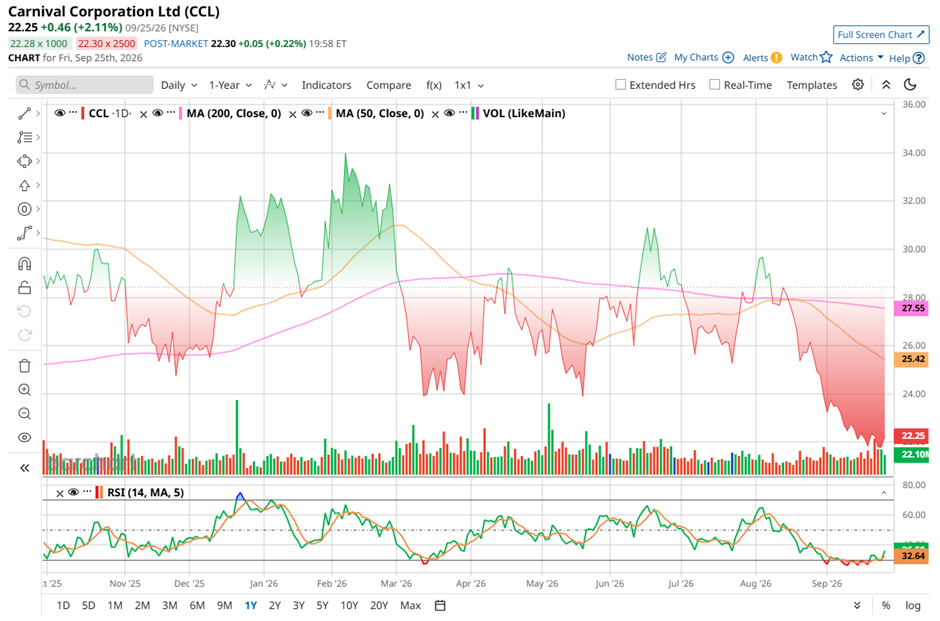
Building on that growth story, Carnival’s shares have had a much rougher voyage in 2026. CCL stock has been caught in a downtrend, falling about 28% on a year-to-date (YTD) basis. After reaching a 52-week high of $34.03 in February, shares of the cruise ship company lost ground and hit a 52-week low of $21.45 on Sept. 24.
CCL stock has since edged 3% above that low but remains 35% below its February peak. The recent waters have not been any calmer, with CCL down 11% over the past month and 24% over the past three months.
What’s weighing on the shares? Moderating European demand, higher fuel costs, and Carnival’s heavy debt load have created headwinds, even as revenue has reached record levels. Rising fuel prices are squeezing margins because cruises are often booked well before sailing, while the prolonged military conflict involving Iran has added uncertainty around consumer spending and travel. Higher interest rates are another drag, raising borrowing costs for highly leveraged cruise operators and potentially making vacations harder for some consumers to afford.
The chart is not exactly sending out a “smooth sailing” signal either. CCL is trading below both its 50-day and 200-day moving averages. The stock spent much of September in oversold territory, though its 14-day RSI has recovered to 35, suggesting selling pressure may be easing somewhat.
Valuation-wise, CCL looks relatively inexpensive, trading at 10.05 times forward adjusted earnings, below both its sector average and historical median. On a sales basis, the stock trades at 1.1 times revenue, above the sector average but still below its own historical average, offering a mixed valuation picture.
After years of keeping its wallet shut, Carnival brought back its dividend in 2026, marking an important step in its post-pandemic recovery. The company resumed quarterly dividend payments at $0.15 per share, signaling that management is becoming more comfortable returning cash to shareholders as its financial position improves. At an annualized $0.60 per-share dividend, it carries a yield of about 2.7%. The payout ratio stands at 12.6%, meaning Carnival is returning only a modest portion of its earnings to shareholders while retaining most of its profits to strengthen the business, reduce debt, and fund future growth.
A Snapshot of Carnival Corporation’s Q2 Report
Carnival’s Q2 financials showcased a business that is still moving forward, even with some rough seas around it. In June, the cruise operator reported another quarter of record results, marking its 12th consecutive quarter of record net yields despite geopolitical headwinds and nearly 30% higher fuel costs.
Revenue rose 5.3% year-over-year (YoY) to $6.66 billion, although it fell short of analysts’ expectations. Adjusted net income climbed 21.1% annually to $569 million, while adjusted EPS rose 17.1% annually to $0.41, beating expectations. Adjusted EBITDA reached a record $1.58 billion, up from roughly $1.51 billion a year earlier.
Underneath those headline numbers, the operating picture looked encouraging. Net yields in constant currency increased 2.2%, while adjusted daily cruise costs per available lower berth, excluding fuel, remained essentially flat YoY. Fuel, however, remained a sizable wave to navigate. Higher fuel prices and currency movements reduced EPS by 6 cents, representing a $73 million hit during the quarter. With fuel costs higher, gross margin yields fell 3.9%. Still, Carnival managed to post record adjusted earnings, while fuel consumption per available lower berth day improved by 5.6%.
The balance sheet also continues to heal from the pandemic-era shock. After the cruise shutdown forced Carnival to take on substantial debt and suspend its dividend, long-term debt had declined to $23.4 billion as of May 31. Net interest expense also fell to $285 million from $341 million a year earlier. Plus, cash and cash equivalents rose to $2.2 billion.
Demand indicators remain encouraging. Customer deposits reached a record $9 billion, while Carnival had booked 93% of its capacity. Management expects record net yields for the rest of the year. There are still some clouds on the horizon, particularly Middle East tensions affecting Mediterranean operations and raising questions around future demand and yields.
Meanwhile, Carnival repurchased more than $450 million of its stock and paid $207 million in dividends during the quarter.
The company is all set to release its Q3 report on Tuesday, and management expects adjusted EBITDA of approximately $2.88 billion, along with adjusted net income of nearly $1.86 billion and adjusted EPS of $1.35.
For the full fiscal year, the company projects adjusted EBITDA of about $7.11 billion. Adjusted net income is expected to reach nearly $3.07 billion, and adjusted EPS is projected to be around $2.22.
Analysts tracking the company predict Q3 revenue to be around $8.4 billion, while EPS is anticipated to be $1.36, down 4.9% YoY. Looking ahead, EPS is expected to be around $2.20 for fiscal 2026, down 2.2% YoY, but then surge by 15% annually to $2.53 in fiscal 2027.
What Do Analysts Expect for CCL Stock?
Wall Street has not been rowing in the same direction on Carnival, but several analysts have recently trimmed their price targets ahead of the company’s Q3 results. JPMorgan analyst Matthew Boss lowered his target to $39 from $43 while maintaining an “Overweight” rating. Following recent fieldwork, the analyst sees Carnival’s second-half 2026 fundamentals tracking expectations, although he expects the company’s 2027 outlook to come in below consensus.
Susquehanna also took its target down, cutting it to $28 from $33 while keeping a “Positive” rating. The brokerage firm is watching near-term yields across Carnival’s key Caribbean and European markets. It also pointed to a longer-term consideration—Royal Caribbean’s (RCL) newly announced joint venture with Sandals Resorts could add pressure to Caribbean yields as Royal Caribbean strengthens its position in the region.
Then there is TD Cowen analyst Kevin Kopelman, who lowered his price target to $32 from $34 but kept a “Buy” rating ahead of the Q3 report. The brokerage firm is adjusting its estimates to account for higher fuel prices. The analyst is also keeping tabs on several moving pieces, including Caribbean capacity, European demand, close-in yields, 2027 bookings, non-fuel costs, balance-sheet deleveraging, and shareholder returns.
Analysts are still confident in their ratings, but their targets suggest a more cautious view of the road—or seas, rather—ahead.
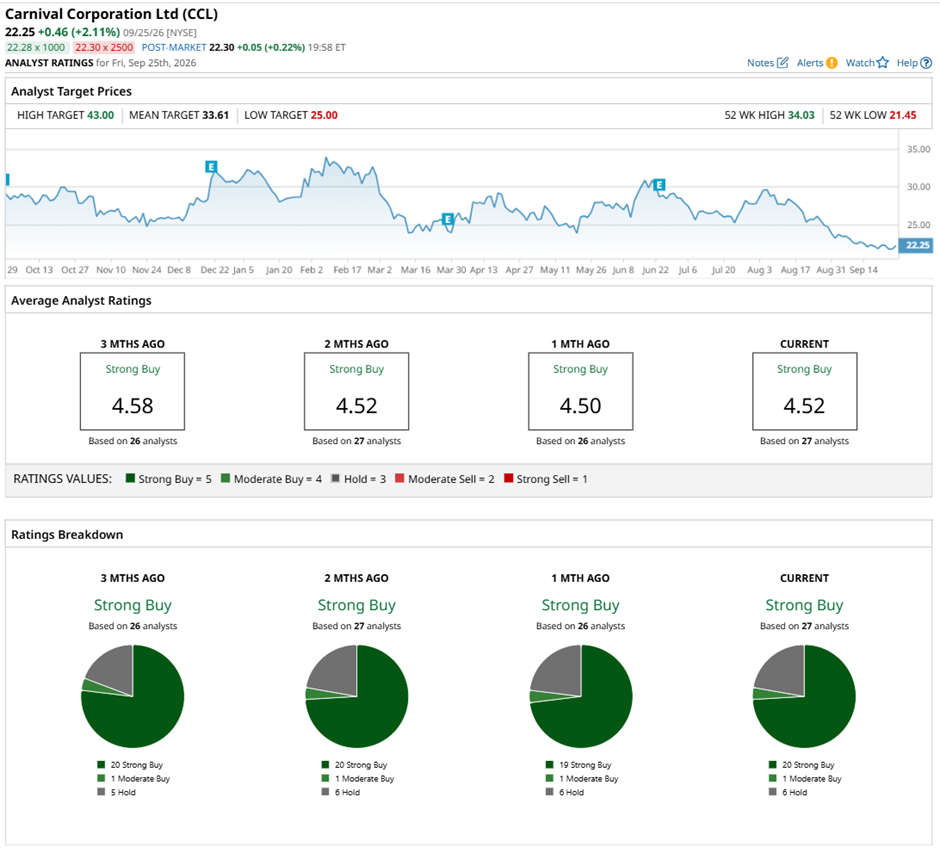
Overall, CCL has a consensus “Strong Buy” rating. Of the 27 analysts covering CCL stock, 20 advise a “Strong Buy,” one suggests a “Moderate Buy,” and six analysts are on the sidelines, giving it a “Hold” rating.
The average analyst price target for CCL is $33.61, indicating a potential upside of 51%. The Street-high target price of $43 suggests that the stock could rally 93%.
On the date of publication, Sristi Suman Jayaswal did not have (either directly or indirectly) positions in any of the securities mentioned in this article. All information and data in this article is solely for informational purposes. For more information please view the Barchart Disclosure Policy here.