
- PRICING
- LIVE QUOTES
- LEARN
- HELP


EN
What Do Commodity Complex Bulls and Garfield the Cat Have in Common to Start the Week?
US Treasury yields continued to rocket higher overnight with the 30-year hitting a 22-year high.
The Metals sector melted down, led by sharp breaks in silver and gold.
And while Energies screamed higher on weekend news, the Grains sector was under pressure across the board.
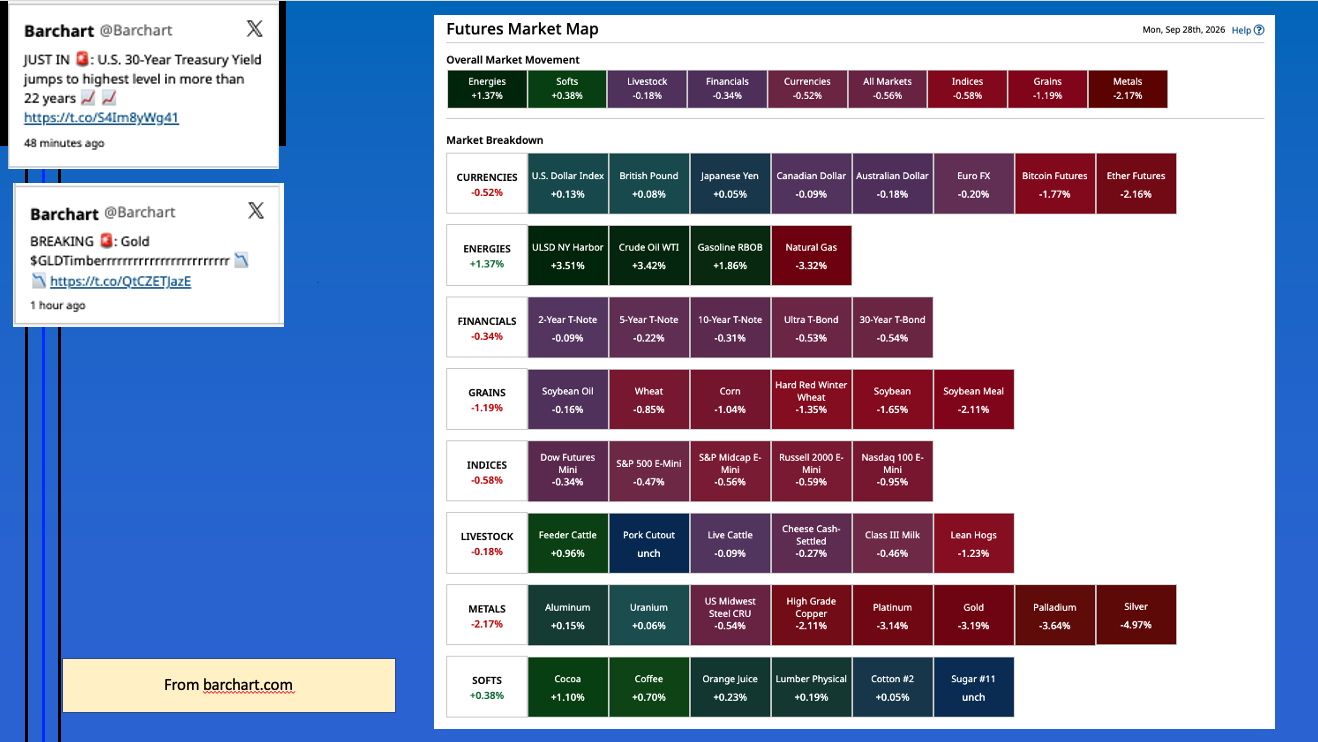
Morning Summary: The commodity complex was off to a bearish start this week. Those who are inherently bullish will be quoting famed cartoon character Garfield the Cat, “I hate Mondays”, pulling the blanket back over their heads and waiting to see if Turnaround Tuesday will be any better. Where to begin? Barchart has been busy on the social media site formerly known as Twitter, posting a comment on gold that read, “Timberrrrrr”. That sums it up in a nutshell as the December contract (GCZ26) is down $131 (3.0%) at this writing after falling as much as $148.50 overnight. Silver (SIZ26) was taken to the glue factory after losing as much as $3.49 (5.4%) through Monday’s early morning hours. A look at the Barchart Futures Market Heat Map shows the Metals sector leading the way down, to nobody’s surprise. Another post read, “U.S. 30-Year Treasury Yield jumps to highest level in more than 22 years”. This means US Treasury futures (ZBZ26) were lower across the board while the US dollar index ($DXY) firmed overnight. Additionally, US stock index futures were under pressure despite European markets trading higher to start the week. Energies are screaming higher with spot-month diesel (HOV26) up 18.0 cents (3.9%) and WTI crude oil up $3.35 (3.7%).
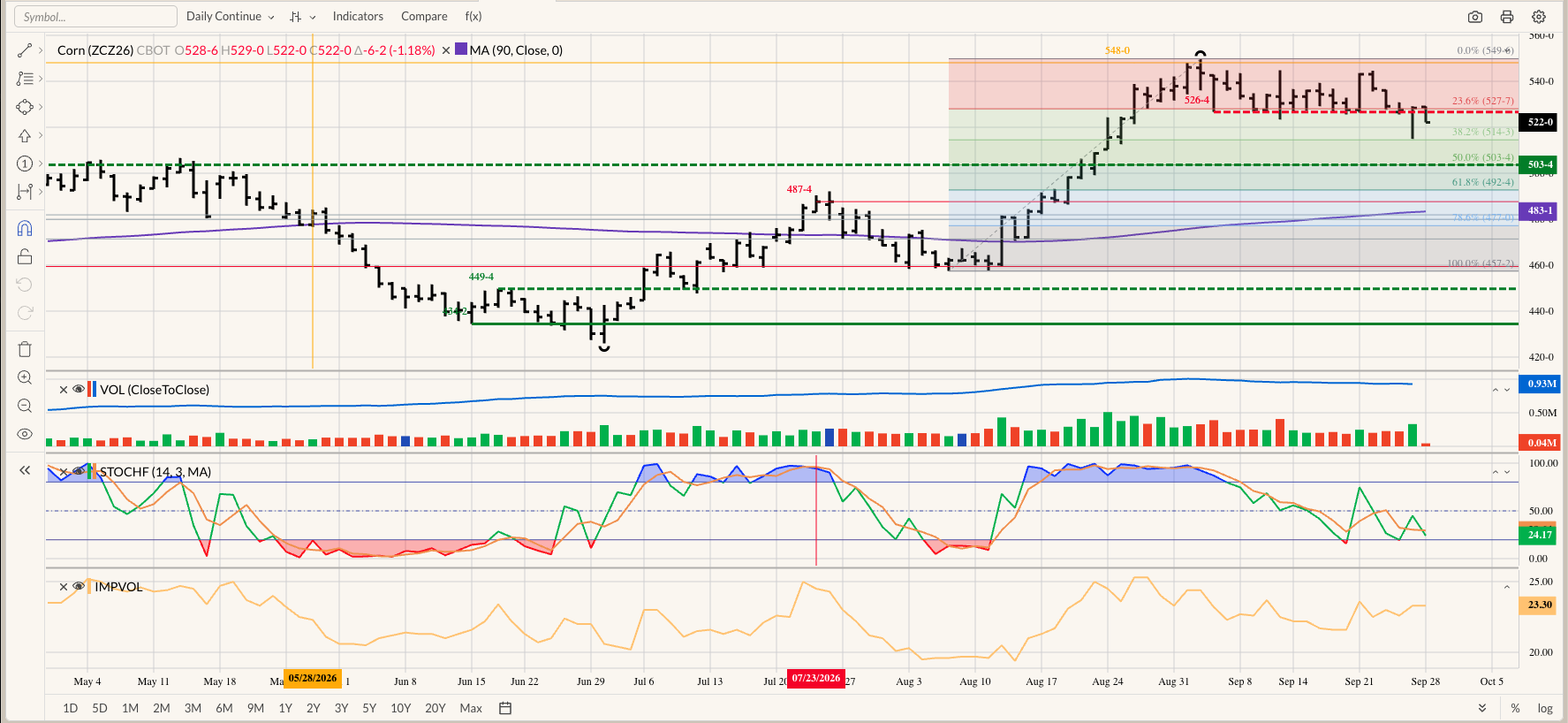
Corn: The third King of Commodities, King Corn was also in the red pre-dawn Monday but not to the degree of its royalty brethren (Gold and Crude Oil). The December issue (ZCZ26) dropped as much as 6.25 cents overnight on trade volume of 45,000 contracts, but as we’ve seen of late, corn has been as difficult to keep down as convenience store sushi. Recall last Friday’s session when Dec fell as much as 12.75 cents before settling with a gain of 0.75 cent. After the dust had settled, a friend from central Nebraska called to say, “The Wilhelmi Element (the only price that matters is the close) held true again.” However, Friday also showed us Dec26 is now comfortable below the round number $5.30, opening the door to $5.20 and beyond. Recall Friday’s low came in at $5.1475, so if the market starts to see harvest hedge pressure it seems logical for Dec to slide back to the $5.20 to $5.10 range. Fundamentally the market hasn’t changed much. Last Friday’s national average basis calculation came in at 41.0 cents under December futures as compared to the previous Friday’s final figure of 42.0 cents under. For comparison, the previous 5-year low weekly close for last week was 41.75 cents under December.
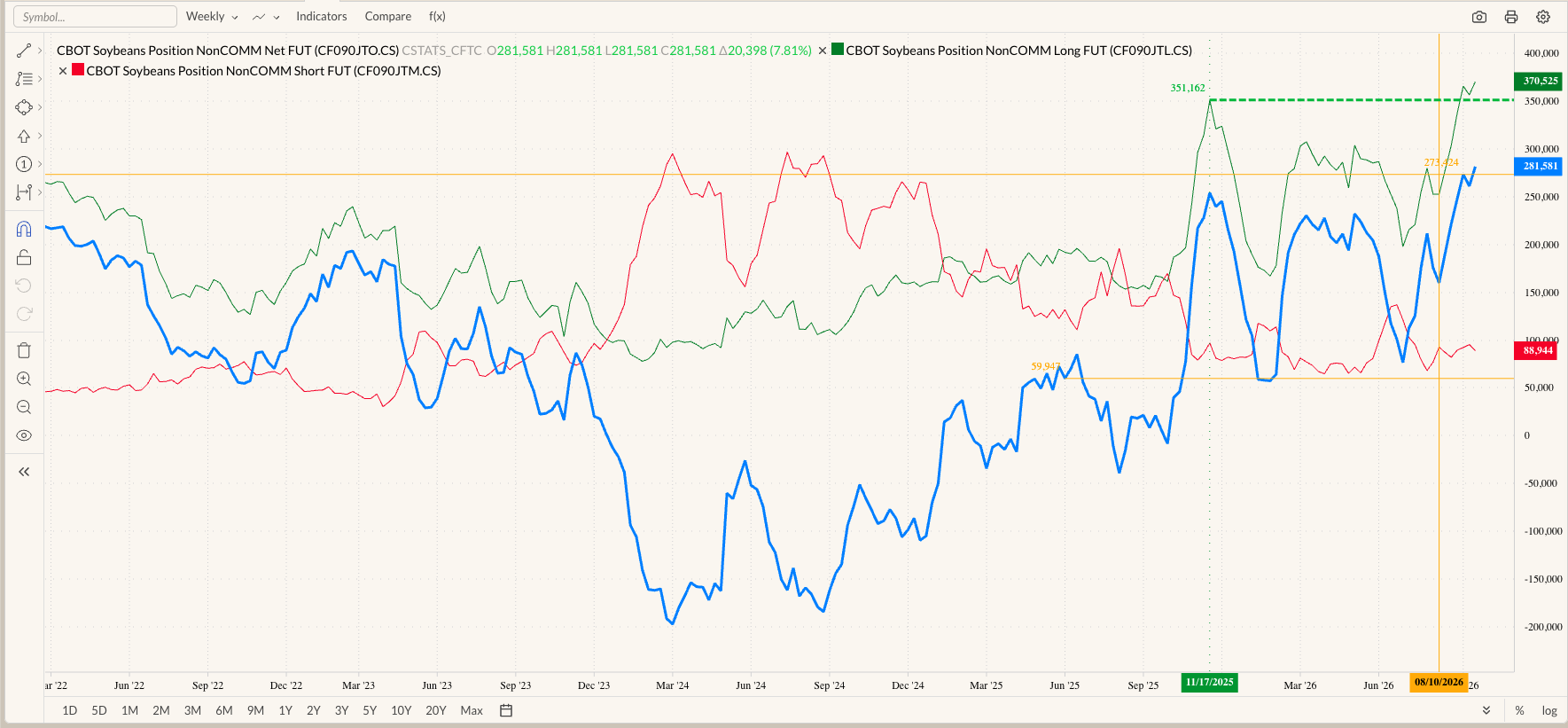
Soybeans: It was a case of split personality in the oilseed sub-sector overnight through early Monday morning. Given the explosive rally in diesel fuel[i], with the national average cash price expected to jump to a new record high by the end of the day, it would seem logical for oilseed markets to be higher to start the day. As I’ve often said, though, logic is not a useful tool in market analysis. The sub-sector was lower across the board led by strong commercial selling in soybean meal. Here we see the December issue (ZMZ26) down $8.30 (2.2%) after losing as much as $9.10 overnight. Additionally, Dec is losing $0.50 to January at this writing hinting at possible commercial pressure to go along with noncommercial selling. Regarding the latter, the latest Commitments of Traders report showed Watson held record large long and net-long futures positions as of Tuesday, September 22. As usual, this opened the door to a round of fund long liquidation. As for soybeans, the November issue (ZSX26) was down 21.25 cents after falling as much as 22.75 cents overnight on trade volume approaching 50,000 contracts. As with meal, funds held record large long and net-long futures positions in the latest Commitments of Traders report.
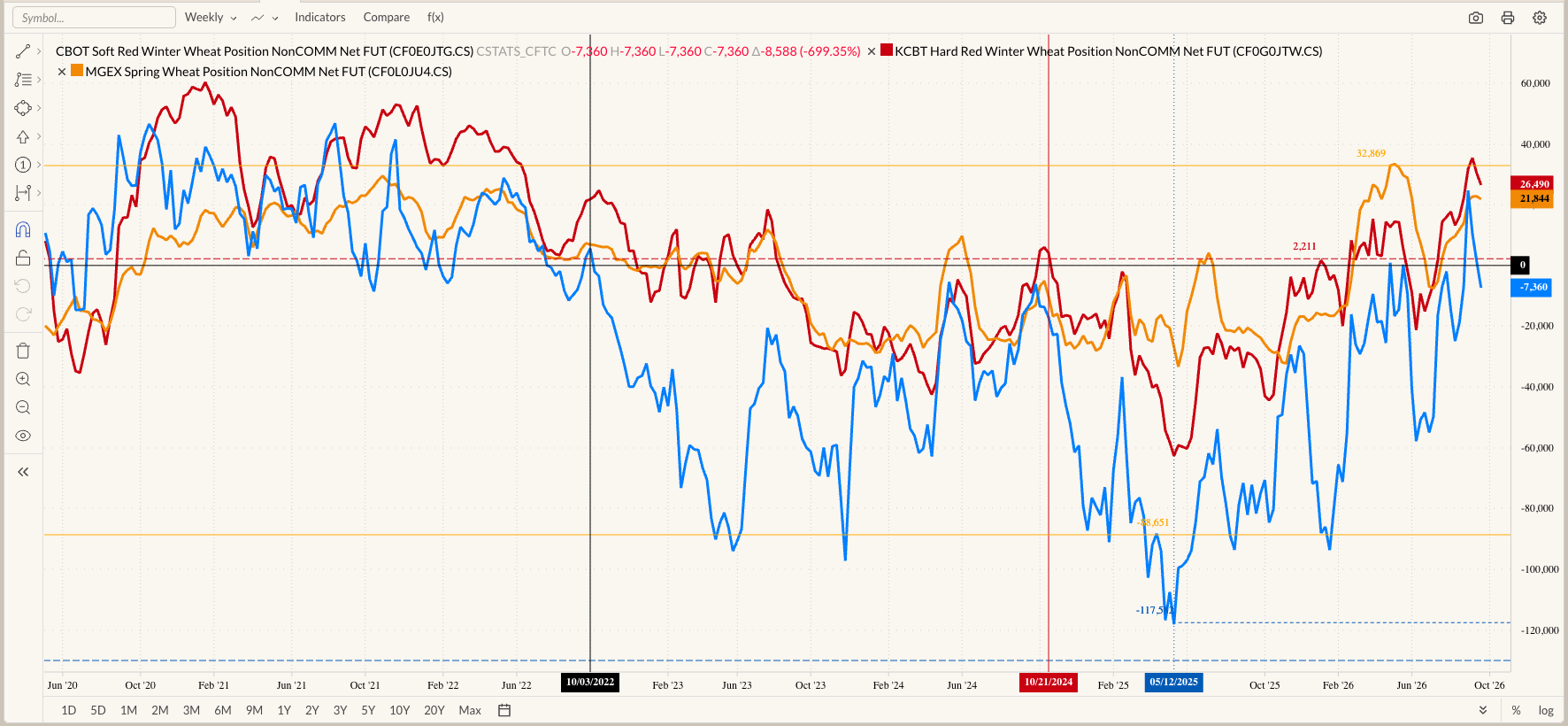
Wheat: It doesn’t take much imagination to conclude the wheat sub-sector was in the red pre-dawn Monday. That being said, the three markets didn’t collapse on big overnight trade volume. Maybe because King Corn and Sir Soybean garnered all the attention. The December SRW issue (ZWZ26) was down 5.75 cents to start the day after sliding as much as 7.75 cents on trade volume of about 12,000 contracts. That isn’t much. The more interesting aspect of SRW was in last Friday’s Commitments of Traders report that showed Watson had moved back to a net-short futures position of 7,360 contracts, a switch of 8,590 contracts from the previous week. Since last Tuesday’s close at $7.1725, Dec SRW has lost as much as 21.75 cents indicating funds have been adding to the net-short futures position. But as my friend in the brokerage industry likes to say, “There is a lot of positioning week left the next couple days”. Over in HRW we see December down 9.5 cents, but still 2.0 cents off its overnight low, on trade volume of fewer than 5,000 contracts. Watson decreased its net-long futures position in HRW by 3,845 contracts, though still held a sizeable 26,490 contracts. New-crop July was off 8.0 cents to start the week.
[i] I hesitated to quote the lead headline this morning, but here goes, “(The US president) ‘very seriously’ considering diesel export ban as global supply crunch worsens”. I will withhold my editorial comment for now.
On the date of publication, Darin Newsom did not have (either directly or indirectly) positions in any of the securities mentioned in this article. All information and data in this article is solely for informational purposes. For more information please view the Barchart Disclosure Policy here.