
- PRICING
- LIVE QUOTES
- LEARN
- HELP


EN
How Preferred Share Offering Will Impact National Bank of Canada Stock Investors
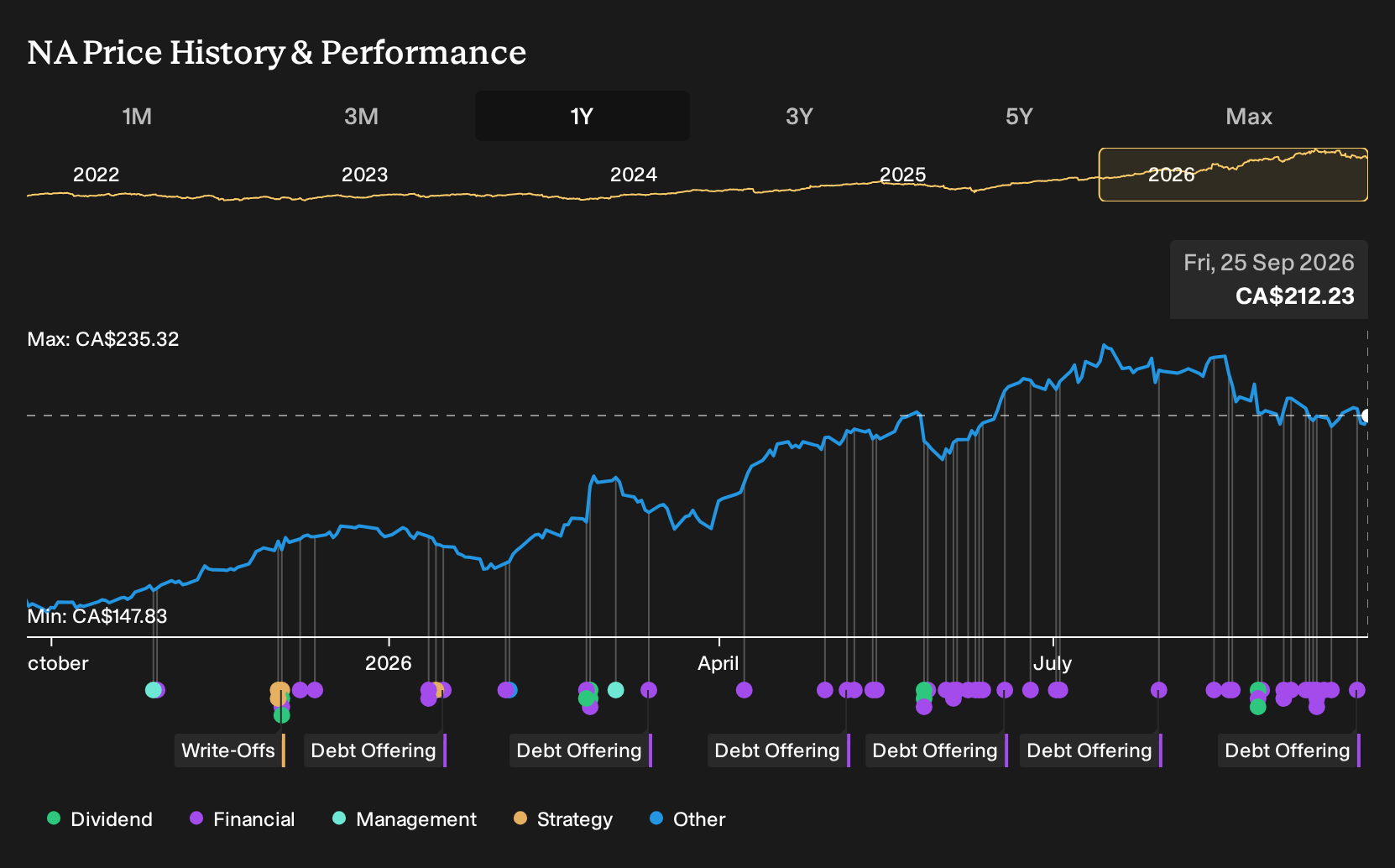
- National Bank of Canada has recently completed a CAD 750 million fixed income offering of 750,000 non convertible, callable, non cumulative variable rate preferred shares priced at CAD 1,000 each with a CAD 10 discount per security.
- This preferred share issuance gives National Bank of Canada added funding flexibility without ordinary share dilution, and the callable, variable rate terms keep future funding costs and balance sheet structure under management’s control.
- We will now look at how this large preferred share financing could influence National Bank of Canada’s existing investment narrative.
Scan how National Bank of Canada is managing its capital stack, then see how other issuers are structuring their balance sheets with the hand picked list of solid balance sheet and fundamentals (7 results).
National Bank of Canada Investment Narrative Recap
To own National Bank of Canada, you need to believe the franchise can keep growing earnings in a controlled way while managing concentration in Quebec, the Canadian Western Bank integration and rising technology spend. The preferred share issue does not alter that core story much. It mainly changes how the bank funds those projects rather than what it is trying to build.
In the near term, the key swing factor remains how net interest margins and credit quality hold up as loan growth and fee income develop. The biggest risk still sits in regional and macro pressure that could push provisions for credit losses higher, especially with a relatively low 58% allowance for bad loans already in place.
The CAD 750m variable rate preferred stock is the headline announcement here. It gives National Bank of Canada extra flexibility around capital while management works through CWB integration, ongoing digital investments and competitive pressure from non bank lenders. Because it is non convertible, it avoids ordinary share dilution and keeps existing shareholders’ ownership more stable.
Callable, non cumulative, variable rate terms keep future funding costs more adjustable, which matters if deposit spreads stay under pressure or if interest rates move around. For you as a shareholder, the important link is execution. How well the bank turns this extra layer of capital into steady lending, fee income and controlled credit risk will influence how those existing catalysts actually play out.
National Bank of Canada's narrative points to revenue of CA$18.0b and earnings of CA$6.0b by 2029. That profile assumes revenue growth of 7.2% a year and an earnings increase of CA$1.3b from CA$4.7b today.
Uncover why National Bank of Canada's fair value indicates a 6% potential upside to its current price that could narrow quickly.
Exploring Other Perspectives
Simply Wall St Community members have posted only two fair value estimates for National Bank of Canada, yet those views already span a wide band from about CA$224 to CA$295 per share. That spread sits beside real execution questions around CWB integration, regional exposure and interest rate pressure, so you should compare several viewpoints before taking a firm stance.
Explore another National Bank of Canada fair value estimate, including one that suggests as much as 39% upside from the current price!
Decide For Yourself
Don't just follow the ticker. Dig into the data and build a conviction that's truly your own.
- A great starting point for your National Bank of Canada research is our analysis highlighting 4 key rewards and 1 important warning sign that could impact your investment decision.
- See our latest analysis for National Bank of Canada. The report includes a comprehensive fundamental analysis summarized in a single visual, the Snowflake, making it easy to evaluate National Bank of Canada's overall financial health at a glance.
Looking For More Investment Ideas Beyond National Bank of Canada?
Once you have a view on National Bank of Canada, it can help to widen the lens and compare it with other opportunities that match your risk tolerance and income or growth preferences. The Simply Wall St Screener lets you filter listed businesses by fundamentals, balance sheet strength and income profile so you can build a shortlist that actually fits your plan.
- If you want resilient businesses with relatively lower risk profiles, start with a focused set of 8 resilient stocks with low risk scores that may better align with a steadier approach.
- For investors looking for value opportunities backed by strong fundamentals, scan a curated group of 9 high quality undiscovered gems that might not yet be widely followed.
- If income is a priority and you care about more robust payouts, review a targeted pool of 1 dividend fortresses that match a higher yield threshold.
This article by Simply Wall St is general in nature. We provide commentary based on historical data and analyst forecasts only using an unbiased methodology and our articles are not intended to be financial advice. It does not constitute a recommendation to buy or sell any stock, and does not take account of your objectives, or your financial situation. We aim to bring you long-term focused analysis driven by fundamental data. Note that our analysis may not factor in the latest price-sensitive company announcements or qualitative material. Simply Wall St has no position in any stocks mentioned.
Have feedback on this article? Concerned about the content? Get in touch with us directly. Alternatively, email editorial-team@simplywallst.com