
- PRICING
- LIVE QUOTES
- LEARN
- HELP


EN
The prospects for opening up in Hormuz are once again overshadowed, and Asian bonds are under pressure: 2Y Japanese bond yields are approaching 2%, and 3Y Korean bond yields have risen to the highest since 2022
The Zhitong Finance App learned that Asian bond yields generally rose and Japanese and South Korean treasury bonds fell on Monday. Earlier, US President Donald Trump rejected Iran's latest proposal to reopen the Strait of Hormuz, leading to a rise in oil prices.
Japan's two-year treasury bond yield is approaching the critical 2% threshold as investors increase their bets on further interest rate hikes by the Bank of Japan. Treasury bond yields, which are more sensitive to monetary policy expectations, rose 4 basis points to 1.975% on Monday, the highest level since 1995. Treasury yields for other maturities are also under pressure, with 5-year treasury yields rising 3 basis points to 2.43%.
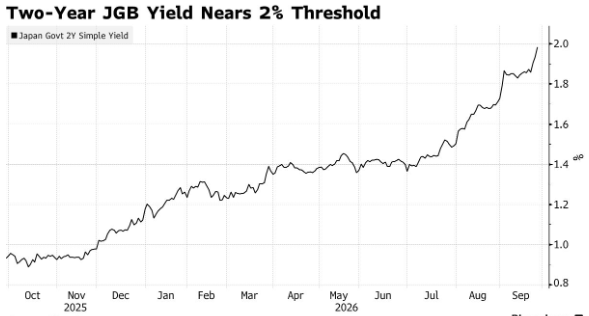
Since Bank of Japan Governor Kazuo Ueda did not give clear guidance on the pace of future austerity after the market generally anticipated an interest rate hike at the beginning of this month, investors are worried that the Bank of Japan may be slow to act. This reinforces market expectations that policymakers may eventually need to be more aggressive in raising interest rates, especially as the hawkish US Federal Reserve threatens to maintain the gap between the US and Japan.
Kazuo Momma, a former executive member of the Bank of Japan's monetary policy executive, said in an interview that the central bank may raise the benchmark interest rate for the second month in a row in October. This timeline is earlier than many economists expected. Overnight index swaps show that the probability of a rate hike in October is about 40%, while the possibility of a 25 basis point rate hike in December has been fully digested.
The analysis points out that the more severe test may be Wednesday's two-year treasury bond auction. The market generally expects the Bank of Japan to raise interest rates in December, and some analysts even think it is possible to raise interest rates in October. This may cause buyers to be reluctant to enter the market until yields reach at least 2%, especially as Thursday's short report reinforces market expectations for further monetary policy tightening.
The weak yen has heightened market concerns about tightening monetary policy. US President Trump expressed concern about the Japanese yen exchange rate during a recent meeting with Japanese Prime Minister Takaichi Sanae, while Japan's Finance Minister Katayama Satsuki stated that Takaichi Sanae “is not an inflationist” in an attempt to ease concerns that the government will put pressure on the Bank of Japan to maintain low interest rates.
SMBC Nikko Securities strategist Ataru Okumura and others pointed out in a report that as politicians in Japan and abroad are increasingly concerned about the weak yen, transactions betting on the Bank of Japan to speed up monetary policy tightening are heating up. They said that fiscal expansion in major economies and rising commodity prices may also reinforce market expectations that Japan will eventually need to tighten monetary policy to curb inflation.
Meanwhile, the yield on South Korea's three-year treasury bonds rose to the highest level since November 2022, and also joined the global sell-off because high oil prices raised concerns about inflation, and the yield rose 11 basis points to 4.11%. The local market was closed on Thursday and Friday, during which time the yield on America's longest term treasury bonds climbed to the highest level in more than 20 years.
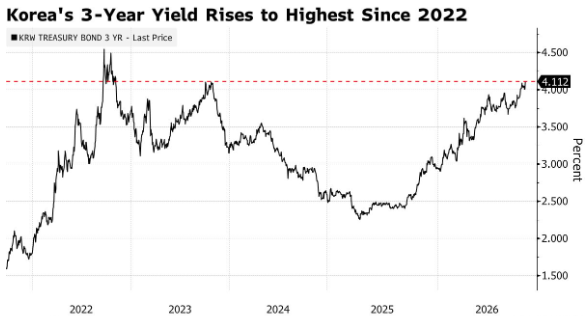
Kang Seungwon, a fixed income analyst at NH Investment Securities, said, “The sharp rise in Korean treasury yields shows that this is not only a US problem, but also shows that the market is increasingly worried that the Bank of Korea will have to raise interest rates further.” Kang also said that if the Federal Reserve raises interest rates for the second time in a row in October, it is likely to prompt the Bank of Korea to raise interest rates in November.
Since this year, the performance of the South Korean bond market has been weak due to the ongoing war in the Middle East driving up oil prices, raising concerns about the acceleration of inflation in this country that is heavily dependent on imported energy. The Bank of Korea has raised interest rates twice in a row. Previously, the unprecedented boom in the semiconductor industry boosted South Korea's economic growth stronger than expected, further increasing price pressure.
The Bank of Korea held a market assessment meeting on Monday to assess global financial conditions during the September 24-27 holiday period. The central bank said in a statement issued after the meeting that the authorities will pay close attention to the market because market volatility may increase.