
- PRICING
- LIVE QUOTES
- LEARN
- HELP


EN
Demand for AI is booming, yet the “credit floodgates” for financing are being tightened! Under the heavy pressure of the 5% US Treasury yield, computing power losers are gradually surfacing
The Zhitong Finance App learned that companies in the stock market that are benefiting from an unprecedented wave of AI computing power infrastructure construction are simultaneously facing demand expansion and drastic tightening of financing conditions: AI smart applications bring ever-expanding demand for AI computing power resources, and the continuous rise in capital costs against the backdrop of 10-year US Treasury yields soaring above 5% has raised the capital threshold for converting excess AI orders into actual cash flow.
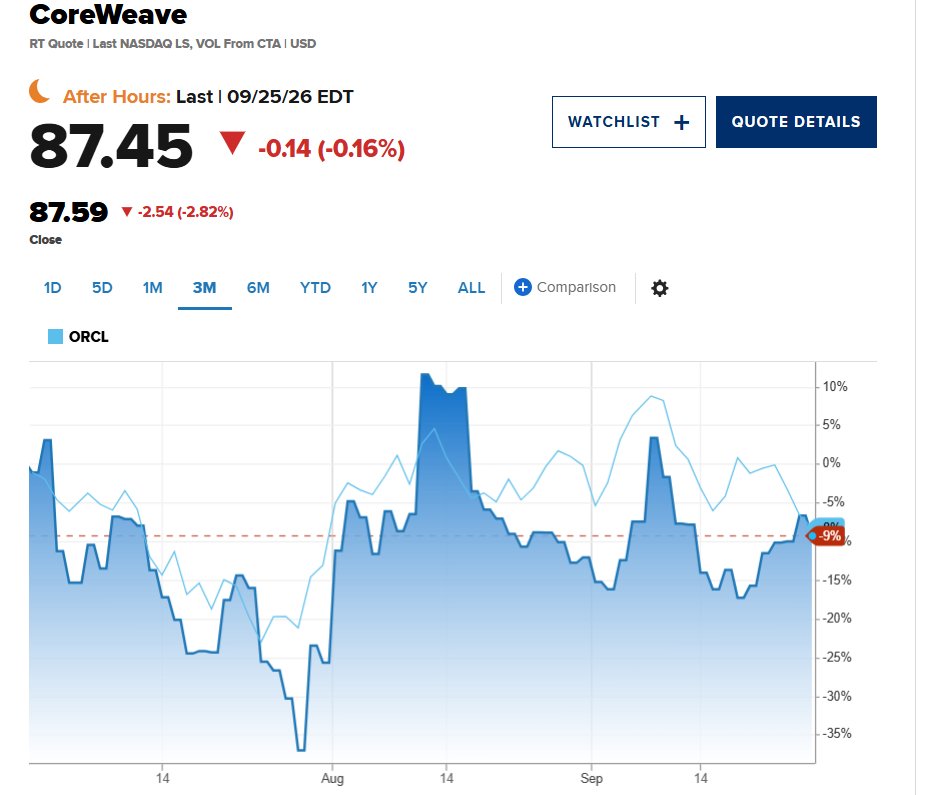
In the week ending September 25, CoreWeave's stock price rose by nearly 8%, but Oracle fell by about 7%, with a cumulative decline of about 30% during the year, indicating that investors are beginning to examine the financing, delivery, and cash flow capabilities of different companies more closely. J.P. Morgan Chase predicted in June that by 2030, the debt financing required for AI infrastructure construction would reach about US$4.1 trillion — this is a multi-year cumulative financing forecast. It is not a single year's issuance scale, nor is it all equivalent to corporate bonds. As such huge demand for construction continues to enter the capital market, interest rates, credit conditions, and availability of capital will directly affect the rate of expansion.
The most popular AI smart applications represented by Muse and Astra provide a new source of strong and sustainable growth for computing power demand. A single user instruction can trigger planning, search, browser operation, code execution, and result verification. Multiple rounds of model calls also increase the need for context processing and state storage. Derived from engineering mechanisms, GPUs are responsible for model calculation, CPU execution tools, and task orchestration; HBM, server DRAM, and enterprise-grade SSDs jointly support data access and cache management; data center optical interconnection controls high-speed data transmission. A detailed engineering analysis by Nvidia indicates that CPU execution speed affects effective GPU utilization, and hierarchical caching can reduce repeated computation through GPU memory, CPU memory, local NVMe, and remote storage. Therefore, the investment value brought about by the penetration of smart devices ultimately needs to be reflected in the ability of a unit of capital to deliver more feable high-complexity tasks and larger AI computing power resource requirements, and to form a stronger cash flow for business operations.
The specific changes on the financial side are unquestionably global. On September 25, US 10-year and 30-year Treasury yields once hit about 5.23% and 5.53%, respectively, reaching the highest levels since 2007 and 2004. Energy supply shocks, inflationary stickiness, and economic demand resilience are driving the market to adjust the future policy interest rate path; the Federal Reserve raised interest rates by 25 basis points in September. According to an analysis by Schwab Wealth Management on September 25, the futures market has been inclined to include expectations of close to three additional interest rate hikes until June 2027. As the “anchor of global asset pricing,” the upward shift in 10-year US bond yields not only raises the pricing benchmark for new long-term financing, but also lowers the valuation of companies' future cash flows through higher necessary returns.
The “credit gate” of the AI frenzy: the expansion of total financing volume may occur at the same time as the contraction of financing qualifications
The current AI computing power expansion frenzy seems to be being screened by a “credit gate” — demand determines how much a company wants to finance, while loan forces determine which orders and projects are sufficient to obtain funding.
The financiers of the American company under Mitsubishi UFJ Leasing believe that the new cloud companies that the market is really willing to support may only be part of the candidate list; this is a practitioner's judgment, but it reveals a very critical change: higher interest rates can cover some of the risks, but the project lacks reliable electricity, delivery guarantees, or an enforceable customer contract, or the AI project relies too much on a single major customer, and may not be able to obtain financing by simply increasing prices. As deduced from this, the industry's overall borrowing may still grow, while capital is gradually concentrated on companies with thicker financial buffers, higher contract quality, and stronger delivery capacity.
Interest rate shocks also require distinguishing debt structures. Fixed-rate debt that is newly issued or requires refinancing will face repricing; stock floating interest loans are usually adjusted according to short-term benchmarks such as SOFR, and the increase in ten-year US bonds cannot be directly applied to all loans. According to CoreWeave's SEC documents, based on the balance of the outstanding floating interest rate debt on June 30, 2026, the interest rate was raised by 100 basis points, corresponding to additional interest charges of about 30 million US dollars for 3 months and 61 million US dollars for six months. The company also disclosed the use of interest rate swaps to mitigate some of its risks. These figures measure the sensitivity of specific existing debt. Future changes in new loans, financing costs, and credit spreads will further affect actual capital costs.
SoftBank reflects the side where demand for financing remains strong. The bond issue finalized on September 24 includes 10 billion US dollar bonds and 1 billion euro bonds, totaling about US$11.1 billion; the maximum term of US dollar bonds is 7.5 years, with a coupon interest of 9.75%, issued at face value, and is expected to be delivered on September 29. Part of the capital raised will be used to pay for subsequent investment in OpenAI. This sign indicates that when a large enterprise believes that the cost of missing out on the AI layout window is higher, it may still accept expensive capital; however, higher interest also means that future investment returns will need to cross a higher return threshold.
Another variable that is more difficult to offset by strong demand is the time gap between construction expenses and operating payments. Equipment procurement, construction, and financing costs are incurred first, while revenue depends on electricity access, project acceptance, and customer use. The “force majeure” dispute over Oracle's Project Jupiter is involving contract payment arrangements after a potential extension; previously, some media reported, citing information revealed by people familiar with the matter, that the relevant arrangements may extend the payment phase for lower construction rents and delay the beginning of higher operating period rents, while Blue Owl Capital indicated that financial commitments have not changed. It can be seen from this that the financing value of long-term AI infrastructure orders also depends on delivery conditions and risk sharing systems, and cannot be directly regarded as cash that has already been paid. For investors, the “credit gateway” ultimately selects AI cloud computing/computing power companies that can convert computing power requirements into cash flow for debt repayment on time and preserve shareholder returns after paying interest.
Demand for AI computing power clashes with financing pressure: bond yields are soaring, and AI computing power companies seeking debt financing face greater risks
As US Treasury yields rise to their highest level since 2007 this week, companies that rely on debt financing will face rising borrowing costs. This means that AI infrastructure construction, which has reached a historic scale, is about to become more expensive.
J.P. Morgan Chase estimated in an in-depth research report in June that it is estimated that by 2030, 4.1 trillion US dollars of AI-related debt will be issued. Data center companies and other companies associated with the AI boom are racing to expand production capacity to meet AI service needs that many industry experts consider almost difficult to meet.
When borrowers re-entered the financing market, they faced a ten-year US Treasury yield close to 5.17%, up about 1 percentage point from the beginning of the year. This means that businesses that issue debt will have to offer more attractive returns to attract investors.
The market hasn't panicked yet, at least not yet. The stock price performance of the new cloud company CoreWeave, which is heavily burdened by debt, remains steady, rising nearly 8% this week; while Oracle, which has high financial leverage and relies on the long-term debt market to support AI expansion, had an even worse time. It fell 7% this week and has fallen about 30% since this year.
Meanwhile, the Japanese investment giant SoftBank Group, which is one of the main capital providers for AI projects, raised US$11.1 billion by issuing junk bonds this week, of which the yield on 7-year bonds reached 9.75%.
Siebert Financial Chief Investment Officer Mark Malek said in an interview: “They are basically insensitive to the price of this financing, which means they are price takers. In my opinion, many of these companies must be less price sensitive. They need to raise as much capital as possible to compete.”
At the center of the AI boom are leading model developers OpenAI and Anthropic. Both companies have surpassed the $1 trillion supermark in the private equity market. To provide these advanced models, as well as the infrastructure needed for many other companies' models and services, the tech industry's hyperscale cloud vendors — Amazon, Google, Meta, and Microsoft — have committed hundreds of billions of dollars in capital spending this year, and are expected to further increase to trillions of dollars in AI capital expenditure in 2027.
Although a significant portion of these investments are funded through debt financing, these tech giants all have investment-grade credit ratings, enabling them to obtain capital at a lower cost. However, some market participants believe that other companies will face greater challenges in the future.
According to information quoted by the media, a senior private equity investor told the media that in the future, financing new cloud projects will become more difficult because these companies have less buffer space to absorb rising costs. To discuss this issue frankly, the investor asked for anonymity.
Riley Thompson, vice president of Mitsubishi HC Capital America, said in an interview that even if borrowers are willing to pay higher interest rates, lenders are more selective in choosing projects they are willing to fund.
Thompson said, “If you list 50 new cloud companies, the market is probably only really interested in 20.”
CoreWeave, which went public last year, warned of the risk of rising interest rates in a filing with the US Securities and Exchange Commission. In its latest quarterly filing, the company said that for every 100 basis points, or 1 percentage point, interest charges may increase by 30 million US dollars, according to the balance of outstanding variable interest rate debt up to June.
An early warning sign may have surfaced this week. On Friday, some media quoted people familiar with the matter as revealing that Oracle issued a “force majeure” notice regarding its New Mexico data center project to avoid higher costs, and the company's stock price fell thereafter. According to reports, if this park called Project Jupiter fails to be put into operation in 2028 as expected, Oracle hopes to postpone related payments. Oracle said the project “is still progressing according to our established schedule.”
Rising interest rates aren't the only problem facing us right now. Anthropic and OpenAI's CEOs have begun calling for a slowdown in AI development before yields soared this week, after industry researchers publicly voiced concerns that advanced models could be at risk of leaving human control.
Meanwhile, as the November midterm elections approach, opposition to AI data centers across the US has become an important topic of discussion. According to a recent poll from the NBC News Decision Desk, with technical support from SurveyMonkey, 69% of respondents opposed the construction of such facilities in their area, mainly due to the unprecedented surge in utility bills and carbon emissions on the residential side brought about by the AI infrastructure frenzy. On Monday, Texas Republican Governor Greg Abbott, who is facing intense competition for re-election, ordered the temporary suspension of all environmental licensing approvals related to data centers; previously, he suspended grid access approvals last month.
Despite this, demand for AI services is growing rapidly. The latest example is Meta's personal assistant app, Muse, which has rapidly increased in popularity since its launch in early September. Muse had more than 2.5 million global downloads in the first two weeks of launch, surpassing ChatGPT at the top of the Apple App Store. Evercore's Mark Mahani told CNBC this week that Muse could reach 100 million users within 6 to 12 months.
Andrew Giudici, head of global corporate, project and infrastructure finance at credit rating agency KBRA, said that although rising interest rates may affect future transactions, he has yet to see a significant impact on borrowing demand.
Giudici said, “In a normal environment, people might take a step back and pause a little bit. But I don't think that's going to happen here. I think you'll continue to see quite large releases.”
There is no doubt that as costs rise, “someone will always have to bear it,” said Haim Zartzman, vice chairman of Latham & Watkins's Emerging and Growth Business. Zartzman, who has been in the core business of AI computing power infrastructure financing for a long time, said, “But under such a structure where demand is so strong, it is much easier to absorb these costs.”
For American Compute CEO Bernie Margulis, who provided risk management advice for GPU financing, this account is even simpler. He said that even though the costs are higher, borrowers are still in a hurry to get financing, especially those with contracts with OpenAI and Anthropic; the two companies have been signing agreements to lock in the supply of computing power for years to come.
Margulis said, “If you sign a multi-year contract with Anthropic and then add 50 basis points, will that really stop you?”