
- PRICING
- LIVE QUOTES
- LEARN
- HELP


EN
The AI Fear That Crushed Accenture Just Created Its Biggest Opportunity. Here’s What The Anthropic Partnership Means.
For years, the fear hanging over Accenture (ACN) was simple to understand. The market feared artificial intelligence (AI) would automate the consulting work that companies pay firms like Accenture to do. That is what punished ACN stock; shares fell from a 52-week high of $291.09 in January 2026 to under $120 by late June. ACN stock is still down about 34% so far this year, while Guggenheim recently downgraded Accenture over soft consulting demand.
Now, though, investors finally have a glimmer of hope that could change Accenture's story. Specifically, the company recently announced a partnership with Anthropic to build a team of embedded evaluators who will work inside Anthropic to stress-test its AI models, probe safeguards, and check that they behave as intended. Each company plans to invest at least $1 billion over five years.
A New Line of Work From an Unlikely Source
This deal comes after Anthropic CEO Dario Amodei called for the pace of AI development to slow down so that safety standards can keep up. That same call rattled many chip stocks earlier this month, first causing a decline in Arm Holdings (ARM) stock and then threatening shares of ASML (ASML). In response to both instances, I argued that Arm and ASML remained solid businesses just suffering from a strange remark from Anthropic's CEO.
For Accenture, however, the same news opened a whole new market. Basically, AI safety evaluation is an emerging field, and someone has to do the hands-on testing that labs can’t fully do alone. Accenture is positioning itself to be that someone using Faculty, the AI firm it bought earlier this year. So, the technology that previously threatened to shrink consulting is now creating fresh demand for it.
There is one catch, though. Accenture will act as an independent safety checker while also selling AI consulting to businesses. Some observers have already questioned whether one firm can credibly do both. That tension will follow the deal. But for a company many had given up on, a major safety role is a meaningful turn.
About Accenture Stock
Accenture is a global professional services firm that helps businesses with consulting, technology, and operations. It has been building up its AI capabilities, including through its purchase of U.K.-based Faculty earlier this year. Founded in 1989, the company is headquartered in Dublin, Ireland.
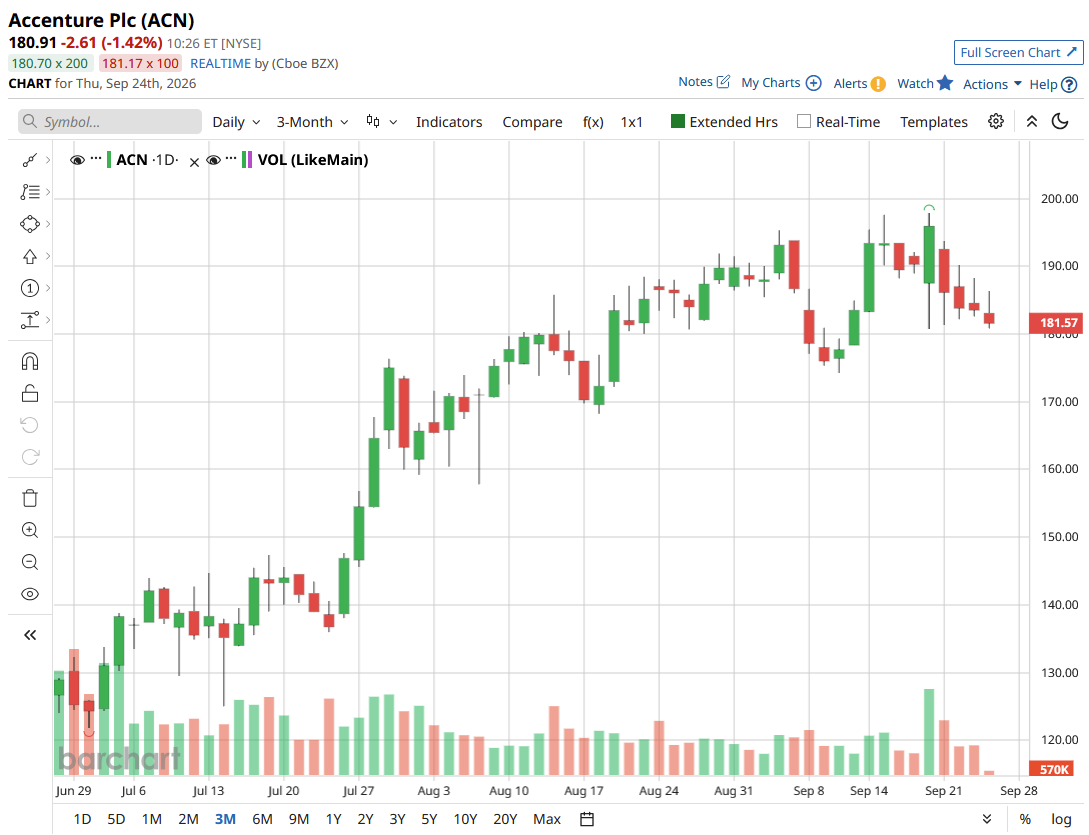
Year-to-date (YTD), ACN stock is down 34%, far underperforming the Technology Select Sector SPDR Fund’s (XLK) 36% gain during the same period. After peaking near the $291 mark in mid-January, the stock fell to a low of roughly $118 in June. This included an 18% one-day drop after the company trimmed its outlook. Since then, ACN stock has recovered to around $176 per share.
Accenture looks genuinely cheap. Its forward price-to-earnings (P/E) ratio of 12.1 times sits well below its five-year average of 25 times, while the price-to-sales (P/S) ratio of 1.5 times shows a similarly steep discount. The market has priced in the fear that AI is coming for consulting work, and the fear doesn’t look baseless. Earnings growth is expected to be modest at around 7% in fiscal 2026 and 6% in fiscal 2027. So, the low price reflects a business that the market still doubts. But if the Anthropic deal signals that AI has become an opportunity rather than a threat, the market may look back and see a bargain.
Accenture Cuts Fiscal 2026 Growth Outlook as AI Demand Faces a Reality Check
Accenture reported its third-quarter fiscal 2026 earnings on June 18. The company showed revenue of $18.7 billion, up 6% year-over-year (YOY). Diluted EPS came in at $3.80, comfortably beating the Wall Street consensus of $3.72 per share. Profitability for the quarter also increased. Operating margin rose 20 basis points from a year earlier to 17%, while gross margin was 32.8%, nearly flat YOY.
Looking forward, the company is set to announce Q4 fiscal 2026 earnings on Oct. 1. Accenture guided for revenue of $17.75 billion to $18.4 billion for the quarter. For the full fiscal year, the company expects local-currency revenue growth of 3% to 4%, including about a 1% headwind from U.S. federal business. Adjusted EPS is expected to be between $13.78 and $13.90 in fiscal 2026. Moreover, the company expects about $9 billion in acquisitions for fiscal 2026, up from a prior estimate of $5 billion.
UBS analyst Kevin McVeigh asked about the company’s $9 billion plan. CFO Angie Park said the company expects acquisitions to contribute slightly less than 2% of growth entering fiscal 2027. CEO Julie Sweet added that Accenture's cybersecurity acquisitions have generated $208 million in annual recurring revenue (ARR), growing 48%.
What Do Analysts Expect for ACN Stock?
BMO Capital recently increased its Accenture price target from $150 to $200 while maintaining a “Hold” rating. Deutsche Bank also raised its price target from $136 to $175, mainly because similar companies are now trading at higher valuations.
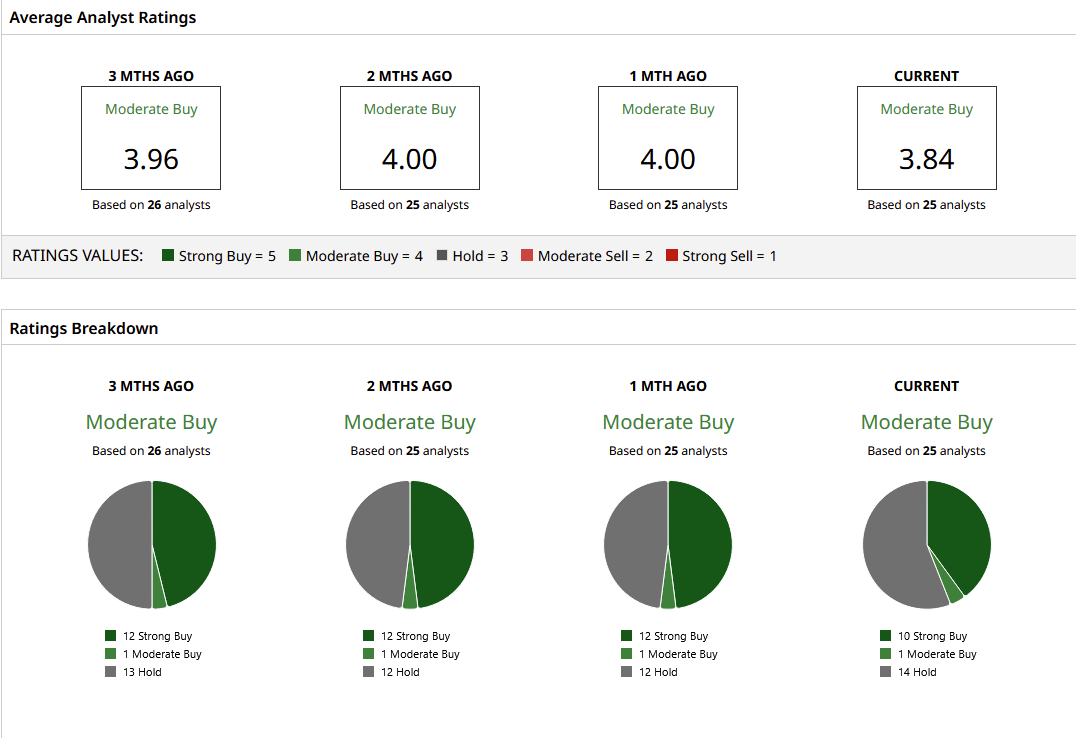
Based on the 25 Wall Street analysts covering the stock, ACN stock holds a consensus “Moderate Buy” rating overall. The mean price target of $195.33 indicates potential upside of 11% from current levels.
On the date of publication, Jabran Kundi did not have (either directly or indirectly) positions in any of the securities mentioned in this article. All information and data in this article is solely for informational purposes. For more information please view the Barchart Disclosure Policy here.