
- PRICING
- LIVE QUOTES
- LEARN
- HELP


EN
Should Slower Self Storage Development Require Action From Public Storage (PSA) Investors?
- Public Storage, a large self storage REIT with 3,584 facilities and significant exposure to Western Europe, is operating in an industry where self storage deliveries are now projected to decline 19.6% in 2026 as new development slows and operators work through pandemic era oversupply.
- The slower construction pipeline reduces near term competitive pressure on existing facilities. This can give Public Storage more room to absorb prior supply, manage occupancy, and focus on extracting value from its current footprint rather than defending against aggressive new-build activity.
- This analysis considers how Public Storage's investment narrative is affected by slower new self storage development and the current sector backdrop.
Scan beyond Public Storage and see how other storage and real estate players with solid balance sheets are positioned in our curated list of solid balance sheet and fundamentals (24 results).
Public Storage Investment Narrative Recap
To own Public Storage, you need to be comfortable with a large, slow and steady self storage platform that leans on scale, technology and acquisitions rather than rapid top line expansion. The key near term swing factor is how effectively it fills and prices its much larger portfolio, especially in markets still digesting prior oversupply.
The projected 19.6% drop in 2026 self storage deliveries should ease competitive pressure, which helps the operating backdrop but does not remove core risks. Sunbelt weakness, high leverage and integration of National Storage Affiliates and Public Storage Canada still sit at the center of execution risk for the next few years.
In that context, the most relevant development is the large acquisition of National Storage Affiliates at roughly US$10.5b. This expanded Public Storage’s footprint and created a bigger base of properties where slower new construction could matter more to occupancy, pricing experiments and cost savings.
The same logic applies to the US$1.2b Public Storage Canada deal. Catalysts now depend on whether management can turn these transactions plus PS Next and PS4.0 into the US$110 million to US$130 million of targeted synergies while keeping NOI margins near 65% in new markets, without stretching the balance sheet further.
What The Current Forecasts Imply For Public Storage
Analysts outline a relatively measured path for Public Storage over the coming years, built around moderate expansion rather than dramatic swings. Revenue is assumed to increase by 5.3% a year over the next 3 years. Profit margins are projected to ease from 37.6% today to 36.9% by 2029, which points to a slightly thinner cushion on each dollar of income even if the overall pie gets larger.
On the earnings side, the consensus view has net income moving from US$1.8b today to about US$2.1b by 2029, with some estimates stretching as high as US$2.5b. That shift from US$1.8b to US$2.1b equates to an earnings increase of roughly US$300m over the period. Forecasts also assume only minimal dilution, with share count expected to edge up by 0.09% per year, which keeps much of that projected profit gain tied to existing holders rather than new capital.
Public Storage's narrative projects US$5.7b revenue and US$2.1b earnings by 2029. This setup requires 5.3% yearly revenue growth and an earnings increase of roughly US$300m from US$1.8b today.
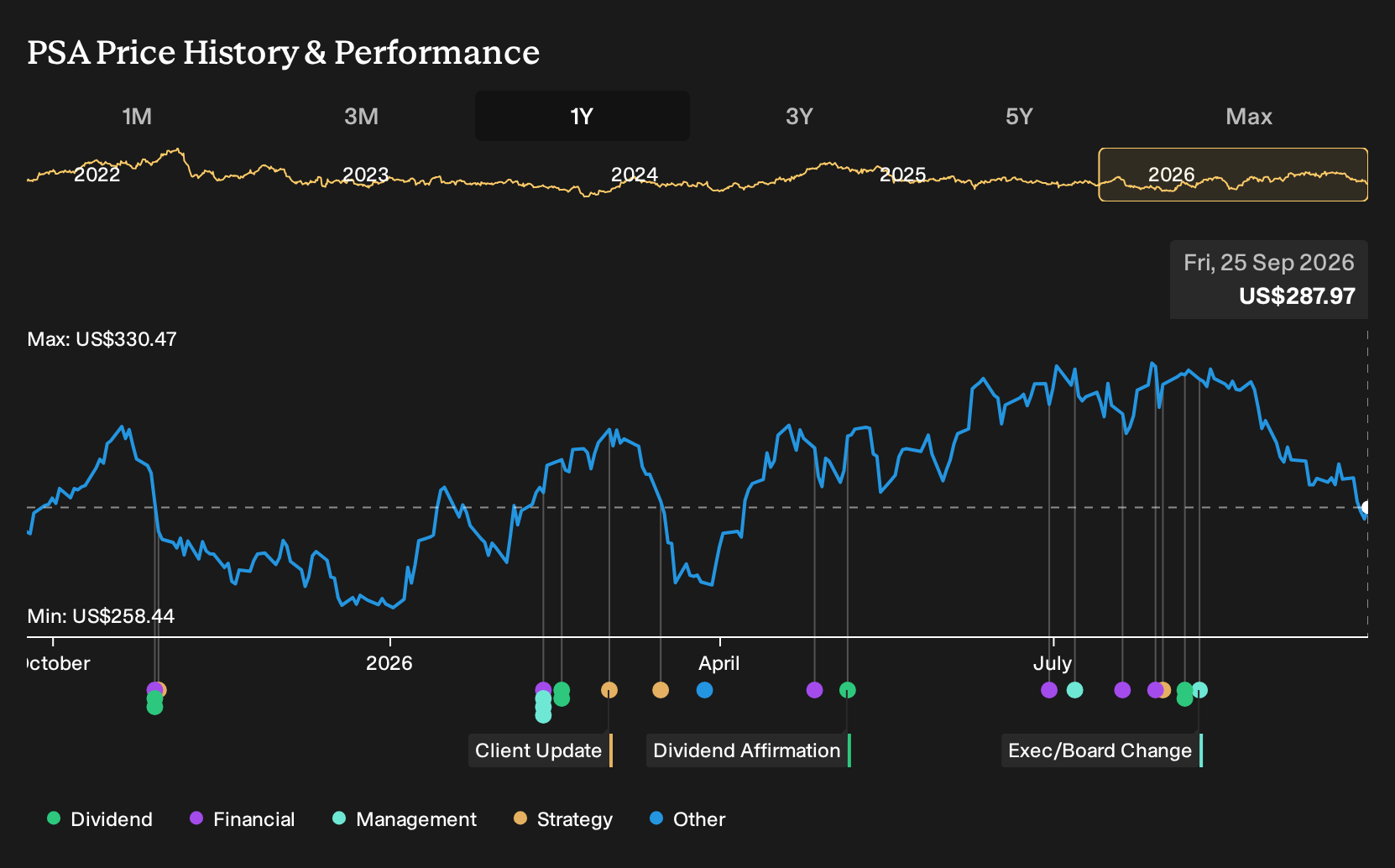
Valuation work in the current research pulls these assumptions together into a single reference point. The consensus target price of US$337.11 sits about 12.1% above the recent share price of US$296.31. That target is built on the idea that by 2029 Public Storage could be earning US$2.1b on US$5.7b of revenue and trade on a P/E multiple of 35x those future earnings, compared with about 30x today and an industry level of 26.7x for US specialized REITs.
For you as an investor, the key question is less about the exact target price and more about the path implied by those inputs. To line up with the current consensus, you would need to be comfortable that Public Storage can sustain roughly mid single digit annual revenue growth, accept a modest margin step down, and still command a higher P/E multiple in 2029 than both its current level and the sector average. Any personal view that differs on growth, margins, or what multiple feels reasonable will naturally lead you toward a different sense of fair value than the analyst blend outlined here.
Uncover why Public Storage's fair value indicates a 17% potential upside to its current price, which could narrow quickly as sentiment catches up.
Exploring Other Perspectives
Three fair value estimates from the Simply Wall St Community span roughly US$260.51 to about US$454.71 for Public Storage, which is a wide spread for one stock. That gap reflects how differently private investors frame Sunbelt softness, integration risk, and self storage demand, so explore these contrasting views before setting your own stance.
Explore 2 other Public Storage fair value estimates, including one that suggests as much as 10% downside from the current price.
Form Your Own Verdict
Disagree with existing narratives? Extraordinary investment returns rarely come from following the herd, so go with your instincts.
- A great starting point for your Public Storage research is our analysis highlighting 4 key rewards and 1 important warning sign that could impact your investment decision.
- See our latest analysis for Public Storage. The report includes a comprehensive fundamental analysis summarized in a single visual, the Snowflake, making it easy to evaluate Public Storage's overall financial health at a glance.
Looking For More Investment Ideas Beyond Public Storage?
If the Public Storage story has sharpened your thinking and you want to test that framework on other opportunities, the Simply Wall St Screener can help you quickly narrow the field to businesses that better fit your own risk and return preferences.
- For investors who care most about valuation support and business quality, start with a focused set of companies trading on compelling fundamentals through 32 high quality undervalued stocks.
- If capital preservation and sleep-at-night resilience matter more to you than chasing every rally, filter for businesses with sturdy finances using our 30 resilient stocks with low risk scores.
- Income focused investors who want potential yield plus balance sheet strength can zero in on high payout opportunities screened by our 8 dividend fortresses.
This article by Simply Wall St is general in nature. We provide commentary based on historical data and analyst forecasts only using an unbiased methodology and our articles are not intended to be financial advice. It does not constitute a recommendation to buy or sell any stock, and does not take account of your objectives, or your financial situation. We aim to bring you long-term focused analysis driven by fundamental data. Note that our analysis may not factor in the latest price-sensitive company announcements or qualitative material. Simply Wall St has no position in any stocks mentioned.
Have feedback on this article? Concerned about the content? Get in touch with us directly. Alternatively, email editorial-team@simplywallst.com