
- PRICING
- LIVE QUOTES
- LEARN
- HELP


EN
How Investors Are Reacting To Fannie Mae Stock After $203 Million Loan Sale
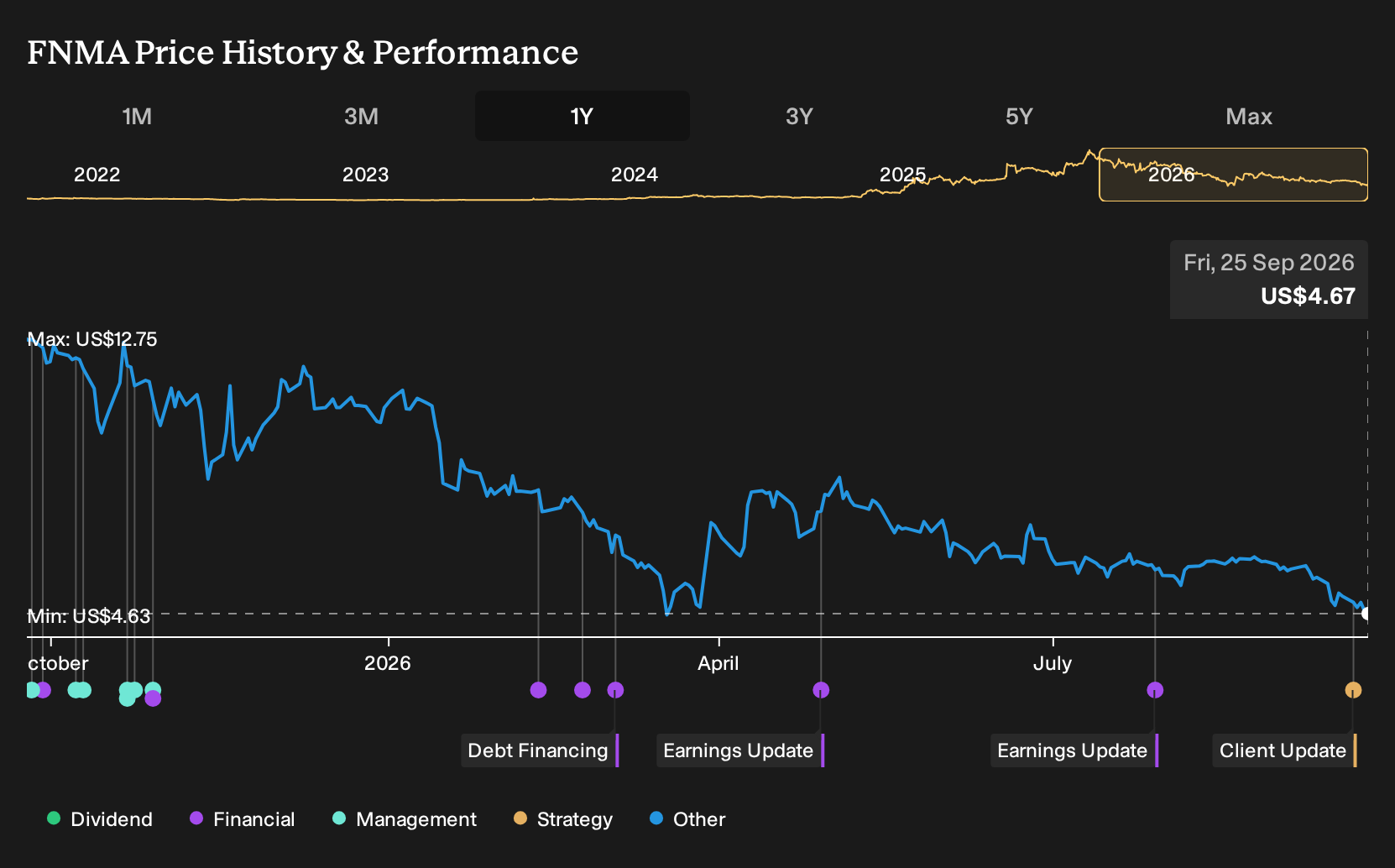
- Fannie Mae reported the results of its twenty-eighth non-performing loan sale, offloading 919 mortgages with US$203,303,314 in unpaid principal balance to Residential Credit Opportunities Trust IX-D after marketing the single pool with BofA Securities as advisor.
- The requirement for the buyer to honor existing loss mitigation efforts and offer a full waterfall of borrower relief options highlights how Fannie Mae is managing distressed assets while still prioritizing foreclosure alternatives and owner-occupant outcomes.
- We will now look at how this sizeable non performing loan sale and its loss mitigation conditions could reshape Fannie Mae’s investment narrative.
Scan beyond Fannie Mae and consider other housing-exposed opportunities with the curated list of solid balance sheet and fundamentals (24 results) that may better match your risk tolerance and return goals.
Federal National Mortgage Association Investment Narrative Recap
To own Federal National Mortgage Association, you need to be comfortable with a mortgage guarantor whose $4.1b scale and role in US housing are central to its story, while earnings are forecast by analysts to decline sharply and revenue growth expectations sit in the mid single digits. The big swing factor near term remains how credit costs and guaranty fee income balance out as housing conditions evolve.
The latest non performing loan sale looks small relative to the guaranty book and retained portfolio, so the direct financial impact appears limited. It still matters at the margin for how efficiently Fannie Mae manages distressed exposures, which feeds into credit loss provisions, capital needs, and the key risk that weaker credit performance eats into already thin forecast profit expectations.
The September 2026 announcement on the twenty eighth non performing loan sale ties directly into the existing catalyst that investors watch: credit quality on the single family and multifamily books. A pool with a US$203.3m unpaid principal balance and a weighted average 48% BPO loan to value ratio gives the buyer room to absorb resolutions, while Fannie Mae reduces on balance sheet problem assets.
Because purchasers must honor current loss mitigation and apply a waterfall of borrower relief options before foreclosure, this sale also intersects with the risk narrative. Execution quality on these workouts, and how many loans still move into foreclosure, influences realized losses, the pace of net worth build, and how much flexibility management has as regulatory capital requirements and funding costs interact with a high P/E valuation.
Federal National Mortgage Association is framed around analyst expectations that revenue reaches US$32.1b and earnings land at US$169.4 thousand by 2029, off a base of US$68.0m in earnings today. This implies 5.7% yearly top line growth and a drop in profit of about US$67.8m from current levels.
Uncover why Federal National Mortgage Association's fair value points to a 125% potential upside to its current price, while the discount to fair value may not last much longer.
Exploring Other Perspectives
One alternate view on Fannie Mae focuses more on multifamily credit risk than on earnings forecasts. The most pessimistic analysts had already anticipated pressure in this area and still projected revenue of around US$32.0b and earnings of US$29.4b by 2029. You can use this loan sale news to assess whether that more severe credit scenario now seems more or less realistic.
Explore 6 other Federal National Mortgage Association fair value estimates, including one that suggests it could be worth just $9.85!
Form Your Own Verdict
Disagree with existing narratives? Extraordinary investment returns rarely come from following the herd, so consider relying on your own analysis.
- A great starting point for your Federal National Mortgage Association research is our analysis highlighting 2 key rewards and 2 important warning signs that could impact your investment decision.
- See our latest analysis for Federal National Mortgage Association. The report includes a comprehensive fundamental analysis summarized in a single visual, the Snowflake, making it easy to evaluate Federal National Mortgage Association's overall financial health at a glance.
Looking For More Investment Ideas Beyond Federal National Mortgage Association?
Once you have a handle on Federal National Mortgage Association, it can help to widen the lens and compare it with other listed businesses that better reflect your time horizon, risk appetite, and income needs.
- If you want stability to be the priority, consider screening for companies that focus on resilience and balance sheet strength using the 30 resilient stocks with low risk scores.
- Income focused investors can narrow in on stocks that combine higher yields with an emphasis on durability by reviewing the 8 dividend fortresses.
- Those hunting for potential future leaders off the beaten path can scan a curated list in 16 high quality undiscovered gems, which filters for quality and fundamentals rather than hype.
This article by Simply Wall St is general in nature. We provide commentary based on historical data and analyst forecasts only using an unbiased methodology and our articles are not intended to be financial advice. It does not constitute a recommendation to buy or sell any stock, and does not take account of your objectives, or your financial situation. We aim to bring you long-term focused analysis driven by fundamental data. Note that our analysis may not factor in the latest price-sensitive company announcements or qualitative material. Simply Wall St has no position in any stocks mentioned.
Have feedback on this article? Concerned about the content? Get in touch with us directly. Alternatively, email editorial-team@simplywallst.com