
- PRICING
- LIVE QUOTES
- LEARN
- HELP


EN
Will Business Rewards Change Lyft (LYFT) Stock Narrative
- Sphere Entertainment Co. previously announced a multi-year marketing partnership naming Lyft as an official rideshare partner, giving Lyft branded pickup zones, in-venue and exterior digital signage, and in-app wayfinding exposure across live residencies, Sphere Experiences, and marquee events.
- Alongside this visibility push, Lyft is focusing on higher-value riders through features such as Lyft Business Rewards, which allows employees to earn Lyft Cash and partner miles on work trips that can later be used on personal rides.
- We will now examine how Lyft's expanding corporate rewards ecosystem could influence the broader investment narrative around its rideshare platform.
Scan beyond Lyft and identify other rideshare and platform plays that could be building similar demand funnels inside our curated 16 high quality undiscovered gems.
Lyft Investment Narrative Recap
To own Lyft, you need to believe the rideshare platform can turn record rider activity and strong recent earnings into durable, repeat usage from higher value customers. The Sphere partnership looks more like an incremental brand and demand channel than a core driver of near term results. The bigger swing factor still sits with how efficiently Lyft converts rider growth into cash generation.
The real short term catalyst is execution on profitable trips while keeping insurance and regulatory costs in check. Competitive pressure from Uber and potential changes to minimum coverage requirements remain the biggest risks. The Sphere deal does not materially change either of those pressure points.
The most relevant recent development here is Lyft Business Rewards, which already targets corporate and frequent travelers. That feature lets workers earn Lyft Cash and partner miles on work rides, then spend those benefits on personal trips. It directly supports Lyft’s push toward higher value, repeat riders.
When you line that up with Sphere’s high profile events traffic, the operational story becomes clearer. Product features such as Business Rewards work to deepen engagement from business users, while partnerships such as Sphere focus on top of funnel awareness. Execution risk sits in Lyft’s ability to translate both into consistent ride frequency and stable margins under heavy competitive and regulatory pressure.
Lyft Earnings Bridge Behind the Sphere Story
On paper, Lyft’s story is far more about where the income statement could be heading than about any single partnership with Sphere or other venues. Analyst models point to revenue growing at 10.4% a year over the next three years, while profit margins are expected to compress from 42.3% today to 5.1% on their 2029 view. That combination puts a lot of weight on efficient trip economics and careful cost control to keep the platform attractive for both drivers and riders.
Consensus expectations sketch out a very different earnings profile for Lyft by the end of the decade. Forecast earnings sit at US$463.0 million by 2029 compared with US$2.9b today. This implies a steep drop in absolute profit dollars even as analysts plug in ongoing top line expansion. In practice, it means that any incremental rider or corporate rewards user, whether acquired through Sphere events or business travel funnels, needs to come through at healthier unit margins than these headline numbers currently suggest.
Lyft’s narrative projects US$9.1b revenue and US$463.0 million earnings by 2029. This assumes 10.4% yearly revenue growth and an earnings decrease of about US$2.4b from US$2.9b today.
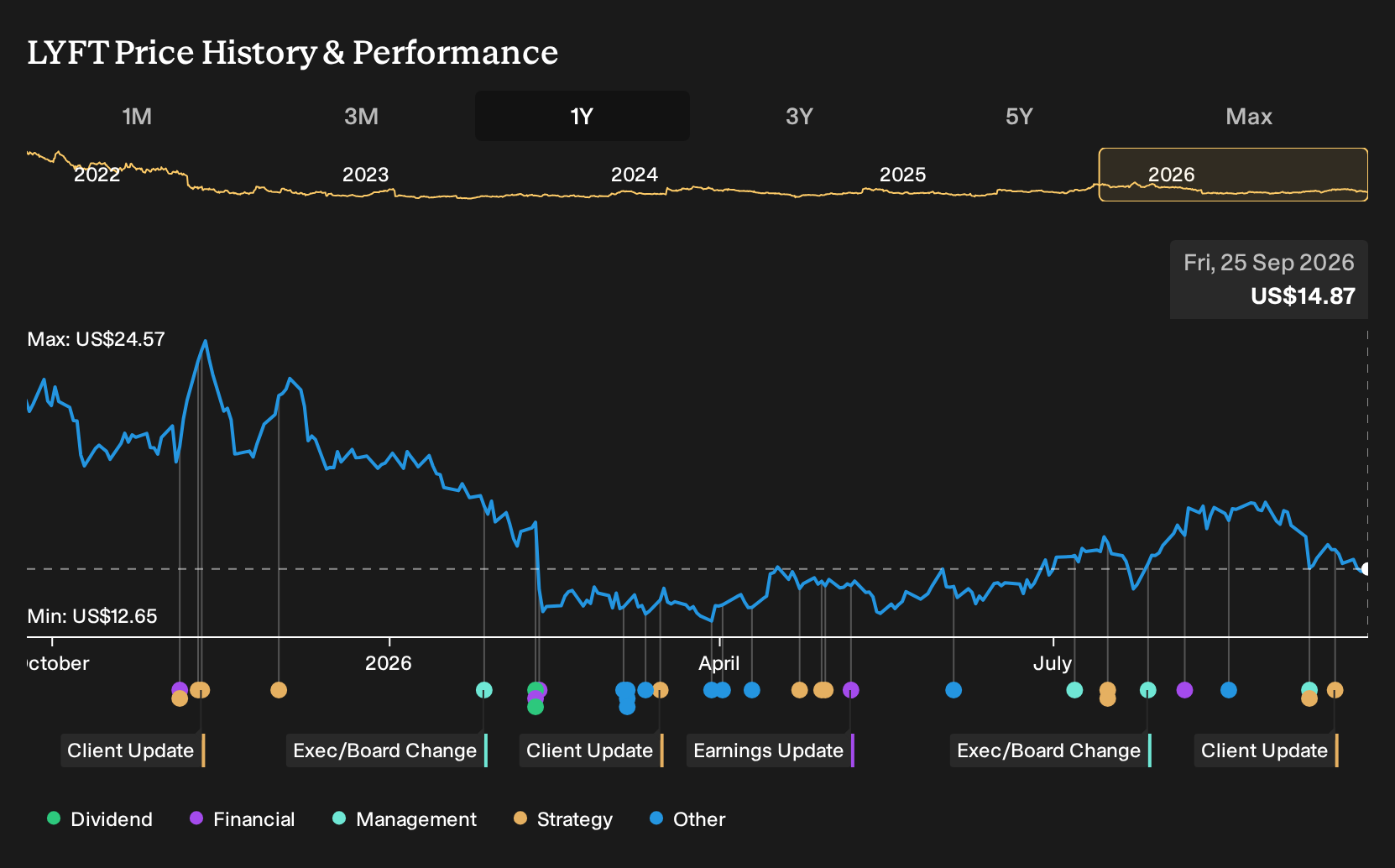
Valuation work in the same reports leans on those 2029 figures to frame what investors are paying for today. The analyst group uses that US$463.0 million earnings line and a 16.5x P/E multiple to justify a consensus price target of US$19.33 per share, compared with a recent quote of US$17.46. Their view also embeds a forecast revenue line of US$9.1b in 2029, effectively asking investors to price Lyft more on a future, thinner margin business than on current earnings power.
The current spread between the average target and the live share price is about 9.7%. That gap, small as it is, embeds a fair amount of disagreement, with the highest target at US$30.00 and the lowest at US$14.00. For readers, the key question is not whether that upside is appealing, but whether the path to US$9.1b in revenue and a reduced earnings base feels realistic given Lyft’s competitive position, regulatory exposure, and the mix shift toward corporate and event driven riders.
Uncover why Lyft's fair value indicates a 30% potential upside to its current price, which could narrow quickly once sentiment shifts.
Exploring Other Perspectives
One alternate view puts public transit expansion at the center of the Lyft story. The most bearish analysts were penciling in only 4.9% yearly revenue growth and US$149.3 million in earnings by 2029, compared with US$7.8b in sales, which is a far harsher setup. Both narratives predate the Sphere deal, so you can watch to see which one adapts most as this partnership plays through.
Explore 5 other Lyft fair value estimates, including one that suggests it could be worth just $19.33!
The Verdict Is Yours
Disagree with existing narratives? Extraordinary investment returns rarely come from following the herd, so go with your instincts.
- A great starting point for your Lyft research is our analysis highlighting 3 key rewards and 2 important warning signs that could impact your investment decision.
- See our latest analysis for Lyft. The report includes a comprehensive fundamental analysis summarized in a single visual, the Snowflake, making it easy to evaluate Lyft's overall financial health at a glance.
Looking For More Ideas Beyond Lyft?
Once you have a view on Lyft, it can help to compare that thesis with other opportunities that share similar traits, whether you care most about value, resilience, or balance sheet strength.
- If you want potential value combined with quality fundamentals, scan for companies that look mispriced on both cash flow and financial strength using our 32 high quality undervalued stocks.
- For readers who care most about durability and capital protection, focus on businesses that screen well on stability and risk controls through the 30 resilient stocks with low risk scores.
- If cleaner finances are at the top of your checklist, concentrate on companies with strong liquidity and modest leverage via the list of solid balance sheet and fundamentals (24 results).
This article by Simply Wall St is general in nature. We provide commentary based on historical data and analyst forecasts only using an unbiased methodology and our articles are not intended to be financial advice. It does not constitute a recommendation to buy or sell any stock, and does not take account of your objectives, or your financial situation. We aim to bring you long-term focused analysis driven by fundamental data. Note that our analysis may not factor in the latest price-sensitive company announcements or qualitative material. Simply Wall St has no position in any stocks mentioned.
Have feedback on this article? Concerned about the content? Get in touch with us directly. Alternatively, email editorial-team@simplywallst.com