
- PRICING
- LIVE QUOTES
- LEARN
- HELP


EN
Daiwa Office Investment (TSE:8976) After Its FTSE Exit And The Fair Value Question
Daiwa Office Investment (TSE:8976) has just been removed from the FTSE All-World Index (USD), a move that can prompt forced selling by index-tracking funds and refocus attention on the J REIT’s fundamentals.
For investors watching Daiwa Office Investment, the recent index removal comes on top of a tougher year. The share price is down 18.22% year to date, and the 1-year total shareholder return has declined 13.55%, even though the 5-year total shareholder return remains slightly positive at 4.80%.
Compare Daiwa Office Investment’s recent setback with other real estate funds by scanning list of solid balance sheet and fundamentals (22 results) that may be better positioned for the next phase of the market.
Daiwa Office Investment still runs a large, tightly leased office portfolio, yet the latest index exit and weaker recent returns now put a sharper spotlight on one issue: Is the current unit price giving you fair value?
Price-to-Earnings of 18.6x: Is it justified?
Daiwa Office Investment trades on a P/E of 18.6x, and that level sits between mixed signals on value and recent share price pressure.
The P/E ratio compares the current unit price with earnings per unit, so it effectively shows how much investors pay for each yen of profit. For a J REIT like Daiwa Office Investment, that earnings multiple helps frame expectations for future income and the perceived resilience of its rental stream.
On one side, the trust screens as expensive against the wider Asian Office REITs group, which averages 14.7x. The current multiple is also flagged as expensive versus that regional peer set, a sign that the market is still willing to ascribe a premium despite forecasts for earnings to decline by an average of 0.7% a year over the next three years and revenue to slip 1% a year. At the same time, the P/E of 18.6x is assessed as fair compared with a peer group average of 18.7x, and even comes through as good value versus an estimated fair P/E of 20.2x. This is a level the market could move towards if sentiment stabilises.
Explore the SWS fair ratio for Daiwa Office Investment.
Result: Price-to-Earnings of 18.6x (ABOUT RIGHT)
Still, Daiwa Office Investment faces pressure if earnings and revenue continue to drift lower and if any slip in occupancy weakens support for that P/E multiple.
Find out about the key risks to this Daiwa Office Investment narrative.
Another view on Daiwa Office Investment’s value
The P/E of 18.6x paints one picture. A different one comes from the SWS DCF model, which puts Daiwa Office Investment’s future cash flow value at ¥1,147.13 per unit, far below the current ¥307,500 price. That points to a sharp premium. So which signal matters more for you right now?
Look into how the SWS DCF model arrives at its fair value.
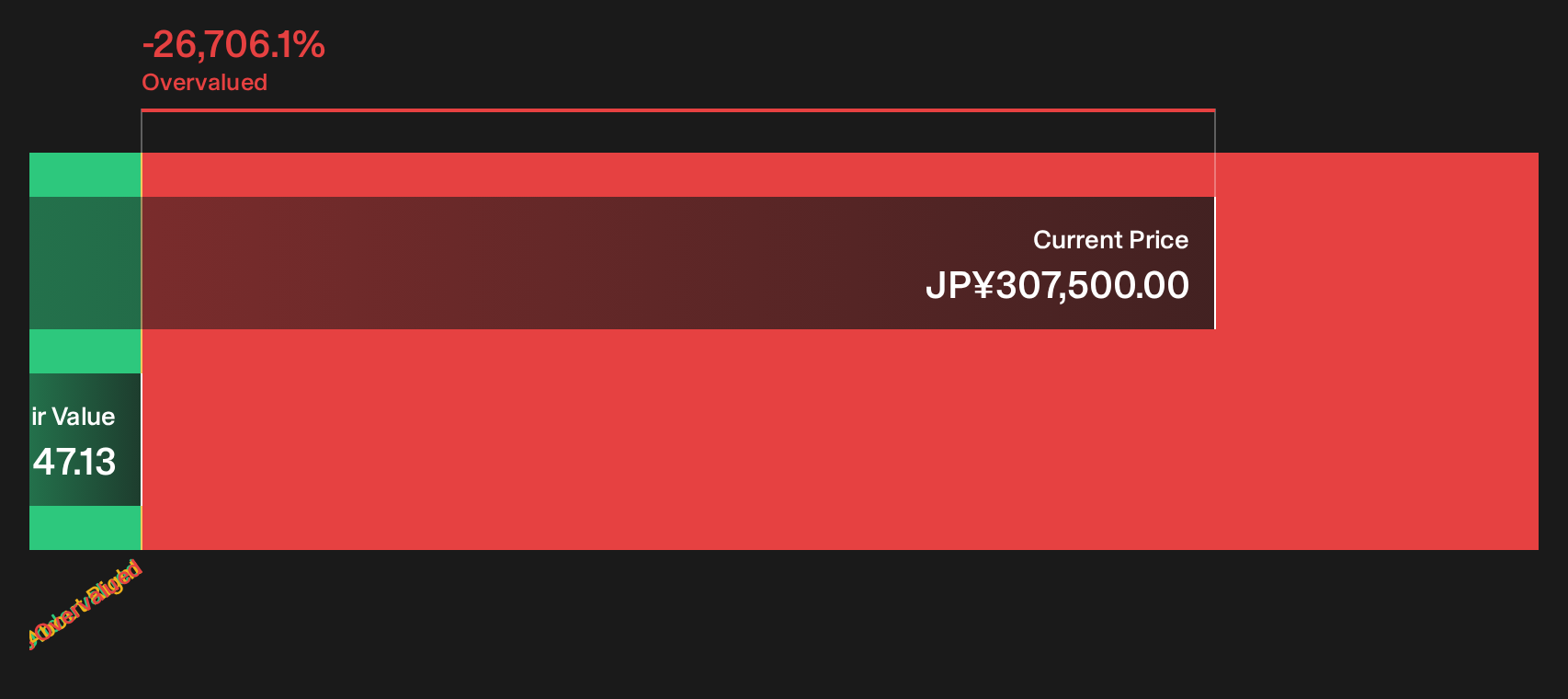
Simply Wall St performs a discounted cash flow (DCF) on every stock in the world every day (check out Daiwa Office Investment for example). We show the entire calculation in full. You can track the result in your watchlist or portfolio and be alerted when this changes, or use our stock screener to discover 18 high quality undervalued stocks. If you save a screener we even alert you when new companies match - so you never miss a potential opportunity.
Next Steps
Sentiment around Daiwa Office Investment is mixed, with pressure on recent returns but a fair-value debate still wide open. Use the data, move quickly, and weigh both the risks and the upside by checking the 4 key rewards and 2 important warning signs
Looking for more investment ideas beyond Daiwa Office Investment?
If Daiwa Office Investment is on your radar, do not stop there. Use fresh ideas from focused stock lists to sharpen your watchlist and spot opportunities early.
- Target resilient performers by scanning 21 resilient stocks with low risk scores that can help stabilise your portfolio when volatility picks up.
- Hunt for quality at a discount by reviewing the 18 high quality undervalued stocks that combine stronger fundamentals with more appealing prices.
- Build a pipeline of future contenders by checking the 74 high quality undiscovered gems before attention and liquidity move elsewhere.
This article by Simply Wall St is general in nature. We provide commentary based on historical data and analyst forecasts only using an unbiased methodology and our articles are not intended to be financial advice. It does not constitute a recommendation to buy or sell any stock, and does not take account of your objectives, or your financial situation. We aim to bring you long-term focused analysis driven by fundamental data. Note that our analysis may not factor in the latest price-sensitive company announcements or qualitative material. Simply Wall St has no position in any stocks mentioned.
Have feedback on this article? Concerned about the content? Get in touch with us directly. Alternatively, email editorial-team@simplywallst.com