
- PRICING
- LIVE QUOTES
- LEARN
- HELP


EN
How Investors May Respond To CarMax (KMX) Earnings Beat
- CarMax recently reported quarterly revenue of US$8.01b with earnings per share above analyst estimates, alongside ongoing corporate layoffs aimed at reaching US$200m in annualized overhead savings by fiscal 2027.
- The combination of cost cuts, a focus on digital and logistics efficiency, and stronger used vehicle and protection plan volumes highlights how CarMax is trying to rebuild profitability while reshaping its operating model.
- We will examine how CarMax's investment narrative is affected by this earnings beat and its push toward US$200m in overhead savings.
Scan how CarMax’s restructuring story compares with other retailers trying to balance growth with cost discipline by reviewing the hand picked 30 resilient stocks with low risk scores in the current market.
CarMax Investment Narrative Recap
To own CarMax, you need to believe the used car retailer can turn healthy customer demand and its omnichannel model into better profitability. The recent revenue and EPS beat supports that view in the near term, but the more important short term swing factor is whether cost cuts and logistics efficiencies show up clearly in margins over coming quarters.
The biggest current risk is that earnings pressure persists despite those savings. Debt is not well covered by operating cash flow, profit margins sit at 0.8%, and wholesale profit per unit has weakened. If sourcing costs or credit losses worsen, that could weigh on CarMax’s ability to deliver the margin reset many holders are hoping for.
The most relevant update is CarMax’s plan to reach US$200m in annualized overhead savings by fiscal 2027 after multiple rounds of corporate layoffs. For you as a shareholder, the real question is whether those reductions flow through to operating income without disrupting sales execution, reconditioning quality, or the customer experience that underpins volumes.
If management hits the savings run rate while keeping unit sales, CAF lending, and extended protection plan volumes on track, it could help offset margin pressure from sourcing competition and higher funding costs. If the cuts bite into execution or require further one off charges, that same program could add volatility to results rather than reduce it.
What CarMax Analysts Are Building Into Their Models
CarMax's analyst narrative hinges on fairly steady revenue, higher margins, and much stronger earnings over the next several years. Forecasts call for profit margins to move from 0.8% today to 2.3% within roughly three years, helped by the same cost reductions and efficiency work that management is targeting with its US$200m overhead program.
Revenue itself is not modeled for rapid expansion. Analysts expect the top line to stay broadly flat over the near term, which effectively puts the burden on margin repair rather than outsized sales gains. That setup matters for you as a shareholder because it frames the story as one of operational improvement and capital discipline rather than aggressive volume growth.
The consensus earnings path is much steeper than the revenue outlook. Current earnings of about US$222.5m are projected to rise to US$642.5m by 2029, with some forecasts as high as US$805.3m and some as low as US$370.3m. That wide spread shows there is real disagreement about how far cost savings, mix, financing income and omnichannel gains can go in reshaping the income statement.
Those profit assumptions sit alongside expectations that shares outstanding will decline by roughly 3.36% per year over the next three years. If CarMax keeps retiring stock while earnings grow, per share figures could move faster than the absolute totals. That possibility is one reason valuation work leans heavily on earnings per share and P/E rather than only aggregate profit.
CarMax's narrative projects US$28.3b revenue and US$642.5m earnings by 2029. This implies broadly flat yearly revenue and an earnings increase of roughly US$420m from current earnings of about US$222.5m.
Analysts then link those operating estimates to a P/E reset. Their consensus assumes CarMax trades on about 15.6x those 2029 earnings, compared with roughly 37.5x today and around 19.8x for the wider US Specialty Retail peer group. In other words, the story they are using does not rely on an elevated multiple. It relies on the business growing into a lower valuation over time as profitability improves.
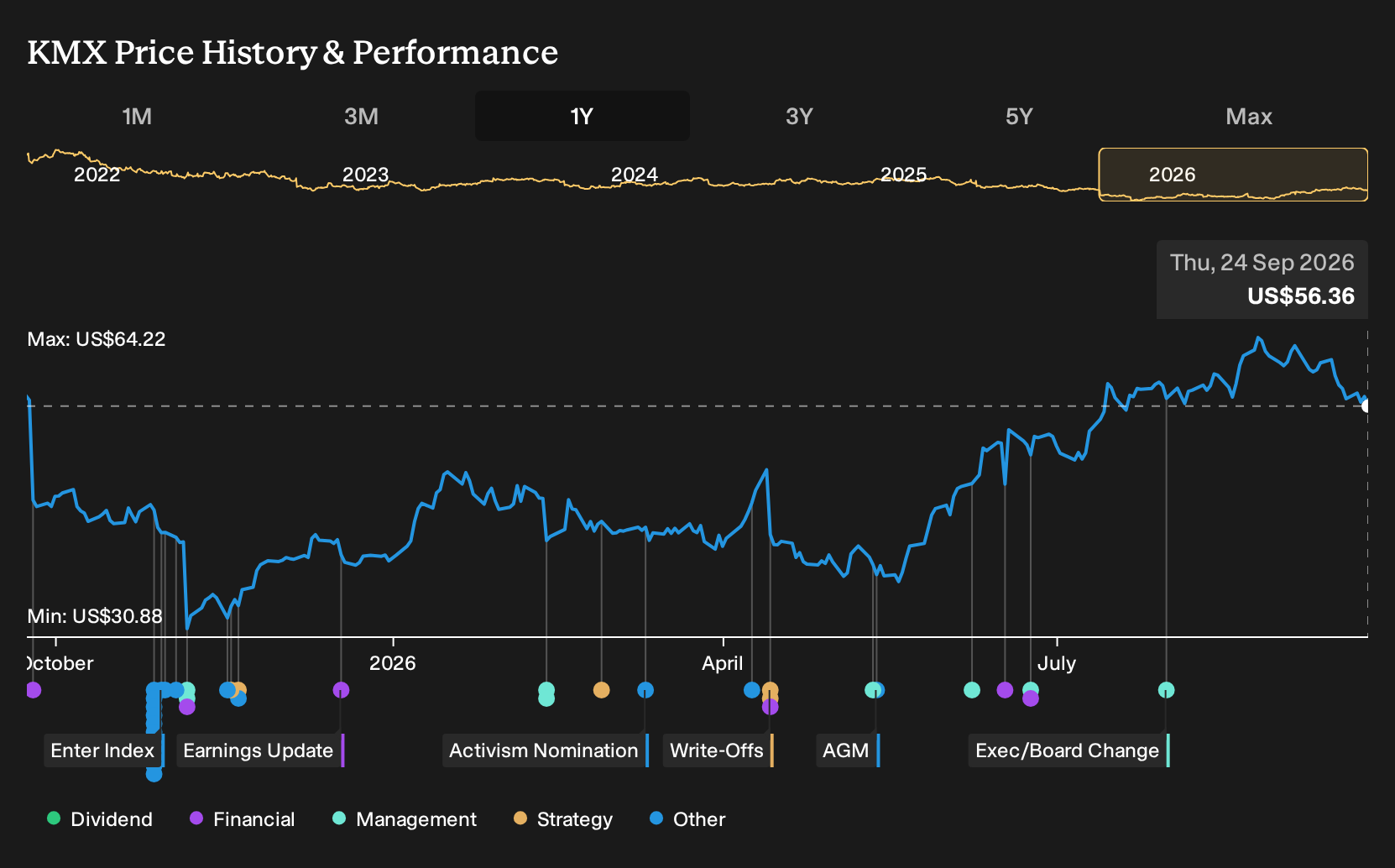
On these inputs, the average target price sits at US$54.85, just below the current US$58.78 share price. The fact that the consensus target is about 7.2% lower suggests many analysts view CarMax as roughly fairly valued on their baseline case. For you, the key question is whether your own expectations on margins, financing income, and unit trends are more optimistic or more cautious than that baseline.
Remember that the same set of public data is driving very different earnings forecasts among brokers. If your view is closer to the bullish US$805.3m profit line, then the cost and digital initiatives may look underappreciated. If your stance sits nearer the US$370.3m estimate, then the current valuation may already price in more margin repair than you are comfortable with.
Uncover why CarMax's fair value indicates a 3% potential downside to its current price, which leaves little room for error.
Exploring Other Perspectives
One alternate view on CarMax leans heavily on digital expansion as a potential upside catalyst. Before this earnings surprise, the most optimistic analysts were already sketching out about US$31.1b in revenue and roughly US$824.6m in earnings by 2029. You can now ask whether this beat and the layoff program push those bullish assumptions closer to reality or further from it.
Explore 4 other CarMax fair value estimates, including one that suggests potential upside of up to 53% from the current price.
Form Your Own Verdict
Don't just follow the ticker. Dig into the data and build a conviction that's truly your own.
- A great starting point for your CarMax research is our analysis highlighting 1 key reward and 3 important warning signs that could impact your investment decision.
- See our latest analysis for CarMax. The report includes a comprehensive fundamental analysis summarized in a single visual, the Snowflake, making it easy to evaluate CarMax's overall financial health at a glance.
Looking for more CarMax-style investment ideas?
If you want to stress test your CarMax thesis against other opportunities, use the Simply Wall St Screener to compare business quality, balance sheet strength, and income potential across a wider watchlist.
- For investors who care most about resilient businesses with controlled risk, start with the 30 resilient stocks with low risk scores that meet a stricter resilience threshold.
- If your focus is on strong finances and cleaner balance sheets, filter the market using the list of solid balance sheet and fundamentals (24 results) to see which companies pass tougher quality checks.
- For those hunting for quality that has not yet attracted broad attention, scan through the 16 high quality undiscovered gems and compare their fundamentals to what you see at CarMax.
This article by Simply Wall St is general in nature. We provide commentary based on historical data and analyst forecasts only using an unbiased methodology and our articles are not intended to be financial advice. It does not constitute a recommendation to buy or sell any stock, and does not take account of your objectives, or your financial situation. We aim to bring you long-term focused analysis driven by fundamental data. Note that our analysis may not factor in the latest price-sensitive company announcements or qualitative material. Simply Wall St has no position in any stocks mentioned.
Have feedback on this article? Concerned about the content? Get in touch with us directly. Alternatively, email editorial-team@simplywallst.com