
- PRICING
- LIVE QUOTES
- LEARN
- HELP


EN
Why It’s Time to Load Up on Microsoft Stock
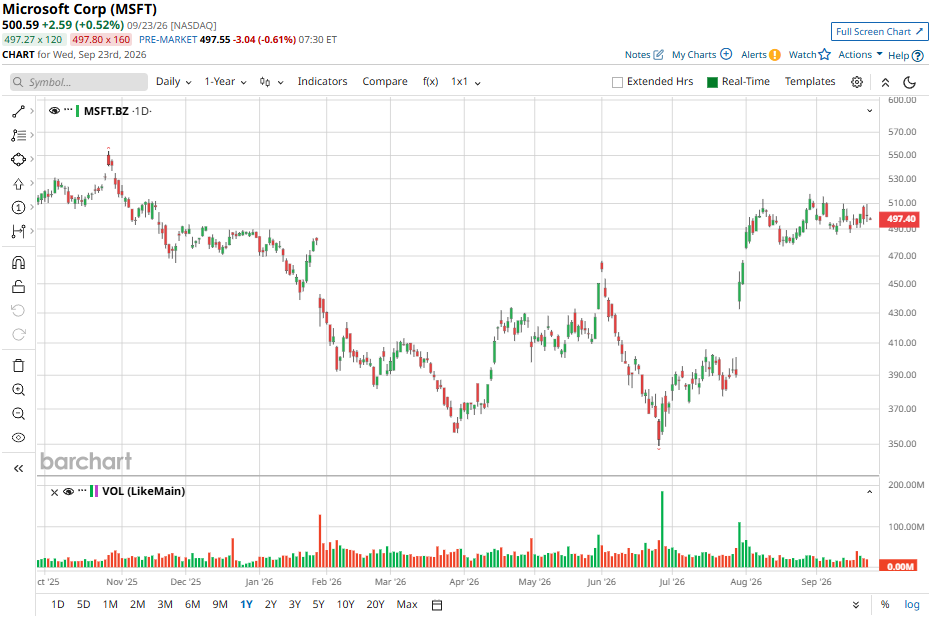
Microsoft (MSFT) stock has staged a solid recovery, rising over 33% in three months. Although it has reversed much of its previous decline, Microsoft stock still has room to run. Instead, the company’s improving operating trends suggest that its investment in artificial intelligence could continue to support earnings and revenue expansion.
A key factor behind the market’s optimism about MSFT stock is the growing evidence that its substantial artificial intelligence (AI)-related capital spending is beginning to generate tangible business demand. Higher capital expenditures had previously raised concerns about near-term profitability and whether the scale of investment would ultimately produce adequate returns. Microsoft’s recent performance, however, indicates that its investments are accelerating its cloud business and supporting future growth.
Microsoft’s AI Investments Are Translating Into Broad-Based Growth
Microsoft’s fiscal 2026 performance indicates that its AI investments are beginning to translate into solid financial growth across multiple parts of the business. Full-year revenue exceeded $331 billion, up 18%, while Microsoft Cloud revenue surpassed $214 billion, up 27%. Azure was a significant contributor, crossing the $100 billion revenue threshold after growing 41% year over year.
The momentum remained strong in the fourth quarter. Revenue increased 18% year over year to approximately $90 billion, while cloud revenue rose 27% to $59.3 billion. More significant from an AI-investment perspective, growth in Azure and other cloud services accelerated to 43%, up from 40% in the preceding quarter. This indicates that its investments are paying off.
Notably, in Microsoft Cloud, 90% of revenue came from customers outside Frontier Model companies. This matters because it suggests Microsoft's AI opportunity isn't being driven exclusively by a handful of large AI developers.
Microsoft’s AI monetization strategy also extends beyond infrastructure. Copilot is becoming an increasingly important part of its software ecosystem, allowing the company to capture AI spending through productivity applications as well as cloud infrastructure. Paid Copilot seat additions more than doubled sequentially, taking total paid seats above 30 million. Meanwhile, increased adoption of premium offerings, including Copilot, E5, and early E7 traction, contributed to higher ARPU during the quarter.
Overall, Azure is capturing spending on the computing infrastructure needed to support AI workloads. Meanwhile, Copilot and premium Microsoft 365 offerings capture value from AI-enabled productivity and applications. As enterprise adoption continues to expand, Microsoft could monetize the broader AI trend across multiple layers of the technology stack.
Microsoft’s Growth Outlook Strengthens on Azure and AI Demand
Microsoft is positioned to deliver strong growth, supported by robust demand for Azure cloud services and the increasing integration of AI across its product portfolio. For the first quarter of fiscal 2027, the company expects its Intelligent Cloud segment to generate revenue of approximately $40.95 billion to $41.25 billion, representing year-over-year growth of around 33% to 34%. This guidance indicates that cloud and AI-related demand is becoming an increasingly important contributor to Microsoft’s overall revenue expansion.
Azure is expected to remain the segment's primary growth engine. Management projects about 45% constant-currency growth in Azure revenue, up from 43% in the preceding quarter, and expects further acceleration in the first half of fiscal 2027. The guidance reflects continued demand growth for cloud computing capacity and AI infrastructure.
Meanwhile, AI monetization is also broadening through Copilot, which provides an additional avenue for Microsoft to capture enterprise AI spending across its software ecosystem.
Forward-looking contractual commitments provide further insight into demand visibility. Microsoft’s commercial remaining performance obligations (RPO) increased 84% year over year to $678 billion. This substantial expansion indicates a significant volume of contracted future business and provides an important indicator of the company’s revenue pipeline.
Taken together, accelerating Azure growth, broader AI monetization through Copilot and premium products, and strong contractual commitments point to continued momentum for Microsoft as it enters fiscal 2027.
It’s Time to Load Up On MSFT Stock
Microsoft continues to show strong momentum, driven by accelerating Azure growth, broader Copilot adoption, and a significant increase in commercial RPO. Together, these trends point to solid growth ahead for Microsoft.
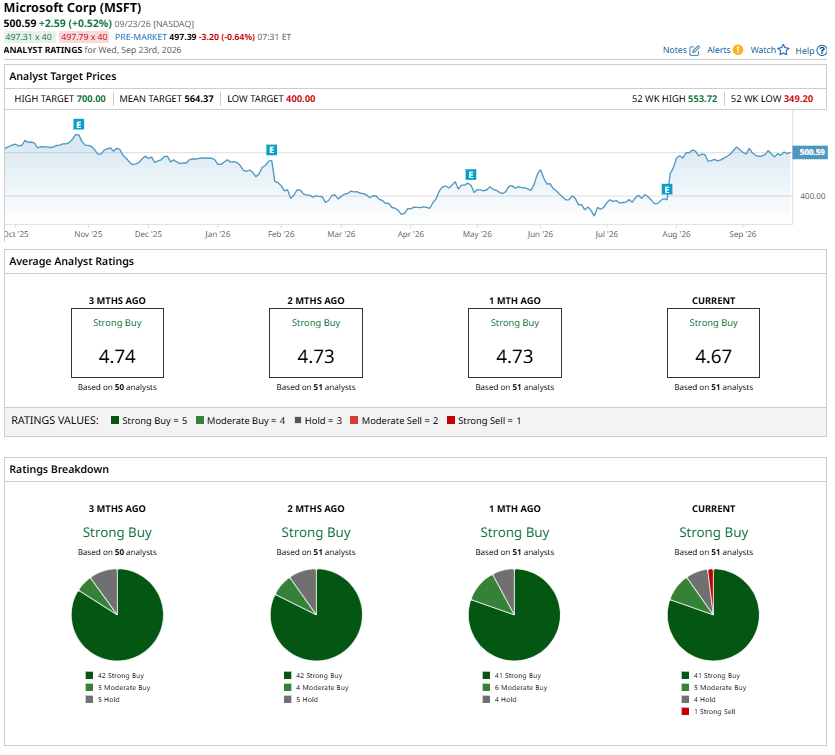
With a forward earnings multiple of 25.6, Microsoft’s valuation does not seem stretched. Analysts are also broadly positive on Microsoft, with the stock currently carrying a “Strong Buy” consensus rating.
On the date of publication, Amit Singh did not have (either directly or indirectly) positions in any of the securities mentioned in this article. All information and data in this article is solely for informational purposes. For more information please view the Barchart Disclosure Policy here.