
- PRICING
- LIVE QUOTES
- LEARN
- HELP


EN
Microsoft And 2 Other Quality Stocks To Own
Surging Treasury yields are forcing investors to think harder about risk, as government borrowing costs rise and bond prices fall. In a world where the so-called safe asset now swings around more than many are used to, rock solid corporate balance sheets gain extra appeal. This article breaks down three low risk leaders from our quality screener to help you firm up the base of your portfolio.
The three stocks covered below are just a sample of what this theme uncovers. The full screen surfaces 28 more companies with equally compelling stories that are not included in this article. To go deeper into the full list of low risk leaders, analyze and identify your own highest conviction ideas directly inside the Low Risk Leaders screener.
Microsoft (MSFT)
Microsoft is a cornerstone holding for many investors because its cloud, productivity tools, and consumer platforms combine into a broad, recurring cash engine that fits neatly with the Low Risk Leaders theme and raises an important question about regulatory scrutiny.
"The U.S. Federal Trade Commission has an active antitrust investigation examining whether Microsoft is using its dominance in productivity software to funnel customers into Azure through punitive licensing terms."
What matters most for investors now is how one unresolved pressure on Microsoft’s cloud economics ultimately feeds through to the durability of those high margins.
That cloud margin question is exactly what the full narrative for Microsoft unpacks, showing how regulatory risk, capital allocation and product mix could be decoupling faster than headlines suggest.

Vertiv Holdings Co (VRT)
Vertiv Holdings Co builds the power and cooling gear that keeps data centers online, giving the Low Risk Leaders theme a very literal backbone through its uninterruptible power and thermal management systems for the AI era.
Vertiv Holdings Co supplies power, cooling, and lifecycle services for critical digital infrastructure worldwide, with revenue centered in the Americas at about US$7.5b, Asia Pacific at roughly US$2.7b, and EMEA around US$2.4b. The stock’s market value is roughly US$95.8b.
"The liquid cooling market is already growing at roughly 20-30% annually as hyperscalers like Microsoft, Google, and Amazon race to build AI infrastructure. Vertiv's Q4 2025 organic orders surged 252% year-over-year, and its $15 billion backlog is equivalent to roughly 1.5 years of trailing revenue."
What really locks Vertiv into the Low Risk Leaders story is how one quiet shift in the mix of products and services could reshape long run margin power.
That quiet shift is exactly what the full narrative for Vertiv Holdings Co unpacks, showing how accelerating liquid cooling demand could be masking both upside and execution risks for Vertiv.

Palantir Technologies (PLTR)
Palantir Technologies builds data platforms for governments and large enterprises, with Foundry at the center of long-term, contract-heavy work that fits the Low Risk Leaders theme by leaning on customers that typically carry strong balance sheets and multi-year software commitments.
Palantir Technologies runs Gotham for defense and intelligence clients and Foundry for commercial data operations, supported by Apollo and its AI Platform, drawing roughly US$3.2b from government contracts and about US$2.9b from commercial work, with the stock valued around US$461b.
That blend of government and corporate demand matters for Low Risk Leaders because it ties Palantir to customers that prize security, resilience, and predictable software spend over quick, experimental projects.
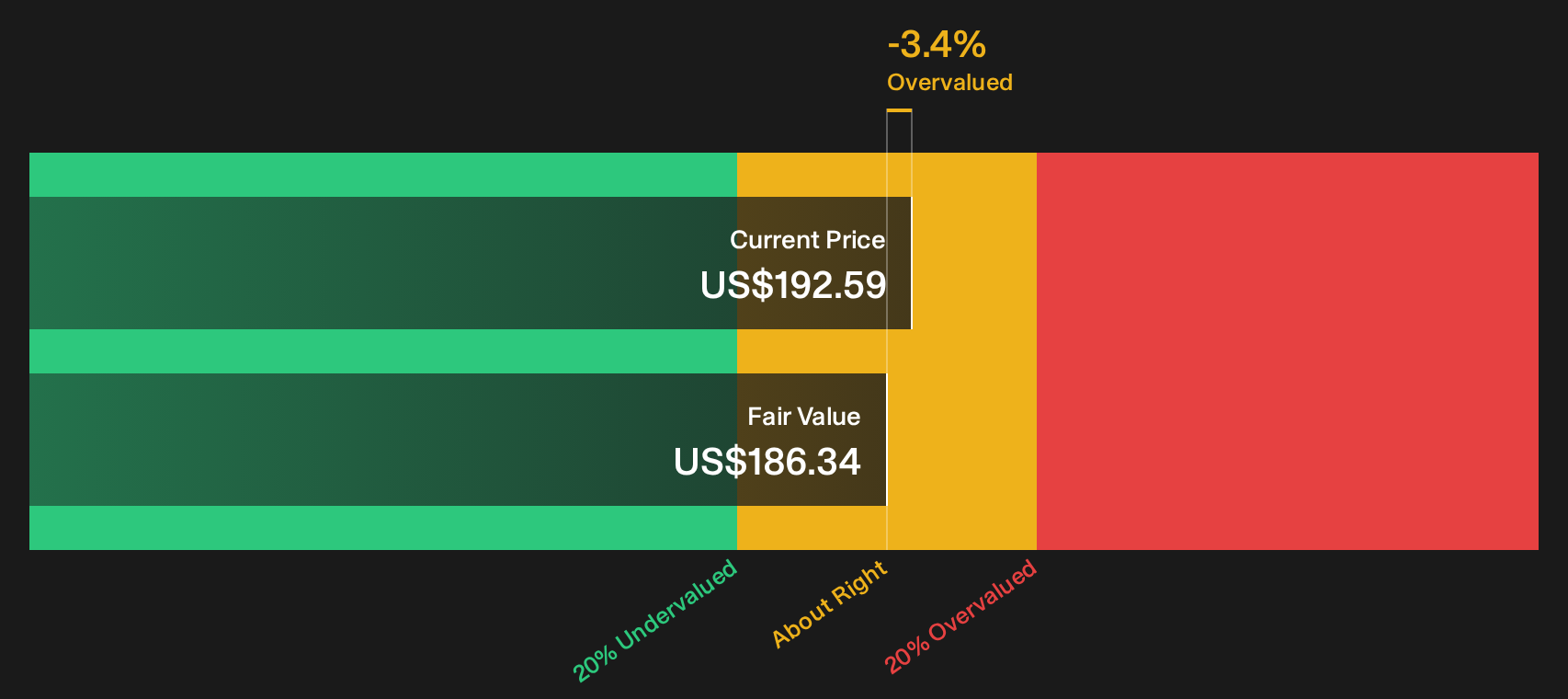
"But the balance sheet tells a different story: the company has zero debt and tons of cash, so that model rewarded it heavily and gave a fair value close to $925."
The real hinge for investors is what happens if a single assumption about how quickly those contract-heavy AI workloads scale begins to shift.
That scaling question is exactly what the full narrative for Palantir Technologies tackles, showing how contract-heavy AI demand and that cash rich balance sheet could be quietly resetting the risk profile for Palantir Technologies.
Seeking Alternatives Before Momentum Flies
Fresh ideas can break out fast while older stories lose momentum and edge. Scan under the radar for now, before the crowd catches on, and consider acting sooner rather than later.
- Target potential future cash generators by running the list of solid balance sheet and fundamentals (23 results) to focus on businesses with the financial strength to keep operating through sentiment swings.
- Spot early AI momentum by scanning the 37 profitable AI stocks that aren't just burning cash and concentrate on companies already turning data and algorithms into current earnings instead of ongoing cash burn.
- Explore the next power buildout by checking the 39 power grid technology and infrastructure stocks and focus on operators involved in long term grid and electrification projects.
This article by Simply Wall St is general in nature. We provide commentary based on historical data and analyst forecasts only using an unbiased methodology and our articles are not intended to be financial advice. It does not constitute a recommendation to buy or sell any stock, and does not take account of your objectives, or your financial situation. We aim to bring you long-term focused analysis driven by fundamental data. Note that our analysis may not factor in the latest price-sensitive company announcements or qualitative material. Simply Wall St has no position in any stocks mentioned.
Have feedback on this article? Concerned about the content? Get in touch with us directly. Alternatively, email editorial-team@simplywallst.com