
- PRICING
- LIVE QUOTES
- LEARN
- HELP


EN
Should AI Demand Tailwinds Require Action From Applied Materials (AMAT) Investors?
- Applied Materials plans to invest US$5b in India over the next decade, building a 140 acre semiconductor research park, expanding local suppliers, and doubling its R&D workforce beyond the current 7,000 employees.
- The push to grow India based supply chain capacity 10x by 2035 shows Applied Materials leaning into regional manufacturing and tighter customer collaboration in advanced chipmaking.
- We will examine how Applied Materials' India research park and supply chain expansion may reshape the broader investment narrative around AI demand.
Scan beyond Applied Materials and track other potential beneficiaries of the AI buildout with our hand picked list of 85 AI infrastructure stocks in the same supply chain story.
Applied Materials Investment Narrative Recap
To own Applied Materials, you need to believe that AI driven chip spending, advanced packaging and recurring service income remain the main engines of the business. The India plan fits that view by deepening materials engineering and customer collaboration. It feels important for long term capacity, but it is not the key near term share price driver.
In the short term, the main swing factor is still wafer fab equipment orders, especially from a small set of big logic and memory customers and from China. The biggest risk is that capex digestion, export restrictions or rising competition hit order visibility just as Applied ramps R&D and India build out spending.
The other announcement that matters here is Applied Materials’ US$0.53 quarterly dividend affirmation for December 2026. A steady payout indicates that management currently sees enough cash flow to fund shareholder returns alongside India investment, Arizona facilities and ongoing technology programs in areas such as advanced packaging.
For you as an investor, that combination of capital return and heavy reinvestment shapes the outlook for the next few years. Execution on the India research park and a 10x local supply chain, while still keeping margins and service revenue resilience intact, will likely be watched more closely than the dividend level itself.
Applied Materials' narrative projects US$53.0b revenue and US$17.0b earnings by 2029. This implies 22.2% yearly revenue growth and roughly a 2x earnings increase from US$8.5b today.
Uncover why Applied Materials' fair value indicates a 32% potential upside to its current price that could narrow quickly.
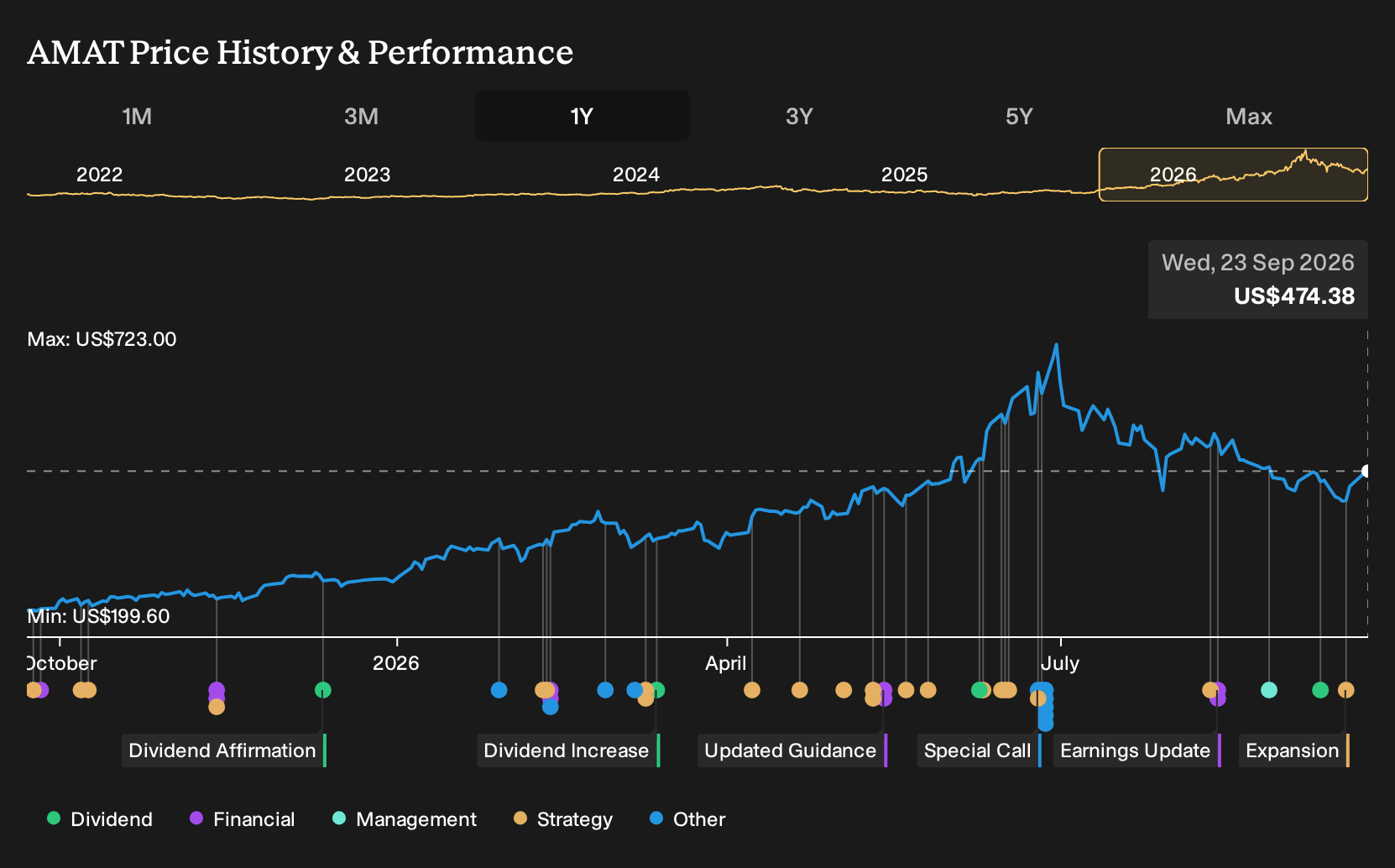
Exploring Other Perspectives
Some of the most optimistic analysts frame Applied Materials very differently. You see the India buildout as one new data point, while they already modeled a rapid AI driven equipment cycle with revenue climbing toward about US$77.5b and earnings near US$28.4b by 2029. Those projections were set before this news, so their story could still shift.
Explore 9 other Applied Materials fair value estimates, including one that suggests as much as 79% upside from the current price!
Reach Your Own Conclusion
Disagree with existing narratives? Extraordinary investment returns rarely come from following the herd, so consider trusting your own research and judgement.
- A great starting point for your Applied Materials research is our analysis highlighting 4 key rewards and 2 important warning signs that could impact your investment decision.
- See our latest analysis for Applied Materials. The report includes a comprehensive fundamental analysis summarized in a single visual, the Snowflake, making it easy to evaluate Applied Materials' overall financial health at a glance.
Looking for more investment ideas beyond Applied Materials?
If the Applied Materials story has you thinking about where else the AI and semiconductor buildout might ripple across markets, a broader search can help you pressure test your thesis and uncover alternatives that fit your risk and return preferences.
- If you want potential mispricing combined with quality fundamentals, scan our 30 high quality undervalued stocks that share similar traits investors often look for in durable compounders.
- If capital preservation and smoother portfolio swings matter to you, sort through a curated set of 31 resilient stocks with low risk scores that screen well on our risk scoring framework.
- If you prefer stronger balance sheets and cleaner fundamentals, filter for companies in our list of solid balance sheet and fundamentals (23 results) and see which ones line up with your investment checklist.
This article by Simply Wall St is general in nature. We provide commentary based on historical data and analyst forecasts only using an unbiased methodology and our articles are not intended to be financial advice. It does not constitute a recommendation to buy or sell any stock, and does not take account of your objectives, or your financial situation. We aim to bring you long-term focused analysis driven by fundamental data. Note that our analysis may not factor in the latest price-sensitive company announcements or qualitative material. Simply Wall St has no position in any stocks mentioned.
Have feedback on this article? Concerned about the content? Get in touch with us directly. Alternatively, email editorial-team@simplywallst.com