
- PRICING
- LIVE QUOTES
- LEARN
- HELP


EN
Peloton’s New Folding Treadmill Might Not Be a Magical Fix for PTON Stock
At-home fitness company Peloton Interactive (PTON) is launching three new treadmills. These include the foldable Tread Flex, which starts at $2,195 and is the company’s cheapest-ever treadmill. It is also launching the Peloton Tread Vision and Peloton Tread+ Vision, and announced new features for its artificial intelligence (AI) platform Peloton IQ. Markets gave the new products a thumbs up, sending the stock to an intra-day high of $5.28 yesterday, Sept. 22. PTON couldn't hold on to the gains, though, and settled only 1.4% higher at $5.02.
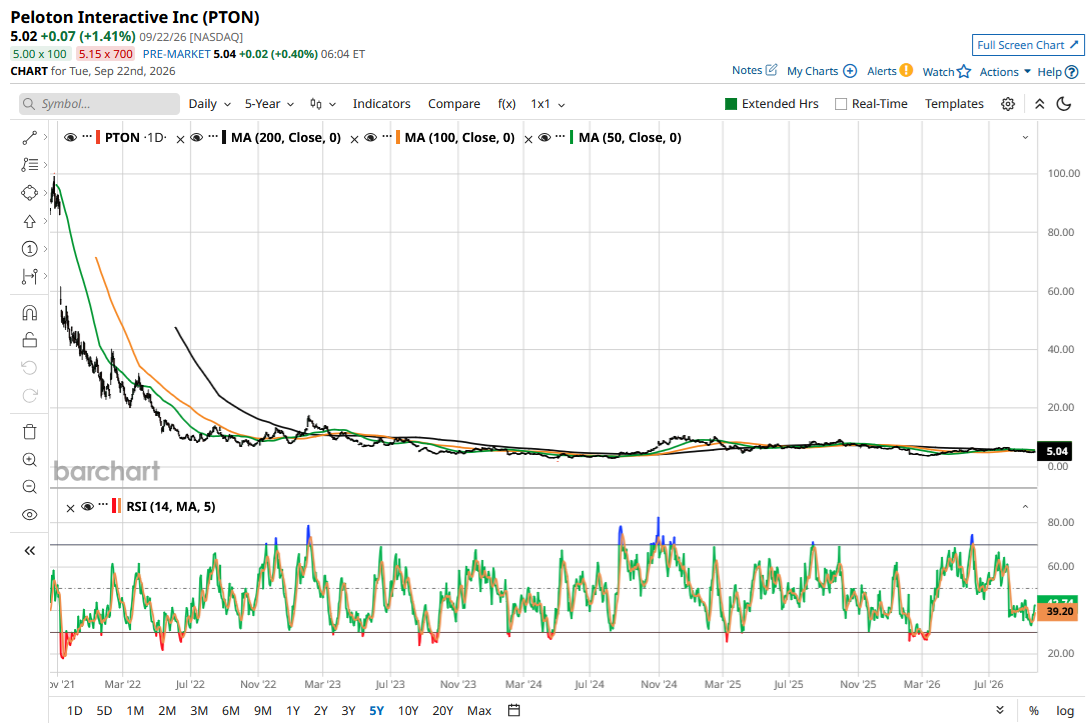
Things have been tough for Peloton, whose IPO couldn’t have been timed better. It went public in September 2019, which was a few months before the world was pushed into lockdowns due to the Covid-19 pandemic. Names like Peloton were hailed as “stay-at-home winners” as their products — fitness equipment in its case — came out as saviors.
Sales grew triple digits, and Peloton became a household name. The booming sales were not lost on markets, and Peloton’s market cap soared past $50 billion. Cut to 2026, and Peloton keeps moving in and out of the penny stock category, with its market cap barely above $2 billion. For context, the company priced its IPO at $29 per share nearly seven years ago, and now trades at about a sixth of that price.
Peloton Is Struggling For Growth
Far from reporting the triple-digit revenue growth it did during its heyday, Peloton is now battling degrowth. Its annual sales peaked above $4 billion in fiscal year 2021 and have declined each year since. The company expects its sales to decline in the current year as well.
Notably, while Peloton’s equipment sales have plummeted, subscriptions have been somewhat of a saving grace. Their share in Peloton’s total revenues has been steadily rising, and subscriptions accounted for over two-thirds of the company’s sales last fiscal year. However, even that business is showing signs of stagnation, with subscription revenue flat in the last fiscal year. Peloton’s paid connected fitness subscriber base has been falling, and fell 9% year-over-year (YoY) in its fiscal Q4 2026. The company expects the metric to fall by another 3.5% at the midpoint in the current fiscal quarter.
PTON Stock Forecast
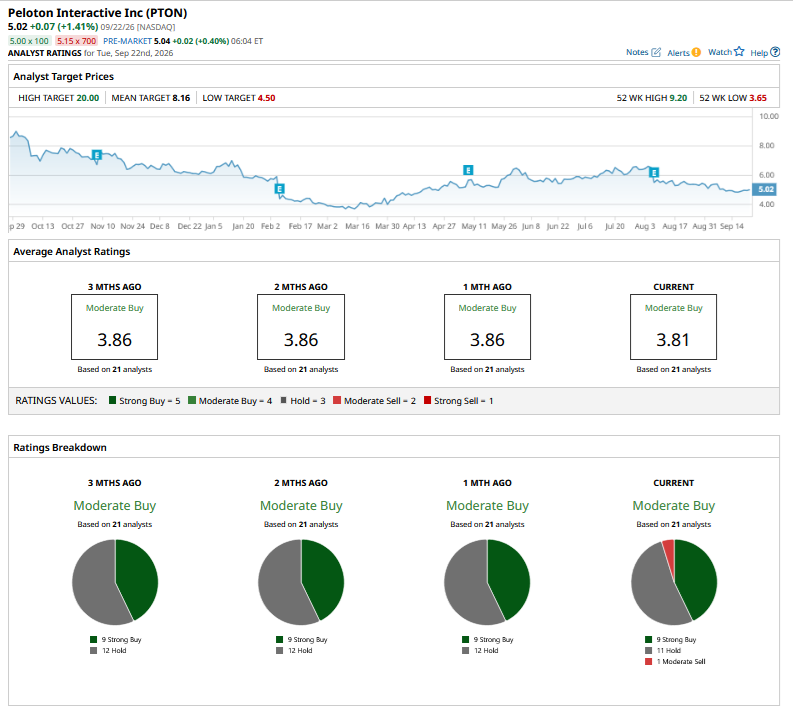
Earlier this month, Morgan Stanley analyst Nathan Feather downgraded Peloton to "Underweight” while slashing the target price to $4.50 amid the growth headwinds. Feather’s sell-side peers are relatively bullish, and of the 21 analysts polled by Barchart, nine rate it as a “Strong Buy” and 11 as a “Hold.” Incidentally, Morgan Stanley is the only brokerage to have a “Sell” rating equivalent on the fitness equipment company and has the Street-low target price. PTON’s mean target price sits at $8.16, which is over 62% higher than current levels.
To be sure, it is not only the analyst community that sees significant upside in PTON. Hedge fund manager David Einhorn has also dabbled with the stock. Perhaps best known for being a Tesla (TSLA) bear and his public spats with Elon Musk, he bought the dip in PTON earlier this year.
In March, EMJ Capital founder Eric Jackson, who was instrumental in fueling the rally in Opendoor Technologies (OPEN), said that he is long on PTON. Jackson has set a base-case target price of $8 on PTON, while his bull-case target was $16.
Should You Buy Peloton Stock?
While Peloton’s sales have been sliding, it has restructured its business and aggressively cut costs. The company delivered its first full year of GAAP profitability last fiscal year and has also repaired its balance sheet, with net debt set to become negative this fiscal year. It is no mean feat for the company that was saddled with too much debt and burgeoning losses.
There is also valuation comfort in the stock at a forward price-to-earnings (P/E) multiple of 16.02x, but with the cost cuts having largely run their course, Peloton needs to return to growth for its stock to see meaningful gains. It remains to be seen how the new treadmills, particularly the foldable version, drive sales, but the company would need to be a lot more innovative with products, considering the dwindling interest in at-home fitness equipment. Higher equipment sales would also increase the funnel for the high-margin subscription business, creating a virtuous growth cycle.
On the date of publication, Mohit Oberoi had a position in: PTON , TSLA . All information and data in this article is solely for informational purposes. For more information please view the Barchart Disclosure Policy here.