
- PRICING
- LIVE QUOTES
- LEARN
- HELP


EN
Stablecoin Settlement Might Change The Case For Investing In Mastercard (MA)
- SoFi Technologies and Mastercard have now activated live settlement of SoFi Bank’s entire debit and credit card program using the SoFiUSD stablecoin, with more than $25 billion in annualized card volume moving onto blockchain rails across Mastercard’s global network.
- The shift to a bank issued stablecoin gives Mastercard a real world test bed for blockchain based settlement, with SoFiUSD operating alongside existing payment infrastructure and potentially informing how future cross border payments, remittances and liquidity management products are built.
- We will now look at how Mastercard’s investment narrative could shift as SoFi’s $25 billion card program moves to stablecoin settlement.
Mastercard Investment Narrative Recap
To own Mastercard, investors need to believe electronic payments, value added services and new payment flows can keep generating attractive economics, even as alternatives like real time domestic schemes grow. The key short term swing factor is whether volume and services revenue trends remain healthy enough to justify continued heavy tech and cybersecurity spend. The SoFiUSD launch is strategically interesting but does not yet look large enough on its own to shift near term financial drivers.
The biggest current risk sits in structural and regulatory challenges. Domestic schemes in places like the UK, rising scrutiny of fees and events such as the ATM surcharge settlement all point to possible pressure on pricing and compliance costs. Stablecoin settlement helps Mastercard stay relevant as rails fragment. It also highlights how fast non card rails are evolving and how important it is for the group to keep card based economics attractive.
Among the recent announcements, Mastercard Wallet Pay looks closest to the SoFi deal in terms of showing how the business is trying to sit inside many different digital experiences. Wallet Pay is about keeping Mastercard credentials and services embedded in e wallets across NFC, QR and online checkouts. This directly supports transaction frequency and service revenue opportunities that investors watch closely.
For catalysts, Wallet Pay ties into the same theme as SoFiUSD. New flows and stored value wallets push more activity onto Mastercard rails and create more touchpoints for high margin security, analytics and tokenization tools. Execution risk is real, because alternative rails and local schemes are also improving. If Mastercard keeps winning wallet and fintech partnerships, that supports the case for its services mix and long term cash generation profile.
What The SoFiUSD Deal Means For Mastercard’s Long Term Set Up
The SoFiUSD settlement launch drops into an already numbers heavy Mastercard story. Analysts currently assume revenue can compound at 12.5% a year for the next three years while profit margins edge from 46.3% today to 46.7% by around 2029. That framing matters for readers trying to judge whether putting a slice of Mastercard exposure alongside faster moving crypto rails still makes sense.
On earnings, the consensus view pins today’s profit at about US$16.3b and points to US$23.3b by 2029. That is an increase of roughly US$7b in annual earnings. The forecast also assumes the share count trends lower, with a 2.45% annual decline over the next three years. This can lift earnings per share even if profit growth slows later.
Mastercard's narrative projects US$49.9b revenue and US$23.3b earnings by 2029. This requires 12.5% yearly revenue growth and an earnings increase of about US$7b from US$16.3b today.
Analysts effectively argue that if Mastercard keeps revenue rising at that 12.5% clip and nudges margins slightly higher, the business could reach that US$49.9b top line and US$23.3b earnings mark in 2029. The implied P/E on those future earnings is 28.8x, which is above the 17.2x level cited for the broader US diversified financial peer group. The current script therefore assumes Mastercard deserves a premium because of its global network, services mix and capital return plans.
The SoFiUSD project does not rewrite those headline assumptions today. It does add another proof point that the group is prepared to run parallel rails, process value through stablecoins and still keep its fraud, tokenization and analytics stack in the middle of the flow. That type of experimentation can help justify why analysts are comfortable underwriting high single digit to low double digit revenue growth without assuming outsized pricing power on traditional card fees.
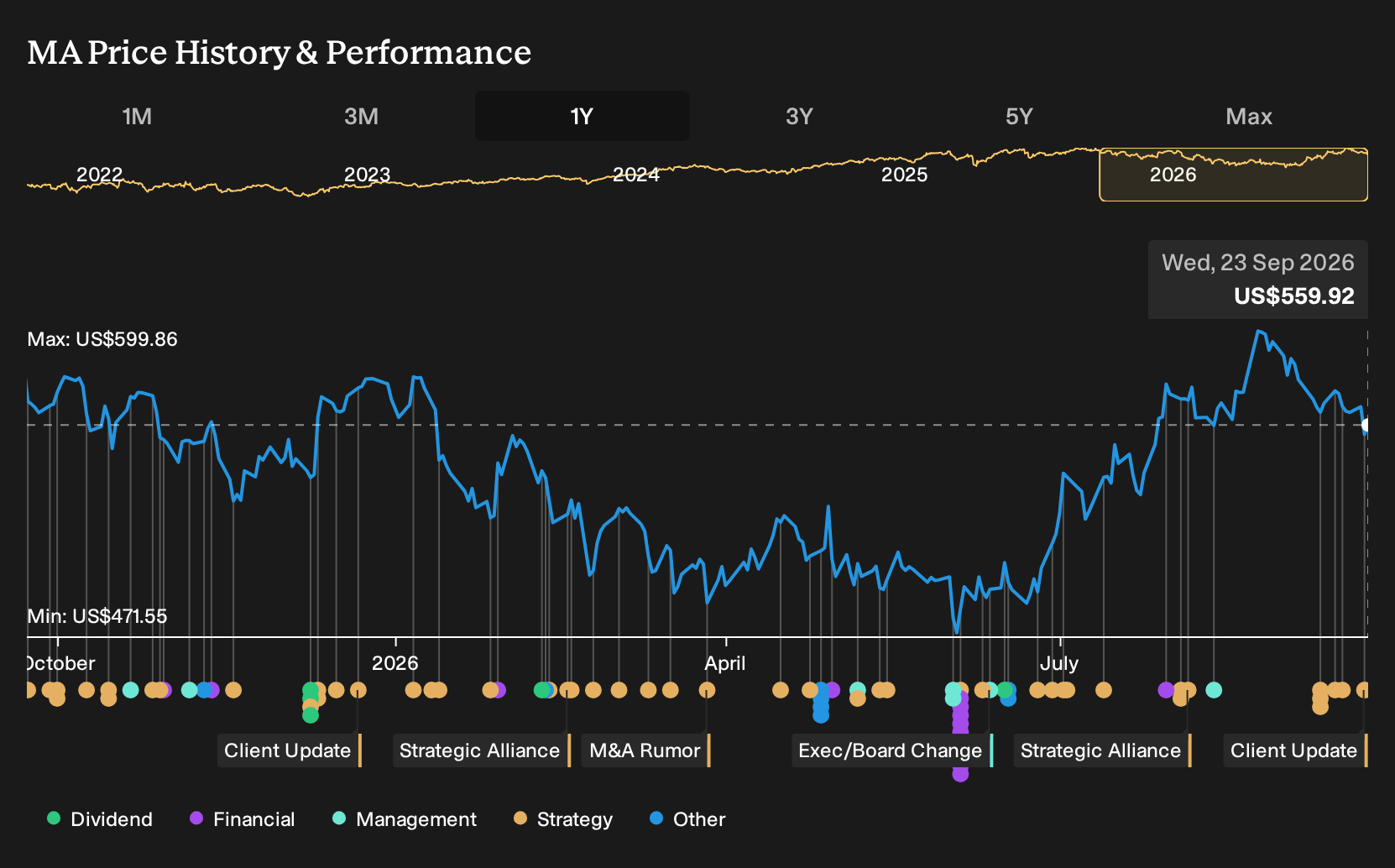
Valuation targets wrap all of this into a single number. The consensus price goal sits at US$666.71 per share versus a current price of US$565.24, which is 15.2% higher. The most optimistic analyst sits at US$740, while the most cautious sits at US$550, showing a fair spread of views on how much Mastercard can earn from services, cross border activity and new rails like stablecoin settlement.
Those price targets rest on the idea that by 2029 Mastercard hits that US$49.9b revenue figure and US$23.3b in profit while trading at a 28.8x P/E and being discounted at roughly 7.4%. Readers comparing Mastercard with emerging crypto and stablecoin networks can use that bundle of assumptions as a reference point. The key question is whether experiments like SoFiUSD settlement support, challenge or simply sit alongside that long range earnings path.
Uncover how Mastercard's fair value indicates a 19% potential upside to its current price before that discount closes.
Exploring Other Perspectives
The Simply Wall St Community has published 23 fair value views on Mastercard, ranging from US$520 at the low end to about US$1,093 at the top. That is a wide spread. You can read those as retail investors weighing strong cash to digital payment trends and products like SoFiUSD settlement against competition, regulation and shifting payment rails. Opinions are likely to differ sharply. Use that diversity and explore several viewpoints before deciding how Mastercard fits into your own portfolio story.
Explore 22 other Mastercard fair value estimates, including one that suggests as much as 7% downside from the current price.
Form Your Own Verdict
Don't just follow the ticker. Dig into the data and build a conviction that's truly your own.
- A great starting point for your Mastercard research is our analysis highlighting 3 key rewards and 2 important warning signs that could impact your investment decision.
- See our latest analysis for Mastercard. The report includes a comprehensive fundamental analysis summarized in a single visual, the Snowflake, making it easy to evaluate Mastercard's overall financial health at a glance.
Looking For More Investment Ideas Beyond Mastercard?
If Mastercard is only one piece of the picture for you, it can help to scan a broader field of candidates that match different risk, quality and income profiles. The Simply Wall St Screener lets you quickly narrow the universe to businesses that fit the kind of portfolio you want to build, rather than forcing your thesis to fit whatever happens to be in the headlines.
- If capital preservation is your priority, start by filtering for resilient balance sheets and steady fundamentals through the list of solid balance sheet and fundamentals (23 results). This can help anchor a more cautious portfolio.
- If income is the main goal, target higher yielding payers with a track record of distributions using the 7 dividend fortresses, which focuses on companies offering richer cash returns.
- If you are hunting for fresher ideas, broaden your watchlist with the 16 high quality undiscovered gems, which highlights quality businesses that may not yet be widely followed.
This article by Simply Wall St is general in nature. We provide commentary based on historical data and analyst forecasts only using an unbiased methodology and our articles are not intended to be financial advice. It does not constitute a recommendation to buy or sell any stock, and does not take account of your objectives, or your financial situation. We aim to bring you long-term focused analysis driven by fundamental data. Note that our analysis may not factor in the latest price-sensitive company announcements or qualitative material. Simply Wall St has no position in any stocks mentioned.
Have feedback on this article? Concerned about the content? Get in touch with us directly. Alternatively, email editorial-team@simplywallst.com