
- PRICING
- LIVE QUOTES
- LEARN
- HELP


EN
Baidu (BIDU) Dropped, So What Is Driving Attention Now?
Baidu (NasdaqGS:BIDU) is back under the spotlight after a new securities class action accused the company of overstating how its AI operations could offset weakness in its traditional online marketing activities.
Recent trading reflects that pressure. Baidu’s 1-day share price return declined 2.87% and the 90-day share price return is down 13.66%, while the 1-year total shareholder return is down 32.46%. This points to fading momentum that recent legal headlines are amplifying.
Pressure around Baidu’s AI narrative can be a useful filter, so compare how other AI focused businesses are priced and growing using the hand picked 38 profitable AI stocks that aren't just burning cash.
Baidu now trades well below many published estimates, yet still carries legal and earnings questions after the recent slide. Where does a reasonable fair value range land in that gap between price and projections?
Most Popular Narrative: 39% Undervalued
Baidu closed at $89.78, while the most followed narrative anchors on a fair value estimate of about $146.50. The market gap is wide and rests heavily on what its AI engines can deliver over time.
The rapid rise in digitalization and urbanization across China is fueling increased engagement with online platforms and services, creating a larger addressable market for Baidu's AI-powered products. This secular shift underpins continued growth potential in core search, cloud, and new digital services, which should drive revenue upside as AI monetization progresses.
See why 176 investors see Baidu as 39% undervalued.
Result: Fair Value of $146.50 (UNDERVALUED)
Still, Baidu faces real pressure if core advertising remains weak and AI search monetization stays slow, especially in light of ongoing legal scrutiny and negative free cash flow.
Find out about the key risks to this Baidu narrative.
Another View: Baidu Through A Cash Flow Lens
The fair value story looks very different when using the SWS DCF model. On that framework, Baidu’s current share price of $89.78 sits above an estimated future cash flow value of $80.81, which screens as overvalued rather than discounted. If cash generation, not earnings targets, ends up driving sentiment, which narrative is more compelling for you?
Look into how the SWS DCF model arrives at its fair value.
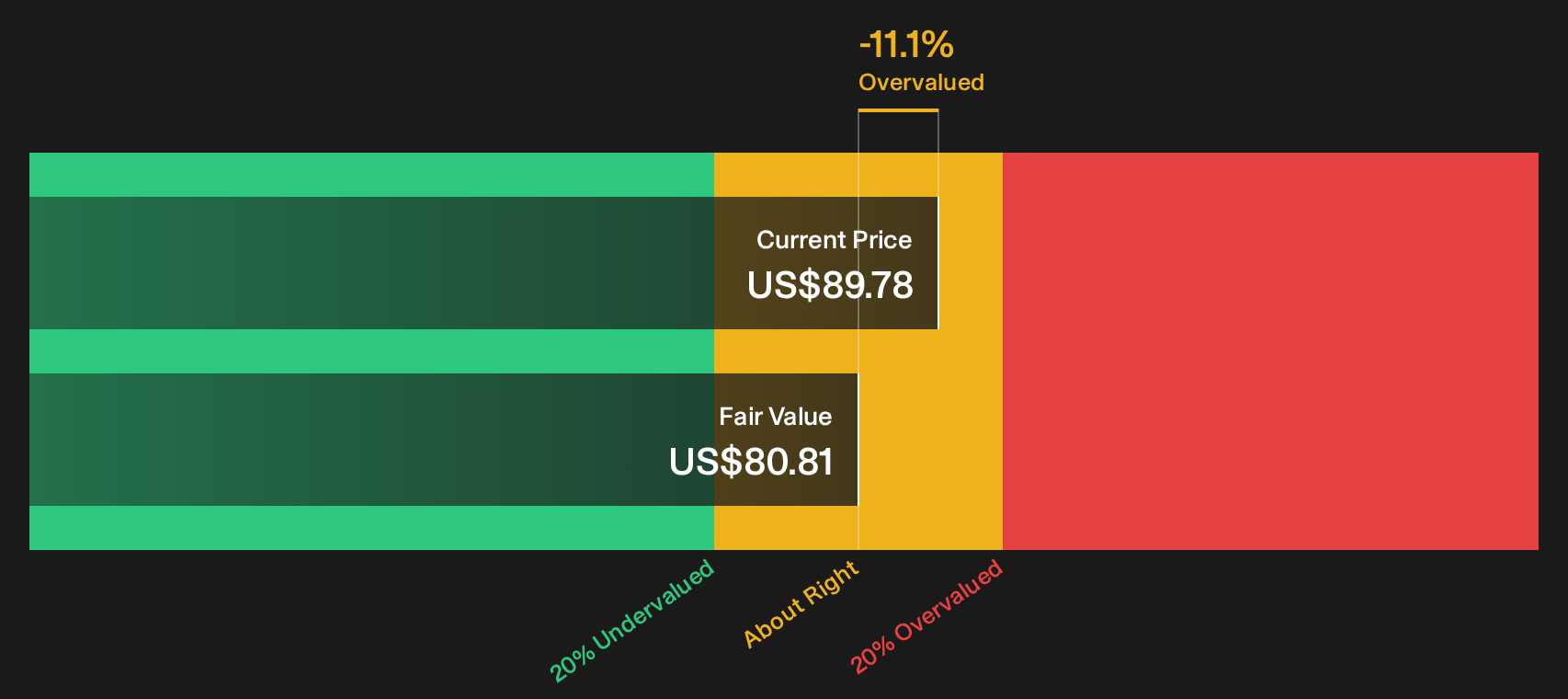
Simply Wall St performs a discounted cash flow (DCF) on every stock in the world every day (check out Baidu for example). We show the entire calculation in full. You can track the result in your watchlist or portfolio and be alerted when this changes, or use our stock screener to discover 30 high quality undervalued stocks. If you save a screener we even alert you when new companies match - so you never miss a potential opportunity.
Next Steps
Short term sentiment around Baidu might feel unsettled, so consider acting promptly and review the numbers against your own expectations. To see what has investors optimistic, review the 1 key reward
Looking for more Baidu sized investment ideas?
If Baidu has your attention, do not stop there. Use the Simply Wall Street Screener to quickly surface fresh ideas that fit your own investing playbook.
- Target quality at a discount by scanning companies that screen as attractively priced relative to their fundamentals with the 30 high quality undervalued stocks.
- Prioritize resilience by focusing on businesses with robust finances and low leverage using the list of solid balance sheet and fundamentals (23 results).
- Hunt for early stage potential by filtering for under followed opportunities with solid fundamentals through the 16 high quality undiscovered gems.
This article by Simply Wall St is general in nature. We provide commentary based on historical data and analyst forecasts only using an unbiased methodology and our articles are not intended to be financial advice. It does not constitute a recommendation to buy or sell any stock, and does not take account of your objectives, or your financial situation. We aim to bring you long-term focused analysis driven by fundamental data. Note that our analysis may not factor in the latest price-sensitive company announcements or qualitative material. Simply Wall St has no position in any stocks mentioned.
Have feedback on this article? Concerned about the content? Get in touch with us directly. Alternatively, email editorial-team@simplywallst.com