
- PRICING
- LIVE QUOTES
- LEARN
- HELP


EN
Joby Aviation: Is It Finally Time to Buy Below $7?
Key Points
Joby has made impressive progress in 2026, including making a strategic acquisition and conducting flight demonstrations of its electric vertical takeoff and landing (eVTOL) aircraft.
The stock has tanked this year, and plenty of risks remain.
Joby Aviation (NYSE: JOBY) is aiming for the skies.
If you've ever missed a flight or an important meeting because you got stuck in city traffic, you might understand the problem Joby is trying to solve. In a nutshell, it wants to introduce a new form of transportation, one that can soar through the air like a helicopter, but with far less noise and downwash, and powered by batteries.
Missed AI’s "Act 1"? Act 2 Could Be 15x Bigger. Most investors think they missed the AI boat because they didn't buy Nvidia in 2005. But according to our analysts, we’re only at the end of "Act 1"—the R&D phase. "Act 2" is the global rollout. Continue »
Never has Joby been closer to its dream of operating electric vertical takeoff and landing (eVTOL) aircraft than it is today. Yet its stock has tanked in 2026: Shares have lost more than half their value year to date, and are trading about 67% lower than their 52-week high.
The company has made impressive progress in 2026. But has it done enough to become a stock you can buy with confidence?
The biggest changes in Joby in 2026
Joby has manifestly become a different company. Not fundamentally different (it is still designing eVTOLs), but developmentally, it has advanced so much in 2026 that one might even argue that it's slightly ahead of what was expected of it.
A list of advancements would have to include its flight demonstrations in New York and Texas, its updated manufacturing alliance with Toyota, its agreement to acquirement defense technology company Resonant Sciences for about $500 million, and its testing of conforming aircraft as it progresses through the FAA's fifth and final stage for Type Inspection Authorization.
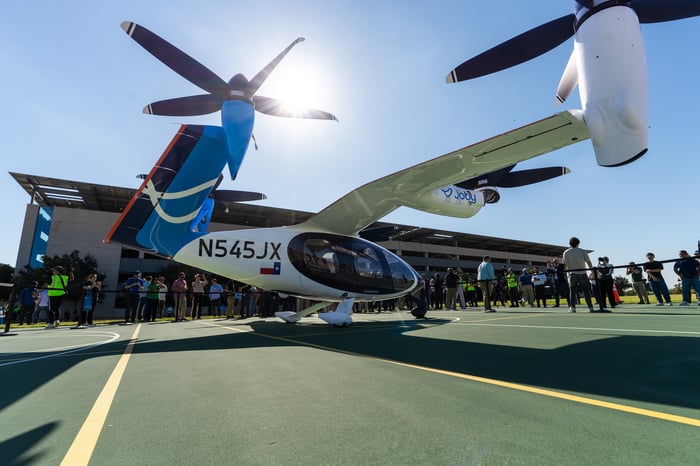
Image source: Joby Aviation.
Joby also generated about $36 million in revenue last quarter, mainly through its passenger helicopter business, Blade. It's sitting on about $2.3 billion in cash and short-term investments, and it expects to use roughly $400 million or so in the second half of 2026.
None of these points changes the fact that Joby still lacks the regulatory approval to operate its air taxi service commercially, nor that it's burning through about $200 million each quarter.
Should you buy Joby below $7?
Joby is no longer a wildly speculative stock. That's good news for shareholders. The stock is less risky, and the company is manifestly more advanced in its aviation technology, despite the stock price having a rough year.
As far as whether or not you should buy Joby now, I would consider two things.
The first is how Joby looks as a long-term investment opportunity. I would not expect much from this stock over the next five years. That's not because Joby's eVTOL won't get FAA type certification, or anything like that. It's because, even with certification, Joby will need time to scale up its eVTOL fleet. It will also need time for consumers to try the service, trust the aircraft, and build air taxis into their travel habits. Again, I don't see any of this happening soon.
The nature of aviation itself might impose a ceiling on Joby's growth. Joby's eVTOLs will carry a maximum of four passengers, and even if we assume maximum utilization on each flight, certain uncontrollable factors like weather and maintenance could still interrupt flight schedules. And if an eVTOL has an accident, whether due to technological failures or human error, that could set back consumer adoption of such platforms for years.
If you have time and an appetite for the unknown, Joby stock might be an opportunity at $7 per share. Otherwise, you might want to look elsewhere for your next growth stock.
Steven Porrello has positions in Joby Aviation. The Motley Fool has no position in any of the stocks mentioned. The Motley Fool has a disclosure policy.