
- PRICING
- LIVE QUOTES
- LEARN
- HELP


EN
Arm Holdings (ARM) Shares Climbed, What Is Driving Attention Today?
Arm Holdings (NasdaqGS:ARM) is back in the spotlight after Meta’s Muse AI agent and a new AGI CPU partnership reignited interest in how agentic AI could reshape long term CPU demand.
The share price reaction has been sharp. Arm Holdings has a 7 day share price return of 37.78% and a 30 day share price return of 36.94%, while the 90 day share price return is down 7.21%. Momentum has swung positive again as AI related headlines pile up, and the 1 year total shareholder return of 136.33% and very large 3 year total shareholder return of more than 5x keep long term holders well in the green.
Scan beyond Arm Holdings and see which AI infrastructure peers are also catching a bid in 86 AI infrastructure stocks as capital chases the next wave of agentic CPU demand.
Arm Holdings has just logged a huge AI driven jump, yet the stock already trades above the average analyst target and a rich intrinsic value estimate. How much of the AGI CPU story is already in the price?
Most Popular Narrative: 22.5% Undervalued
On the numbers, the latest narrative fair value for Arm Holdings sits at $430 per share, compared with a last close of $333.20. That gap frames the current AI driven excitement as more than just a short term swing in sentiment.
The catch is valuation. Arm is now being valued less like a normal semiconductor company and more like a future monopoly-like infrastructure layer for AI compute. The stock recently traded above $400 after a huge run, though it pulled back with the broader semiconductor selloff on July 13, when Arm fell 7.6% alongside other chip leaders.
See why 44 investors see Arm Holdings as 23% undervalued.
According to HedgeY, the most followed narrative assumes Arm Holdings can eventually move from roughly $4.9b of revenue to about $25b, helped by management’s AGI CPU and IP targets. That storyline treats the current share price as still short of the $430 fair value used to justify the long term earnings and revenue ambitions.
Other valuation tools paint a very different picture. The SWS DCF model points to a future cash flow value of $91.70 per share, which is far below the $333.20 last close. That result implies the present quote is well above what a purely cash flow based framework would support, given the discount rate and growth inputs used in the model.
The gap between the narrative fair value and the DCF output shows how sensitive Arm Holdings is to long range assumptions about agentic AI CPU demand, royalty growth and terminal profitability. For investors, the key question is which framework better reflects their own expectations for execution, capital intensity and competitive pressure.
Result: Fair Value of $430 (UNDERVALUED)
Still, the Arm Holdings story can break if AGI CPU execution disappoints, or if regulatory and customer pushback around neutrality start to bite.
Find out about the key risks to this Arm Holdings narrative.
Another View: SWS DCF Puts Arm Holdings In A Different Bucket
The narrative fair value pegs Arm Holdings at $430 per share and calls the stock undervalued. Our DCF model lands in a very different place, with a future cash flow value of $91.70 versus the $333.20 last close, which frames Arm as heavily overvalued on cash flows alone. Which yardstick do you trust more when AI enthusiasm cools?
Look into how the SWS DCF model arrives at its fair value.
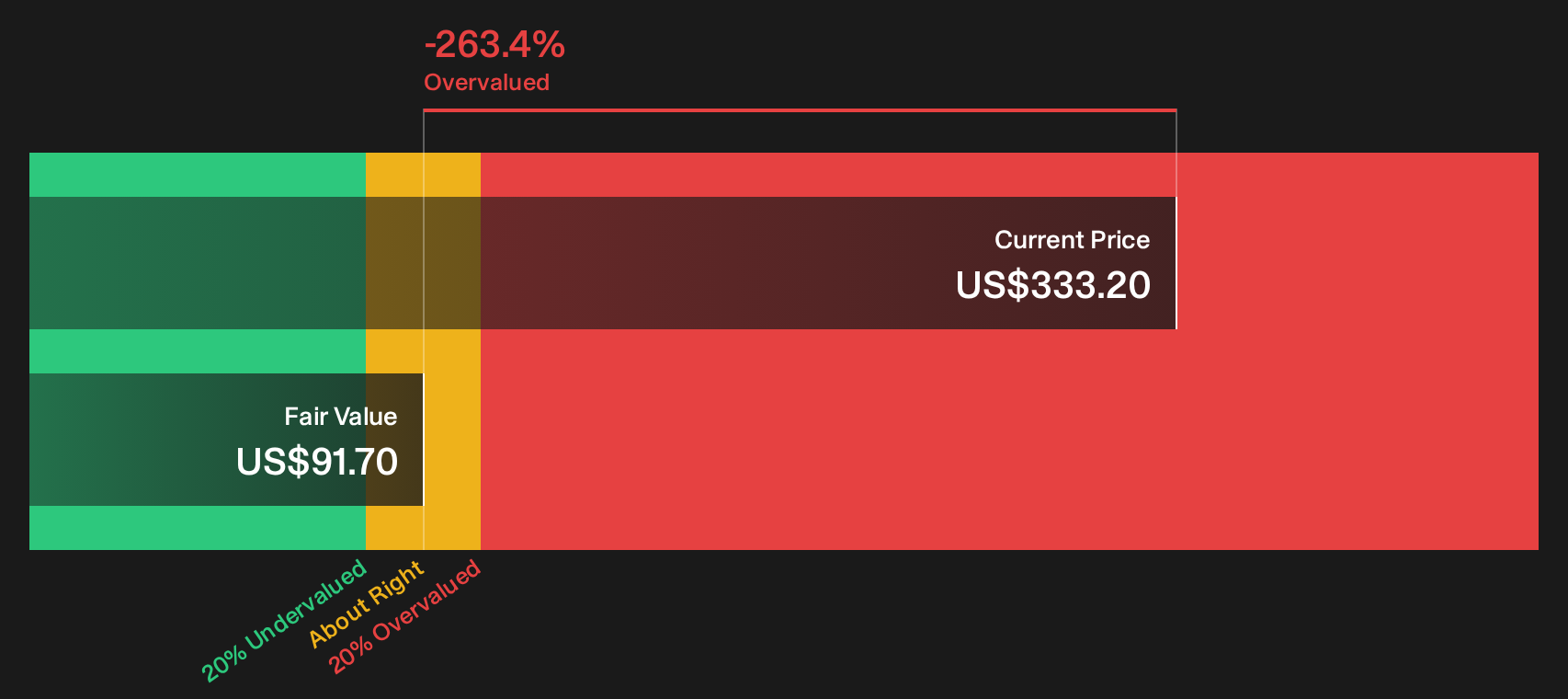
Simply Wall St performs a discounted cash flow (DCF) on every stock in the world every day (check out Arm Holdings for example). We show the entire calculation in full. You can track the result in your watchlist or portfolio and be alerted when this changes, or use our stock screener to discover 29 high quality undervalued stocks. If you save a screener we even alert you when new companies match - so you never miss a potential opportunity.
Next Steps
Big moves around Arm Holdings can make the story feel urgent, so treat this as a prompt to check the data yourself and decide quickly where you stand. To see both sides of that debate in one place, review the balance of 2 key rewards and 1 important warning sign.
Looking for more Arm Holdings style investment ideas?
If Arm Holdings has your attention, do not stop at one ticker. Use this momentum to refresh your watchlist with new, well researched ideas.
- Target potential mispricing and hunt for quality businesses trading below their implied value through the 29 high quality undervalued stocks.
- Strengthen your income stream by scanning for reliable payers with resilient yields using the 7 dividend fortresses.
- Dial down portfolio stress and focus on resilience first by filtering for companies in the 30 resilient stocks with low risk scores.
This article by Simply Wall St is general in nature. We provide commentary based on historical data and analyst forecasts only using an unbiased methodology and our articles are not intended to be financial advice. It does not constitute a recommendation to buy or sell any stock, and does not take account of your objectives, or your financial situation. We aim to bring you long-term focused analysis driven by fundamental data. Note that our analysis may not factor in the latest price-sensitive company announcements or qualitative material. Simply Wall St has no position in any stocks mentioned.
Have feedback on this article? Concerned about the content? Get in touch with us directly. Alternatively, email editorial-team@simplywallst.com