
- PRICING
- LIVE QUOTES
- LEARN
- HELP


EN
IDC's second quarter report released: DJI sports cameras have a global market share of 64%, ranking first in the world
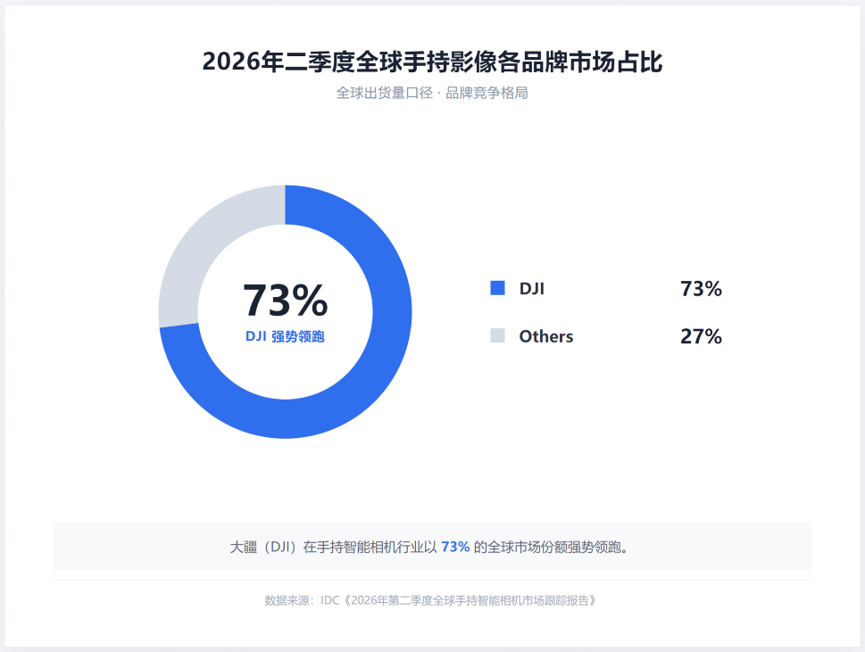
DJI's leading edge in the handheld smart camera industry continues to expand. On September 23, International Data Corporation (IDC) released the “Global Handheld Smart Camera Market Tracking Report for the Second Quarter of 2026”. The report shows that against the backdrop of more entrants and more intense competition, DJI's global market share is still increasing. In the second quarter, DJI took 73% of the global market share with 4.28 million units shipped, leading the pack.
DJI's gimbal camera market share exceeds 93%, gaining an overwhelming advantage
According to the IDC report, the global handheld smart camera market shipped a total of 5.89 million units in the second quarter of 2026, an increase of 57% over the previous year. Among them, the pocket gimbal camera pioneered by DJI reached 2.79 million units worldwide in the second quarter, accounting for 47.4% of the overall market, making it the biggest segment of the industry.
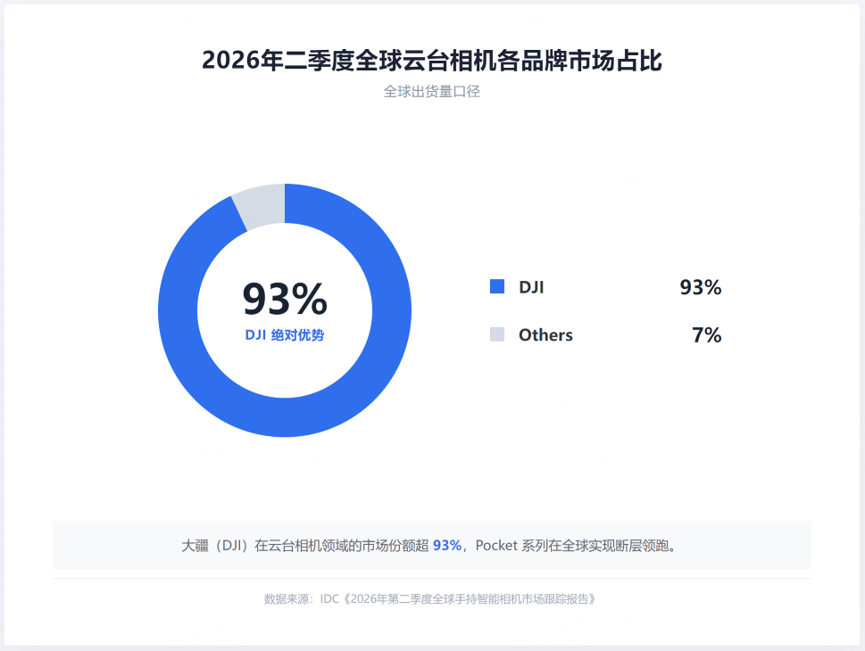
Within this core category, DJI has shown unshakable dominance. According to IDC data, the global market share of DJI Pocket series gimbal cameras is as high as 93%, which is equivalent to more than 9 for every 10 gimbal cameras sold globally.
This outstanding performance is due to the deep product echelon that DJI has built. The classic product Pocket 3 continues to be popular with its excellent reputation and has maintained strong market vitality; while the new Pocket 4, which was launched in April, quickly surpassed one million units by the end of the second quarter due to its balance of image quality and portability; the flagship product Pocket 4P, which was released in mid-June, successfully completed the technological transition to a “pocket movie machine” with dual main camera lenses, a 17-level dynamic range, and a new D-Log2 professional color curve, and continues to be popular in the global market.
Action cameras rank first in the world, and the matrices of all categories have blossomed
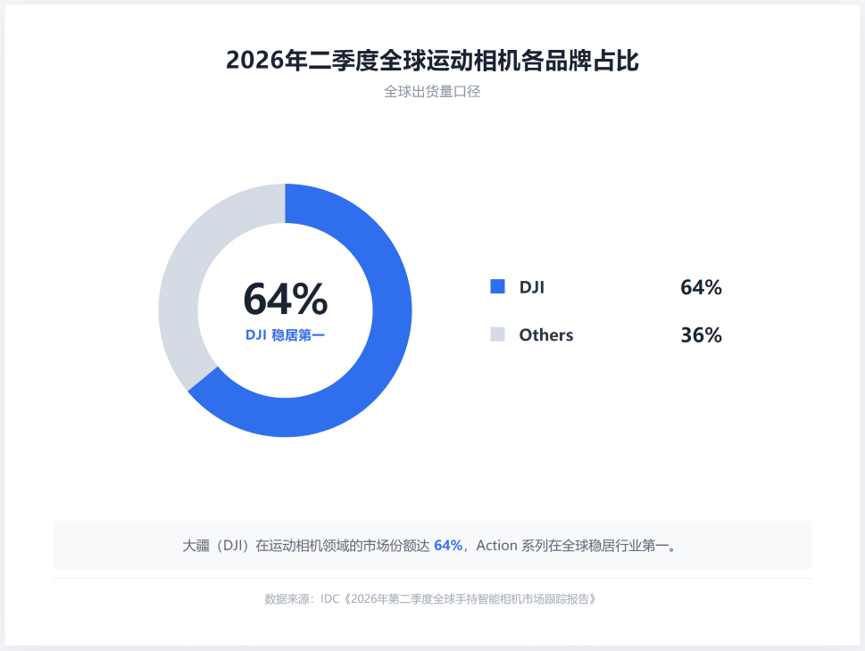
As another core category in the handheld imaging market, global shipments of wide-angle action cameras in the second quarter were 1.93 million units. DJI also has a strong lead on this track, with a global market share of 64%, ranking first. With self-developed outsole sensors, extreme bare-metal weather resistance, and ultra-strong anti-shake algorithms, the proportion of Action 5 Pro and next-generation products of the 6th generation and above has increased significantly.
Furthermore, DJI has also demonstrated its pioneering ability to advance latecomers first in segmented tracks. In the field of detachable thumb cameras, DJI broke through with innovative single products, with a market share of over 55% in the second quarter, continuing to rank first in the industry.
Meanwhile, at the niche panoramic camera circuit, which accounts for 9% of the market, DJI is also showing strong momentum. The Osmo 360 II, released in August, is equipped with a square sensor and 8K/60fps specifications, breaking the image quality and low light bottlenecks of traditional panoramic cameras. On the day of its launch, the product topped the list of the top three mainstream e-commerce panoramic cameras, and won the “Best Exhibit Award” from 17 internationally renowned technology media at the recently concluded IFA exhibition in Berlin, Germany.
Countercyclical supply chain resilience and global layout to build a strong underlying moat
From 93% of gimbal cameras and 64% of action cameras to a fault leader with over 70% share in the entire handheld smart camera industry, DJI's overwhelming advantage has surpassed the logic of a single explosion and is moving towards a deep systemic barrier.
According to reports, in the face of an industry cycle where the prices of core components such as high-capacity storage fluctuated drastically in the first half of 2026, DJI achieved sufficient and stable product delivery and extremely market-competitive sales prices under the premise of fully guaranteeing “high storage” for new products with accurate forecasting and strong supply chain control.
On the channel side, DJI's business has spread to more than 100 countries and regions around the world, and authorized brand stores have entered the world's top business districts such as Regent Street in London and Fifth Avenue in New York. At the same time, we have joined hands with Zhang Xue Locomotive and other community partners to go deep into the frontline extreme scene and create a video ecosystem that best understands the real pain points of users.
IDC predicts that by 2030, the global handheld smart camera market will be close to 41 million units, with a five-year compound growth rate of close to 20%. The global handheld smart camera market is ushering in a new round of expansion. With its fault-level product strength, countercyclical supply chain integration, and a global service network, DJI has not only steadily taken control of the global market, but also continues to lead the accelerated expansion of the global handheld imaging industry.