
- PRICING
- LIVE QUOTES
- LEARN
- HELP


EN
Nvidia (NVDA.US) stock price hits a record high and faces resistance again? When demand for GPUs and Vera CPUs exploded, directors cashed out $300 million
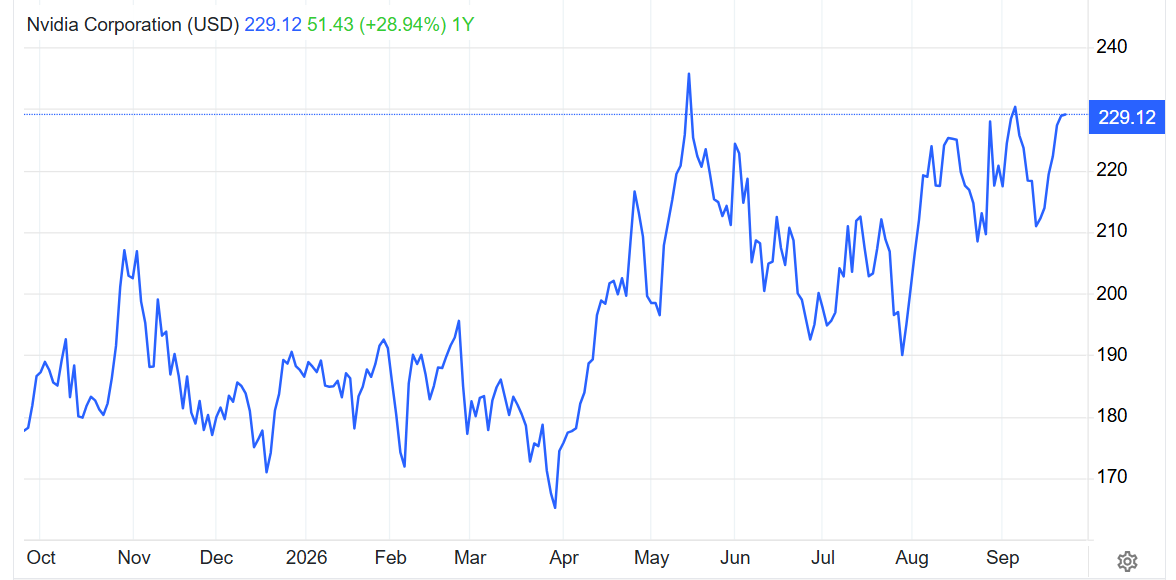
The Zhitong Finance App learned that with the latest disclosure showing that Nvidia director Mark Steven has once again sold Nvidia shares in a big way, the stock price of the world's highest market capitalization company — the “AI chip superpower” NVDA.US (NVDA.US), which recently experienced six consecutive increases, showed a fluctuating trend before the US stock market on Wednesday. Breaking through the US high of 236 US dollars seems to once again encounter significant selling resistance in the market.
According to a recent Form 4 filing submitted on Tuesday, director Mark Stevens once again sold 1.4 million shares worth about US$300 million in a transaction on September 18, continuing the trend of significant holders' holdings reduction in the chip giant. Prior to this latest holdings reduction, Stevens had sold approximately $640 million of Nvidia shares earlier this month.
Notably, the filing did not show that recent sales transactions worth approximately US$300 million were executed in accordance with Rule 10b5-1 transaction plan. A trading plan under Rule 10b5-1 can be understood as a “stock trading arrangement set in advance”: when an executive or director does not have material undisclosed information, predetermines the transaction conditions and implements them according to the plan after meeting requirements such as a cooling-off period, which can be used as a defense against insider trading allegations. Failure to use such plans does not directly mean that the transaction is illegal or suspected of insider trading.
As cutting-edge AI intelligent working systems such as Muse and Astra have expanded the scope of commercial tasks that can be automatically completed, and computing power requirements have also been extended from a single question and answer to an extremely complex intelligent workflow that continues to operate with high efficiency, global AI computing power demand is expected to usher in a new round of expansion. Nvidia AI GPUs and Vera CPUs have also shown a two-line expansion in computing power, which has greatly boosted Nvidia's six consecutive trading days since September 14. The current market value has hovered around 5.5 trillion US dollars, an increase of about 25% since this year. The Philadelphia Semiconductor Index, which includes leaders in the AI computing power industry chain such as Nvidia, AMD, Broadcom, Intel, and TSMC, has recently risen more strongly than Nvidia, making the index rise as high as 80% during the year so far.
After six consecutive gains, Nvidia's declaration documents revealed massive cashout trends
Nvidia's latest insider trading report adds another step to the trend of important shareholders continuing to sell shares.
According to a recent Form 4 filing submitted on Tuesday, director Mark Stevens once again sold 1.4 million shares worth about US$300 million in a transaction on September 18, continuing the trend of significant holders' holdings reduction in the chip giant.
Stevens can be described as continuing to reduce his Nvidia stock holdings. Stevens, a former managing partner at Sequoia Capital, sold the latest batch of shares at a weighted average price of $219.72 and another 10,000 shares for $220.42. These shares are held through trusts. Notably, the filings did not show that these transactions were executed in accordance with Rule 10b5-1 trading plan.
Prior to this latest holdings reduction, Stevens had sold approximately $640 million of Nvidia shares earlier this month. He also continued to sell Nvidia shares regularly in 2026, including a $186 million reduction in holdings in June.
Stevens is still a sizeable shareholder. According to the latest filing documents, he directly holds 11.54 million shares and also holds approximately 1.52 million shares indirectly through the Envy Trust.
After experiencing a strong rise driven by AI, Nvidia's stock price has generally been trending sideways over the past few months and has failed to reach a record high, mainly due to investors weighing its extraordinary growth with continued high market growth expectations, intensifying AI chip competition, and concerns about the sustainability of AI infrastructure spending.
Although Nvidia continues to deliver impressive results, its stock price performance is still lackluster. Nvidia announced second-quarter revenue of US$96.2 billion, up 106% year over year. Among them, data center revenue surged 117% to reach US$89 billion. The company also expects revenue growth of around 70% for the 2028 fiscal year.
CEO Hwang In-hoon said in the August 24 earnings report that AI has reached an “inflection point,” and demand is growing at an accelerated pace as more cutting-edge laboratories, startups, and open model developers scale up their systems.
On the Stocktwits platform, retail sentiment towards Nvidia was “neutral” and remained the same throughout the week. Retail traders continued to watch the upcoming summit in Washington, D.C., with participants from US President Donald Trump, and many business and technology leaders.
Nvidia's growth is accelerating, but valuations are being discounted
Frontier AI systems such as Muse and Astra expand the range of commercial tasks that can be automatically completed, and also extend computing power requirements from a single question and answer to an intelligent workflow that operates continuously. Looking at the underlying architecture, a complex task may include multiple rounds of inference, tool call, code execution, and result verification: GPUs are responsible for model matrix computation, long context pre-filling increases input processing load, and continuous decoding and concurrent sessions increase requirements for computational throughput, memory bandwidth, and key-value cache capacity; the CPU undertakes tool execution, sandbox operation, and task orchestration. The expansion of the number of users, task coverage, and parallel workflows forms the basis for the growing demand for GPUs, CPUs, storage, and networks. This is also an important logic for the market to popularize smart device applications and turn it into growth expectations for computing power vendors such as Nvidia and AMD.
The value of the Vera CPU is particularly evident in the serial steps in the agent's workflow. According to Nvidia technical data, in high-load inference systems, the longer the CPU execution tool, the more likely it is that the key-value cache of the original request will be squeezed out of the GPU memory by other requests, and the context may need to be reprocessed when resuming tasks; faster CPUs can shorten this interval, reduce repeated computation, and increase the effective output of the GPU.
As a result, Vera not only serves Vera Rubin systems, but also expands the independent CPU server market. Manufacturers such as Dell, HP, and ultra-microcomputers have announced related product layouts, and many model companies and cloud service providers are also evaluating or planning adoption. This further extends Nvidia's growth opportunities from model computing to intelligent execution infrastructure, and enhances the commercial value of collaborative optimization of the entire system.
The most prominent pricing characteristic of Nvidia at present is that profit expectations are growing rapidly, and the stock price is not expanding at the same time, causing the forward price-earnings ratio to drop significantly to less than 20 times — this refers to the price-earnings ratio corresponding to the expected profit for the next 12 months, which is close to the lowest level in more than 10 years.
In response, Nvidia's revenue for the second quarter of fiscal year 2027 reached US$96.2 billion, up 106% year on year, and data center revenue reached US$89 billion, up 117% year on year; S&P Global's Visible Alpha research also confirmed that the company proposed a revenue growth forecast of about 70% for the 2028 fiscal year, which is higher than the 44% market forecast before the earnings report was released. What Hwang In-hoon calls “growth value stocks” express the contrast between rapid growth and lower valuations; investors' differences focus on how much certainty these profit predictions can be fulfilled and for how long.
The market is mainly reevaluating profit margins, competitive landscape, and customer investment continuity. Prices of key components such as storage have increased, shifting some of the profits from AI construction to upstream suppliers; large customers are increasing their self-developed ASICs, making the market pay more attention to Nvidia's future share and bargaining power. In terms of engineering economics, custom chips are suitable for optimizing costs around more stable workloads, while Nvidia uses programmable GPUs, software ecosystems, and system interconnections to handle rapidly changing models and complex deployment requirements. At the same time, high interest rates and continuously increasing capital expenses have increased clients' demand for return on investment. As a result, even if aggregate demand in the industry continues to grow, the market will separately evaluate how much revenue Nvidia can earn and how high profit margins can be retained.
If commercialization of cutting-edge AI agents such as Muse can strongly and continuously verify the returns on customers' AI infrastructure purchases, it will greatly support Nvidia's long-term profitability. If more fee-based AI tasks drive infrastructure utilization, customer orders, and new platform revenue growth, GPUs, Vera CPUs, and network products will have an opportunity to jointly expand revenue streams, and profit cashing may also drive valuation repair. The target price of $350 given by Wall Street financial giant Bank of America reflects its positive judgment on Nvidia's long-term strong growth opportunities for AI.