
- PRICING
- LIVE QUOTES
- LEARN
- HELP


EN
How Investors Are Reacting To Trinity Capital (TRIN) Q4 Monthly Dividends
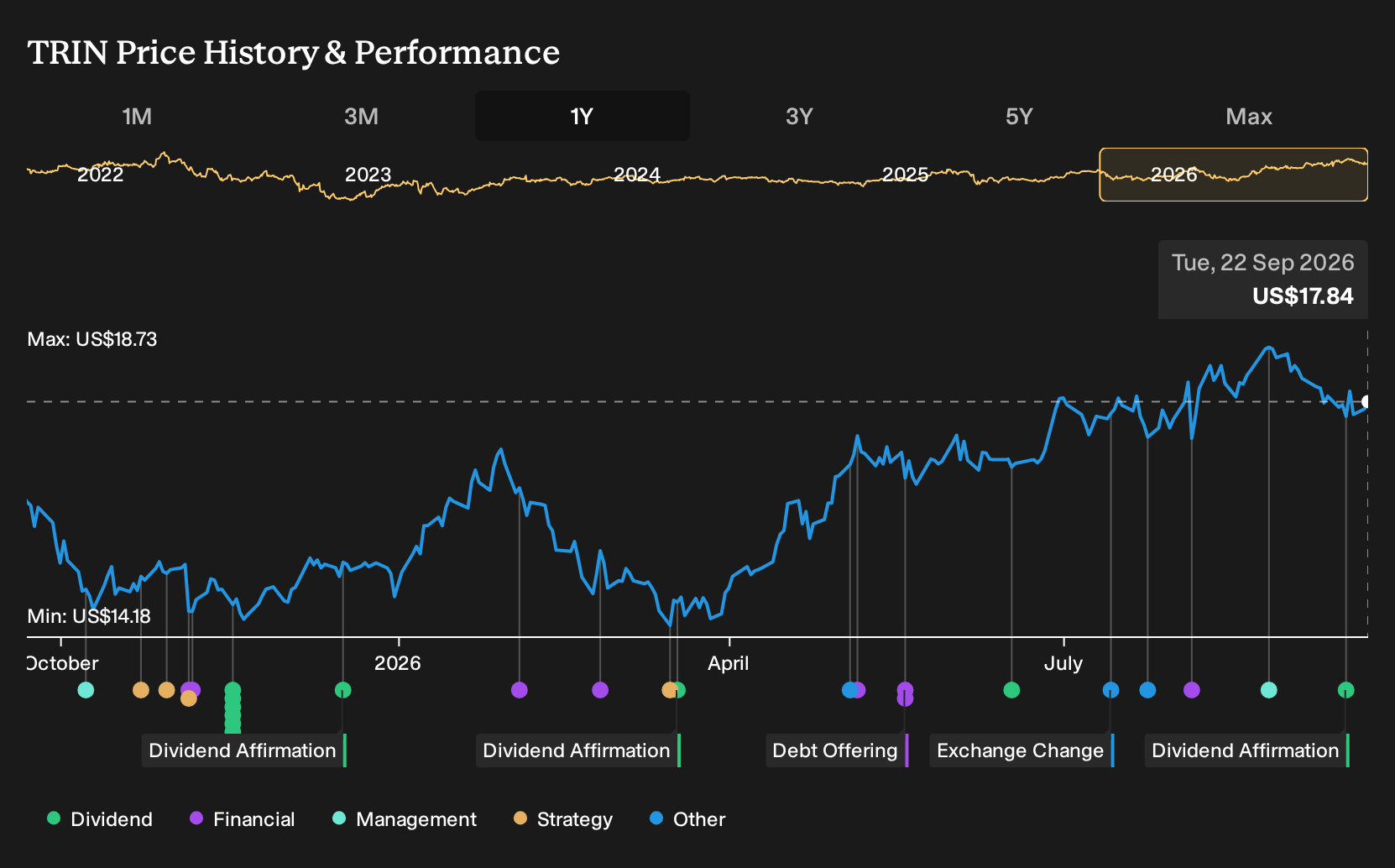
- Trinity Capital announced that its board previously declared a regular monthly dividend of $0.17 per share for October, November, and December 2026, with record dates on October 15, November 13, and December 11 and payments scheduled for October 30, November 30, and December 31.
- The decision to maintain a steady $0.17 monthly payout highlights management's focus on recurring income. This directly links to Trinity Capital's broader emphasis on dividend reliability within its business development company model.
- This article examines how Trinity Capital's affirmed $0.17 monthly dividend for Q4 2026 fits into the broader investment narrative.
Trinity Capital Investment Narrative Recap
To own Trinity Capital, you need to be comfortable with a lender focused on venture debt and equipment financing, where earnings are expected to grow quickly but credit and funding risks matter a lot. The affirmed US$0.17 monthly dividend leans into that income story. It does not materially change the key short term swing factor, which is how the venture and growth company pipeline converts into performing loans.
The biggest near term concern is that a high dividend, currently flagged as not well covered by earnings or free cash flow, puts pressure on payout sustainability if credit costs or funding expenses move against the business. Recent equity dilution and interest coverage flagged as tight keep balance sheet resilience on the watch list, even with the confirmed Q4 2026 distribution run rate.
The dividend affirmation for October through December 2026 ties directly into earlier commentary that Trinity Capital is heavily identified with recurring distributions backed by its private credit portfolio. That focus on regular cash payouts has helped frame investor expectations around income, especially with the stock trading on a P/E that screens as good value versus peers and an internal fair value estimate.
At the same time, the prior flag that the dividend is not fully covered by earnings or free cash flows makes this latest declaration more of a test than a new catalyst. It spotlights execution on credit quality, origination discipline and access to funding as the real operational levers. If those areas stay solid, the current payout level appears more manageable. If not, the high yield could quickly shift from attraction to constraint.
Trinity Capital is modeled to reach US$461.5 million in revenue and US$240.8 million in earnings by 2029, based on analyst assumptions of 15.4% yearly revenue growth and an earnings increase of about US$102.5 million from the current US$138.3 million level.
Uncover why Trinity Capital's fair value is aligned with its current price.
Exploring Other Perspectives
On Trinity Capital, only two fair value estimates from the Simply Wall St Community span roughly US$17.92 to US$26.59 per share, so private investors are already assigning a wide spread before factoring in the fresh dividend affirmation. You can weigh those differing views against risks around credit quality and funding costs, and then explore several alternative viewpoints yourself.
Explore another Trinity Capital fair value estimate, including one that suggests it could be worth just $17.92.
The Verdict Is Yours
Don't just follow the ticker; dig into the data and build a conviction that's truly your own.
- A great starting point for your Trinity Capital research is our analysis highlighting 4 key rewards and 4 important warning signs that could impact your investment decision.
- See our latest analysis for Trinity Capital. The report includes a comprehensive fundamental analysis summarized in a single visual, the Snowflake, making it easy to evaluate Trinity Capital's overall financial health at a glance.
Looking For More Income Ideas Beyond Trinity Capital?
If the Trinity Capital story has you thinking about how recurring payouts fit into your broader plan, it can help to scan a wider field of opportunities using structured filters rather than hunches.
- For investors who want income without stretching too far on quality, start with companies that aim to pair robust cash generation with resilient finances by reviewing our 29 high quality undervalued stocks.
- If capital protection is front of mind, focus on stability first and see which businesses score well on balance sheet strength and fundamental resilience through our list of solid balance sheet and fundamentals (23 results).
- For those who care most about regular cash returns, narrow in on high-yielding payers that still clear basic financial checks by scanning the 30 resilient stocks with low risk scores.
This article by Simply Wall St is general in nature. We provide commentary based on historical data and analyst forecasts only using an unbiased methodology and our articles are not intended to be financial advice. It does not constitute a recommendation to buy or sell any stock, and does not take account of your objectives, or your financial situation. We aim to bring you long-term focused analysis driven by fundamental data. Note that our analysis may not factor in the latest price-sensitive company announcements or qualitative material. Simply Wall St has no position in any stocks mentioned.
Have feedback on this article? Concerned about the content? Get in touch with us directly. Alternatively, email editorial-team@simplywallst.com