
- PRICING
- LIVE QUOTES
- LEARN
- HELP


EN
Interest rates are rising to “strangle” small-cap stocks. Russell 2000's advantage over S&P 500 is only 2 percentage points left. Will the capital return to AI centralized trading soon?
The Zhitong Finance App learned that for most of this year, US small-cap stocks were an important place for investors to diversify the risk of centralized AI transactions. But now, rising interest rates are putting a question mark on this strategy.
The Russell 2000 index's excess earnings compared to the S&P 500 during the year have narrowed sharply from 11 percentage points during the June peak to about 2 percentage points this week. The background of this change is that the market is repricing the Federal Reserve's policy path. As more expectations of interest rate hikes are factored in, and concerns that “the process of taming inflation will be accompanied by pain” spreads, the future for small-cap companies that already carry the “riskiest stock” label is becoming more and more fragile.
“These largely formalized rate hikes are unlikely to hinder earnings as the driving force behind the rise in the S&P 500 index, nor are they likely to significantly curb inflation,” Lisa Shalett, chief investment officer at Morgan Stanley Wealth Management, said in a report to clients. At the same time, she believes “growth in sectors that are already weak — such as housing, regional bank loans, and small-cap stocks — will slow further moderately.”
“This means that the trend of spread in the stock market may subside, the market will once again return to a structured market dominated by AI and the 'Big Seven, 'and the feeling of economic imbalance will once again be highlighted,” she added.
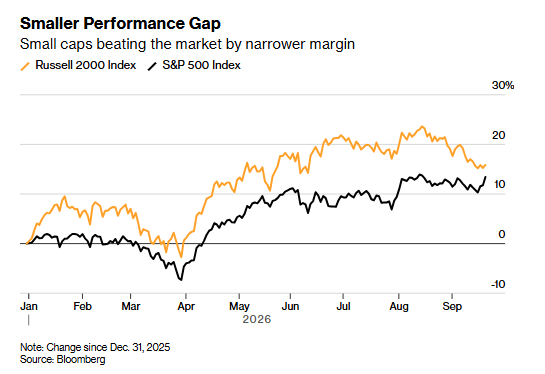
Currently, the Russell 2000 index has fallen below the 50-day and 100-day moving averages, while the large-cap benchmark index continues to operate above the support level. Despite Monday's rebound, the small-cap index is still 2% below its 100-day EMA. However, even after experiencing recent weakness, the Russell 2000 index is still expected to record its best annual performance in ten years compared to the S&P 500.
“We have experienced a period of excellent performance for about a year and a half for low-quality small-cap stocks, and this wave of market gains has already been overdrawn,” said Jill Carey Hall, stock and quantitative strategist at Bank of America. She urged investors to “steer clear of small-cap stocks that are more leveraged and more sensitive to interest rates in the context of the Federal Reserve's interest rate hike.”
The “graduation effect” of exponential balance: high-quality companies are leaving
If interest rates are external pressure, then the annual balance of the index is an internal structural dilemma faced by small-cap stocks. Because of the outstanding performance, Russell 2000 constituent stocks will be “promoted” to Russell 1000, while the laggards in the Russell 1000 will be lowered. The results of the operation of this mechanism this year were particularly unfavorable to the small-cap stock index.
Bloom Energy Corp. (BE.US), Credo Technology Group Holding (CRDO.US), Sterling Infrastructure Inc. (STRL.US), and TTM Technology (TTMI.US) together contributed two-thirds of the increase in the Russell 2000 Index as of June 29, and they were all transferred to the Russell 1000 Index on the same day.
“The small cap market in the first half of the year was more concentrated than usual,” Carey Hall said of the small cap performance. Given recent index rebalancing and rising interest rates, she expects mid-cap stocks to outperform small-cap stocks in the medium to long term.
In addition, many stocks that previously benefited from AI trading have also been transferred out of the Russell 2000 Index, including Credo Technology Group Holding Ltd. and Fabrinet (FN.US).
“As the dual benefits of the interest rate environment and the AI component of the index gradually subside, we continue to believe that small-cap stocks face downside risks,” said Stefano Pascale, strategist at Barclays Bank. He advised investors to hedge against the sharp impact of interest rate hikes on small-cap stocks by buying the Russell 2000 putting option spread strategy.
Stefano believes that the turning point where the performance gap between large and small capitalization stocks began to narrow stemmed from the release of the minutes of the FOMC meeting in July, which prompted traders to reprice interest rate expectations.
Admittedly, for most of this year, optimism about strong earnings growth in the Russell 2000 Index overshadowed concerns about rising interest rates. According to data compiled by Jefferies, small-cap stocks have just recorded their fastest quarterly profit growth since 2022.
J.P. Morgan's Andrew Tyler is in a group that tends not to be optimistic about small-cap stocks for the time being. The bank's head of global market intelligence said in a report to clients on Monday that he maintains his preference for large-cap stocks because “small-cap stocks are still under pressure.” Tyler pointed out that the flow of funds from professional money management institutions shows that the Russell 2000 Index faces greater risks than the S&P 500 Index and the Nasdaq 100 Index.
The Russell 2000 index rose 0.5% on Monday, lagging behind the increase in the S&P 500 index, further narrowing the performance gap between small-cap and large-cap stocks this year.
“Small-cap stocks have clearly lost their leading position in the market,” said Jeff Jacobson, head of derivatives strategy at 22V Research.