
- PRICING
- LIVE QUOTES
- LEARN
- HELP


EN
Cloud vendor revenue and backlog of orders set a record in the second quarter. Bernstein bullish on Amazon and Microsoft, and the doubling of CoreWeave's revenue is still bearish
The Zhitong Finance App noticed that in the second quarter of 2026, global cloud giants collectively accelerated, Amazon's AWS growth rate hit an 18-quarter high, Google Cloud surged 82%, and Oracle's OCI doubled. Investment bank Bernstein believes that demand in the cloud market still far exceeds supply. The bottleneck has shifted from GPU supply to physical production capacity in electrified data centers, and the return on sky-high capital expenditure and financing methods are becoming new winners and losers.
The capital expenditure of the four major cloud companies in a single quarter was about 150 billion US dollars, and the total backlog of orders was 2.33 trillion US dollars
Research estimates that the total cash capital expenditure of Microsoft, Amazon (AMZN.US), Google (GOOGL.US), and ORCL.US (ORCL.US) in the second quarter of 2026 was about 150 billion US dollars; the bank model is expected to reach 660 billion US dollars for the full year of 2026, and close to 800 billion US dollars after Meta. Over the same period, the combined cloud revenue of AWS, Azure, Google Cloud and OCI was 105 billion US dollars, an increase of 52% year over year; the total backlog of orders (RPO) of the four companies reached 2.33 trillion US dollars, an increase of 188% year over year.
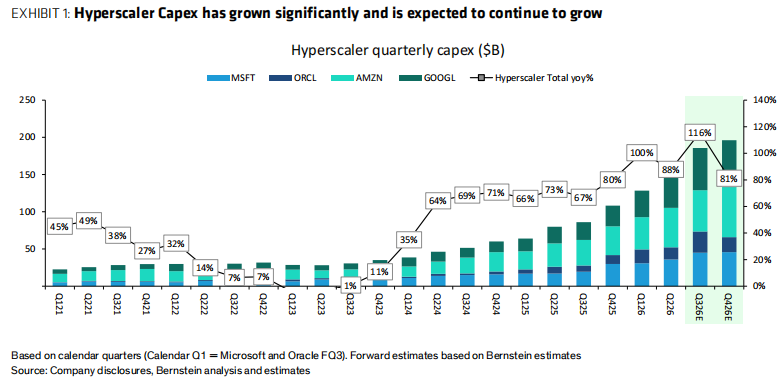
The bank estimates that the hyperscale cloud market is 1.3 trillion to 1.5 trillion US dollars, making it the largest tangible market in the field of software and the Internet.
In terms of financing structure, with the exception of Microsoft, all other US cloud giants have switched to external financing such as issuing bonds or issuing additional funds this year.
Can sky-high capital expenditure be redeemed?
Uncontrolled capital expenditure, AI bubbles, and Anthropic CEO's call to slow the development of cutting-edge models have further fueled market concerns. In response to concerns about uncontrolled capital expenditure and the AI bubble, the bank pointed out that in recent quarters, cloud factory revenue and backlog orders have accelerated simultaneously, and demand has continued to outperform supply.
The research report cites Amazon's return on investment framework: data center shells are invested about two years in advance and can generate revenue for more than 30 years; servers are only purchased a few months before deployment, and the contract period is 5 to 6 years. Subsequent intergenerational equipment can be reused, and the economy is improved from generation to generation. The average contract period for AWS has risen to 6.4 years, most production capacity is locked in 2027, and orders are scheduled for 2028.
In response to the Anthropic CEO's appeal to slow down the development of cutting-edge models, the bank suggested that it is related to the revenue growth rate and profit margin prospects of mega-cloud factories.
The bank believes that AI will drag down IaaS and PaaS gross profit margins at least during the construction period, and the core variable is the actual service life of GPUs. Amazon already lowered the depreciation period for some servers from 6 to 5 years in 2025; Microsoft raised the depreciation period for data centers from 15 to 25 years, reducing the capital expenditure for the 2026 calendar year from 190 billion to 175 billion US dollars, but the company emphasized that this was just an accounting adjustment, not a reduction in hardware investment.
Oracle conveyed price increases for memory and other components to customers through contract terms, and disclosed that the renewal price of old GPUs from 3 to 4 years ago was about 20% higher. Microsoft management also recently stated that the profit margin of the AI business will be close to that of the non-AI business in the long term.
The new cloud model is difficult to sustain
The report positions CoreWeave as a “transition capacity provider”: benefiting from scarce power and GPUs, but with concentrated customers, a tendency for buyers to build their own, and a limited return structure. Once data center capacity is reduced, it will be the first and most affected. Despite CoreWeave 2Q26's revenue of $2.58 billion (+112% year over year), backlog orders of about $104 billion (+246% year over year), and an overall price increase of about 25% in July, Bernstein still gave it a “underperforming market” rating, with a target price of $74.
Large cloud giants continue to benefit
The bank maintained that Amazon “outperformed the market” with a target price of $320. The bank pointed out that AWS grew 37% in the second quarter, the fastest in 18 quarters, with an acceleration of about 9 percentage points; the backlog of orders reached 496 billion US dollars, including the Anthropic agreement signed in April; the annualized AI revenue reached 25 billion US dollars, a sharp jump from 15 billion US dollars a quarter ago; and the annual revenue of self-developed chips was 25 billion US dollars. Management proposed AWS's path to trillion-dollar annual revenue during the earnings call.
Microsoft also maintained its “outperforming the market” rating, with a target price of $660. The bank emphasized that Microsoft's guidance for FY2027 is positive free cash flow and no additional borrowing is required, which is a differentiating advantage.
Oracle maintained its “outperforming the market” rating, with a target price of $325. The company's OCI revenue was US$7.4 billion, up 121% year over year; the RPO reached US$664 billion, of which OpenAI was about US$300 billion; the company directed FY30 OCI revenue of US$166 billion and will launch 10 GW of production capacity in the next three years; and FY27's capital expenditure guide was US$90 billion to US$95 billion, including US$20 billion to US$25 billion in advance from customers. According to the bank, the peak of the company's cash demand is expected in the 2028 fiscal year.
The old three Google companies in the cloud market were the strongest contenders for AI clouds with the vertical integration of their own model+self-developed TPU, but Bernstein gave it exactly the most careful rating of the five coverage targets. It maintains Google's “on par with the market” rating, with a target price of $385, making it the only American giant among the five to not “outperform the market.” The bank also indicated that the release of Gemini 3.5 Pro has been postponed, and that the company leases third-party infrastructure due to limited production capacity, which will suppress profit margins.