
- PRICING
- LIVE QUOTES
- LEARN
- HELP


EN
Overwhelming interest rates and oil prices! Trump has become the biggest risk in the eyes of US retail investors
The Zhitong Finance App notes that in recent weeks, the US market has been plagued by fluctuations. Behind it is a series of catalysts: the Federal Reserve raised key interest rates by 25 basis points, the US-Iran conflict pushed up oil prices, and long-term bond yields soared.
However, retail traders believe that the biggest threat to their portfolios comes from US President Donald Trump's policies.
Is Trump the biggest threat to the stock market?
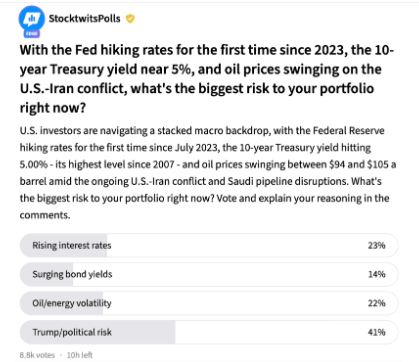
A survey launched by Stocktwits aimed at understanding the biggest threat to investment portfolios in the eyes of retail investors showed that 41% of voters ranked Trump and political risk as the number one option.
Interest rate risk ranked second with 23% of the vote. 21% of respondents voted for oil price fluctuations, while the remaining 14% believed that the biggest risk came from rising long-term yields on US Treasury bonds.
One interviewee said, “Trump's problem is that the market is showing that it doesn't evolve based on natural objective events, but is manipulated by people based on a powerful person — and maybe some people close to him — on a whim for his own benefit. Everyone who isn't in their circle is at risk.”
Another interviewee said, “For me, it's definitely Trump and his terrible administration, but you can also put all politicians in this category.”
However, one optimistic user also said, “Nothing is a risk for this insanely bullish market...”
Fluctuations in the US market
US investors find themselves at the center of a storm of multiple macroeconomic catalysts, and these factors are putting pressure on the stock market.
Last week, the Federal Reserve raised the benchmark interest rate to the target range of 3.75% to 4.00%, the first rate hike since 2023.
Meanwhile, the ongoing conflict in the Middle East has boosted oil prices. Brent crude oil futures due in November were reported at $101.71 per barrel, and WTI crude futures due in October were reported at $96.86 per barrel.
Heightened inflation concerns and complicated macroeconomic conditions have also boosted long-term US yields. The 10-year US Treasury yield hit 5% last week, the highest level since 2007.
As of press release, the US 10-year Treasury yield had fallen from the 5% threshold to 4.951%, while the US 30-year Treasury yield was 5.28%.
Tickmill Group market strategist Patrick Munnelly said in a report: “Currently, the market seems willing to ignore the geopolitical noise and instead price two other more supportive developments.” He said that these two items are “the progress made in the US-China negotiations before Trump's meeting with Xi Jinping this week, and there are signs that oil and gas transportation through the Strait of Hormuz is improving under the escort of the US Navy.”
The US Central Command posted on the X platform on Monday: “The US Navy's 'Rafael Peralta' (DDG 115) sails in regional waters. This missile destroyer continues to strictly enforce the US blockade against Iran and prevent commercial traffic in and out of Iran's ports and coastal areas. As of September 21, the US military has requested 110 merchant ships to change course to ensure that they comply with the blockade.”
On Monday, the rebound in artificial intelligence stocks boosted the US benchmark index, and trading in the tech sector picked up.
However, the US-Iran conflict has yet to be resolved, and after Trump has repeatedly stated that Iran must accept the agreement and warned that the situation will escalate further, the rise in oil prices is still a cause for concern.