
- PRICING
- LIVE QUOTES
- LEARN
- HELP


EN
RWA Big Wave Is Coming! Stock assets are on the chain and ready to go Bernstein targets five major investors
The Zhitong Finance App learned that Wall Street financial giant Bernstein's latest research report shows that stock assets will become the next important asset in large-scale blockchain finance development after stablecoins and tokenized claims, and that regulatory access, shareholder rights, and distribution capacity will determine who can turn “stocks on the chain” into revenue growth. Bernstein's research report on the tokenization of stock assets shows that the size of the global stock tokenization market has increased from about 700 million US dollars to 3 billion US dollars at the end of 2025, but compared to the global stock market of more than 100 trillion US dollars, it is still in a very early stage.
As Wall Street asset management giants are about to embrace the “on-chain” frenzy, which cryptocurrency leaders will be the first to benefit? Bernstein has identified five major investors. The beneficiaries of the listed companies named by Bernstein include: Coinbase, Robinhood, and Bullish, which control trading portals and user distribution; Figure, which builds a native tokenized asset platform, and Circle, which provides on-chain dollar settlement tools; among them, Coinbase, Robinhood, Figure, and Circle received Bernstein's most optimistic bullish rating of “outperforming the market,” and Bullish received a relatively cautious neutral rating of “on par with the big market.” .
The main “stock asset tokenization” investment line compiled by Bernstein covers various aspects of securities issuance, trading, lending, escrow and settlement. The agency expects that the overall RWA revenue generation opportunities of these cryptocurrency leaders will also extend from transaction commissions to infrastructure services, on-chain network activities, and stablecoin-related needs.
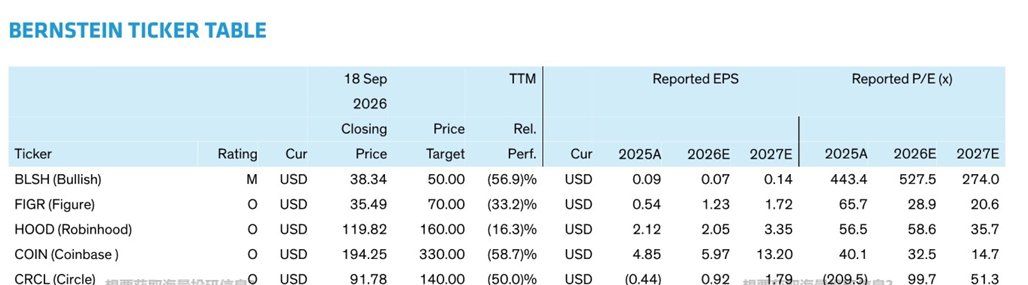
In terms of a specific strong bullish target price, Bernstein gave Coinbase (COIN.US) a target price of 330 US dollars, which means that the potential increase for the stock over the next 12 months is as high as 70% (compared to the closing stock price on September 18); giving Circle (CRCL.US) a target price of 140 dollars, which means a potential increase of up to 52%; giving Robinhood (HOOD.US) a target price of 160 US dollars, which means a potential increase of up to 35%; Figure (FIGR.US) targets $70 The price means a potential increase of up to 97%; a target price of $50 for Bullish (BLSH.US) means a potential increase of up to 30%.
RWA, or Real-World Assets (Real-World Assets), generally refers to the recording and circulation of ownership, beneficiary rights, or contract claims of traditional assets in the form of tokens in the context of blockchain. It includes not only real assets such as real estate and gold, but also financial assets such as treasury bonds, credit, fund shares, and stocks, so stock tokenization is an important part of RWA.
The reason why RWA is the most important and probably one of the core technological development directions of blockchain is that it will introduce global financial activities supported by actual assets, income and financing needs to the chain, record and circulate in the form of tokens with extremely high transaction efficiency and no complicated or redundant procedures, focusing on reducing repeated registrations, manual reconciliation, and multi-level transfers through shared ledgers and smart contracts, and automating some compliance processes.
Furthermore, RWA is one of the core applications and infrastructure directions of blockchain to connect to real finance. Through share splitting, standardized interfaces, and shared infrastructure, RWA can significantly lower the operating threshold for small investment, securities issuance, and customer service, making it easier for issuers to reach qualified investors in different regions. The increase in investor choices and the broadening of funding sources for financiers can be described as important reasons why the “global asset chain” is economically attractive. Smart contracts can link rules such as interest payments, dividends, collateral, payment, and reinvestment, or combine funds, bonds, and cash instruments into automatically executed investment or financing arrangements, making some financial services that were originally too expensive to coordinate and difficult to provide on a large scale and in a customized manner are commercially viable.
Regulation opens and values are being restructured: Bernstein dismantles the five growth pivots of stock tokenization
First, Bernstein's focus on the significance of the innovation exemption is to establish an operational institutional channel for compliant stock transactions on the public chain. The SEC officially issued a five-year conditional exemption on September 17, which allows eligible tokenized securities trading establishments (TSV) to be exempted from exchange registration requirements, and allows participants who use their own funds to provide liquidity from corresponding trader registration requirements. The pilot has clear boundaries: Tier 1 involves up to 75 targets, measured at 0.25% of the average monthly daily turnover above the upper limit of a single share; Tier 2 is 250 targets and 2.5%, respectively, calculated by combining related sites. Tokens must retain the remaining financial, voting, and liquidation property rights in the corresponding shares; third parties must notify the issuer, and the issuer has the right to object; smart contracts must be auditable and deployed on an open, unlicensed network. The exemption does not cover IPOs or synthetic products that only track share prices. It also restricts TSV from borrowing, pledging assets, and providing share purchase credit.
As a result, Bernstein believes that recent direct revenue is subject to transaction limits, but its long-term value lies in incorporating public chains and decentralized transaction infrastructure into securities market rules, laying the foundation for future scale expansion.
Second, the fundamental difference between the three operating models is “who maintains legal holders' records and what rights do token holders have.” The issuer-led model is authorized by the company, and the transfer agent (transfer agent) maintains on-chain shareholder registration, and the tokens represent real shares. Figure, Bullish, Securitize, and Superstate are the participants listed in the report; the depository led model maps existing escrow securities onto the chain and follows the depository, brokerage, and beneficial ownership systems. DTCC (American Depository Trust and Clearing Company) is the core driver; the third-party model usually buys and hosts shares through a special purpose entity (SPV) ) Issuing tokens backed by underlying assets. The specific rights vary depending on the product and jurisdiction. Some only provide economic exposure, and some have passed on shareholders' rights to holders.
The Bernstein research report expects DTCC to launch related services in October 2026, and more than 100 organizations have participated in the design. What needs to be accurately distinguished is that the plan described by NASDAQ follows a unified order book and T+1 settlement; the digital securities platform separately planned by the NYSE is for round-the-clock trading, real-time settlement, and stablecoin deposits. Not all on-chain solutions will immediately switch to T+0.
Third, the core efficiency of tokenization comes from reconstructing the entire life cycle of securities, not just extending transaction time. The report divides opportunities into four sections: issuance and registration, trading and settlement, corporate action, and securities lending: on-chain registration reduces multi-level account reconciliation; coordinated delivery of securities tokens and cash tokens can shorten the settlement cycle; dividends, stock splits, voting, and shareholder communication can be automated through smart contracts and supporting services; and stocks can also enter the on-chain lending and mortgage financing system. Figure's Democratized Prime reflects the latter opportunity in particular — shifting traditional brokers-led and bilaterally negotiated securities source confirmation and lending processes to a more transparent match between supply and demand, enabling holders to obtain loan proceeds and borrowers to obtain financing.
Decentralized trading platforms such as Uniswap provide liquidity pools, and protocols such as Morpho and Kamino expand the use of collateral loans, while Broadridge supports voting and corporate governance services. Securities can be traded and used for compliant financing to increase the actual value of on-chain holdings. Bernstein stressed that these lending applications must still follow their respective applicable institutional arrangements and cannot be confused with location leverage prohibited by the TSV exemption mentioned above.
Fourth, industry competition is forming a pattern of “native distribution platforms, global distribution platforms, and traditional market infrastructure” going hand in hand. Figure uses Provenance blockchain, transfer agency qualifications, and ATS trading systems to support the conversion of on-chain shares and traditional shares, and supplement liquidity, retail distribution, and escrow through Jump Trading, MooMoo, and BitGo; Bullish plans to acquire Equiniti through its own stock tokenization business, and reports that the transaction is expected to be completed in January 2027, connecting about 3,000 issuers and 20 million shareholders who have completed identity verification. Securitize connects to traditional markets through cooperation between Computershare, Continental and NYSE. Robinhood and Coinbase are expanding stock token transactions through user portals, private chains, and overseas distribution. Among them, Robinhood covers more than 120 non-US markets, and Coinbase relies on the Base layout. Ondo, Binance's bStocks, Backpack, and Dinari provide other third party products, with different rights and access arrangements.
Regarding Circle, Bernstein said that the company's opportunities lie on the cash side of these systems: stock trading, mortgage financing, and settlement are increasing, and demand for the use of dollars on USDC and other chains may also expand; Bernstein is also optimistic about the driving effect of related activities on Ethereum, Solana, and the decentralized trading ecosystem.
Fifth, the latest data compiled by the Bernstein Research Report shows that adoption is accelerating. What determines value next is continuous use and liquidity integration. The report chart shows that the on-chain transfer amount of stock tokens in August was about 36 billion US dollars, which reflects a high level of activity compared to the stock size of about 3 billion US dollars; the indicator here is Transfer Volume, which is not directly equivalent to the exchange turnover after deduplication.
According to the Bernstein research report, the size of Robinhood's stock tokens exceeded 160 million US dollars, and the cumulative trading volume of related DEX exceeded 10 billion US dollars as of September 16, and the shareholder index rose from about 27,000 in July to 84,000 in August and 194,000 on September 17. In terms of platform size share, Ondo is about 29%, BStocks is about 26%, Securitize is about 10%, and Robinhood is about 5%; in blockchain distribution, BNB Chain is about 34%, Ethereum is about 23%, and Solana is about 15%.
Bernstein believes that second-tier networks such as Robinhood and Base will have the opportunity to increase their share and obtain more network revenue in the future; the real barriers to competition are compliant distribution, deep enough liquidity, round-the-clock price discovery, and interoperability between traditional stocks and on-chain products. The report also points out that cross-platform token fragmentation, price differences, and the rights structure of some third-party products are still real problems that need to be solved through registration, redemption, unified order books, and supervision.
The RWA giant wave hits: real assets go on the chain, opening up the trillion-dollar financial landscape
As of September 22, 2026, recent cryptocurrency industry trends and regulatory developments are actively echoing the Bernstein Report's description of “accelerated regulatory access, simultaneous acceleration of transaction distribution, and on-chain settlement.” On September 10, Nasdaq announced that it plans to invest US$100 million in Kraken's parent company Payward to jointly promote stock tokenization infrastructure. The relevant Nasdaq Equity Tokens are expected to be launched in the second quarter of 2027. Shortly thereafter, on September 16, Circle officially launched the Arc public main network, using USDC to pay transaction fees, service payments, foreign exchange, and tokenized asset settlement, reflecting the extension of stablecoin issuers to financial infrastructure.
On September 17, the SEC (US Securities and Exchange Commission) issued a five-year conditional “innovation exemption” for stock tokenization, opening up compliance channels for relevant trading venues and liquidity providers, while requiring the retention of equal shareholders' rights and issuers' objections. On September 21, the ECB launched Pontes to support the settlement of wholesale tokenized asset transactions using the ECB system currency, and to begin preparations to invest a small amount of its own capital in tokenized securities.
Judging from Bernstein's investment framework, these recent positive developments all show that RWA is receiving actual support from traditional exchanges, regulators, and central bank settlement systems. Business opportunities are gradually expanding to asset issuance, trading services, escrow, and on-chain cash settlement, providing more specific business growth paths for Figure, Coinbase, Robinhood, Bullish, and Circle named in the report.
RWA, or Real-World Assets (Real-World Assets), generally refers to the recording and circulation of ownership, beneficiary rights, or contract claims of traditional assets in the form of tokens in the context of blockchain. It includes not only real assets such as real estate and gold, but also financial assets such as treasury bonds, credit, fund shares, and stocks, so stock tokenization is an important part of RWA.
From a project implementation perspective, a complete project requires linking legal authorization, underlying asset escrow or registration, identity verification and transfer restrictions, on-chain ledgers, and redemption processes: stock wallet balances must correspond to valid shareholder registration or enforceable securities interests, and smart contracts can check investor qualifications, transfer restrictions, and handle company actions. When the securities side and the cash side such as stablecoins or tokenized deposits can operate in coordination, delivery versus payment (so-called dVP) can be realized, making payment and securities delivery mutually conditional. The value of technology comes from the alignment of legal rights with on-chain status, and programmable execution of transaction, settlement, and financing processes.
In terms of predicting the size of RWA, the forecast section of the joint research report between BCG and Ripple shows that the broader tokenized asset market will reach about 19 trillion US dollars by 2033, covering real estate, lending, and credit. The reason why RWA has become one of the most important development directions of blockchain is that it introduces financial activities supported by actual assets, income, and financing requirements to the chain — that is, the core is asset issuance to expand investable products, products bring transaction and collateral requirements, and transactions and financing then drive stablecoins, escrow, compliance, and complete settlement services. Corresponding to Bernstein's research report, Figure sought the issuance and financing process, Coinbase, Robinhood, and Bullish sought the transaction and distribution process, and Circle sought the demand for dollars on the chain, forming an investment framework that can track business implementation item by item.