
- PRICING
- LIVE QUOTES
- LEARN
- HELP


EN
Interpretation of US IPOs | Jingrui Wangpo: Can the “store+wholesale” cycle of raising about US$37.5 million support valuation?
Recently, Hangzhou home appliance retailer Jingrui Wang Pu Holdings Group Ltd. (Jingrui Wang Pu Holdings Group Ltd.) once again submitted a prospectus to the US Securities and Exchange Commission to issue 6.25 million common shares at 4 to 6 US dollars per share, raising about US$37.5 million according to the upper limit of the issuance range. The stock code “JRWP”, Eddid Securities acts as the sole bookkeeper and plans to land on NASDAQ.
Jingrui Wangpu's second delivery schedule coincided with China's home appliance retail industry entering a deep adjustment cycle: in the first half of 2026, retail sales of all categories of Chinese home appliances (excluding 3C) were about 425 billion yuan, down 9.9% year on year. The industry is completely shifting from incremental expansion to a game stage with “stock replacement+value upgrade” as the main line. However, the continued strength of the trade-in subsidy policy hedged downward pressure to a certain extent. In the first half of the year, the trade-in scale of home appliances reached 63.266 million units. The share of offline channel sales bucked the trend and rebounded to more than 70%, and the value of offline physical stores as the main channel for subsidized consumption was repriced.
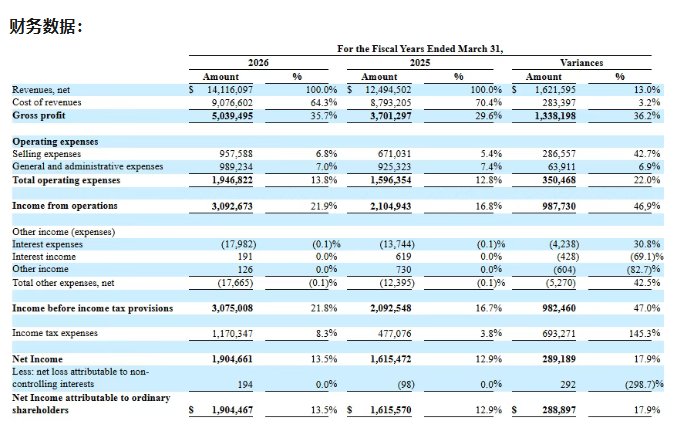
In this context, Jingrui Wangpo, which has been deeply involved in the home appliance industry for more than 20 years, has operated 10 retail stores and 22 wholesale distribution customers as of the prospectus publication date, sold 28,513 home appliances in fiscal year 2026, with sales revenue of US$12.65 million, accounting for 85.4% of total revenue; revenue for fiscal year 2025 and 2026 (as of March 31) was US$12.4945 million and US$14.1,161 million, respectively. Net profit was US$1.615,600 and US$1,904,500, respectively. 12.9% increased to 13.5%.
The synergy between retail stores and wholesale distribution is remarkable
Jingrui Wangpu's business model is not a simple home appliance trade, but is based on a “retail store+wholesale distribution” two-wheel drive refined operation system. The core of this model is to directly reach end consumers through retail stores, and at the same time cover a wider range of regional markets through wholesale distribution networks, forming a “point-to-point” channel layout.
From the retail side, as of the publication date of the prospectus, Jingrui Wangpu operated 10 retail stores. These stores are not only sales terminals, but also comprehensive carriers of brand display, after-sales service, and consumer experience. In the context of the home appliance industry shifting from incremental expansion to stock replacement, the value of offline stores is being redefined — a key touch point in the implementation of the trade-in policy. In the first half of 2026, the trade-in scale of home appliances reached 63.266 million units, and the share of offline channel sales bucked the trend and rebounded to more than 70%. This trend directly benefited Jingrui Wangpu's store network. When consumers buy home appliances, especially large appliances, they often need to experience the functionality, size, and texture of the product on the ground. Offline stores provide this kind of “what you see is what you get” consumption scenario, which is difficult to completely replace online channels.
From the wholesale side, Jingrui Wangpu has 22 wholesale distribution customers. These customers form the company's second-level distribution network to help the company penetrate products into areas not covered by retail stores. The advantage of the wholesale distribution model is that it can quickly expand market coverage, reduce single store operating costs, and enhance procurement bargaining power through scale effects. In fiscal year 2026, Jingrui Wangpu sold 28,513 home appliances, and the sales revenue of home appliances reached US$12.65 million, accounting for 85.4% of total revenue. This data shows that the company's two-wheel drive model has formed a certain market foundation in terms of scale.
Notably, Jingrui Wangpu's net interest rate increased from 12.9% in FY2025 to 13.5% in FY2026. The reason behind this improvement is an increase in the company's operating efficiency. In the context of the overall decline in the industry, the increase in net interest rate shows that the company has achieved an increase in profitability by optimizing the supply chain, controlling costs, and increasing the share of sales of high-margin products. This ability to “improve efficiency in a countercyclical manner” is a direct reflection of the resilience of Jingrui Wangpu's business model
Small to medium retailers take a different path to break through
In the home appliance retail industry, the competitive pattern faced by Jingrui Wangpu can be described as “surrounded by giants.” From an upstream perspective, leading home appliances not only control brands and products, but are also gradually building their own channel systems. From a downstream perspective, e-commerce platforms such as JD and Tmall have taken the dominant position in online retail with their traffic advantages and logistics systems. In such a general environment, how small and medium-sized retailers like Jingrui Wangpu can find their own living space is the key to whether they can be recognized by investors on the NASDAQ.
Jingrui Wangpu's differentiation path is mainly reflected in three aspects.
First, cultivate the regional market and establish localization advantages. Unlike national retail chains, as a local enterprise in Hangzhou, Jingrui Wangpu has been deeply involved in Zhejiang and surrounding markets for more than 20 years, and has a deep understanding of local consumers' needs, consumption habits, and channel characteristics. This advantage of localization allows the company to develop a high market penetration rate and brand awareness within a specific region, thereby taking a place in a regional market that is difficult for giants to fully cover.
Second, focus on offline experiences and enhance service attributes. Under the impact of e-commerce, the customer acquisition costs of pure online retail continued to rise, while the experiential value of offline stores was rediscovered. Jingrui Wangpu's retail store is not only a sales place, but also a platform for providing value-added services such as after-sales service, installation and maintenance, and trade-in. This “sales+service” integrated model can increase customer stickiness and repurchase rate, and form a differentiated competitive advantage.
Third, respond flexibly to policy dividends and seize structural opportunities. In the first half of 2026, the continued strength of the trade-in subsidy policy brought new growth impetus to offline channels. As an offline physical store operator, Jingrui Wangpu can directly reach consumers who enjoy the subsidy policy, thereby benefiting from the policy dividends. In contrast, although e-commerce platforms also have online trade-in services, in actual operation, offline stores are often more advantageous in terms of convenience and reliability.
However, a differentiated path doesn't mean there are no risks. Jingrui Wangpu is small in size and relatively weak in its ability to withstand risks. Once industry competition intensifies or policy dividends subside, the company may face greater operating pressure. Furthermore, there is a clear gap between the company and industry leaders in terms of brand influence, supply chain bargaining power, and digital operation capabilities. These shortcomings may limit the company's long-term development.
Judging from the competitive landscape, Jingrui Wangpu's core competitiveness lies in its “small but beautiful” refined operation capability rather than scale expansion. Whether this model is replicable and sustainable will be a key factor in determining a company's valuation. If the company can prove that its two-wheel drive model can be replicated in more regional markets and can continue to improve operational efficiency and profitability, then its price-earnings ratio growth may be supported to some extent. Conversely, if the company is unable to break through the bottleneck of scale, then the living space in the shadow of giants may be further compressed.